The Longest Letter and a Crown of Tin
Some days in Korea don’t feel like days at all. They feel like a single, endless loop of low-grade exhaustion, the smell of damp canvas, and the distant, rhythmic thud of artillery echoing over the hills like a heartbeat the valley couldn’t shake.
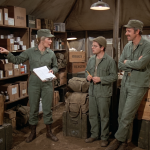
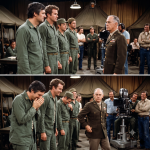
In the middle of that endless loop sat Colonel Potter’s office, a small island of order in a sea of absolute chaos.
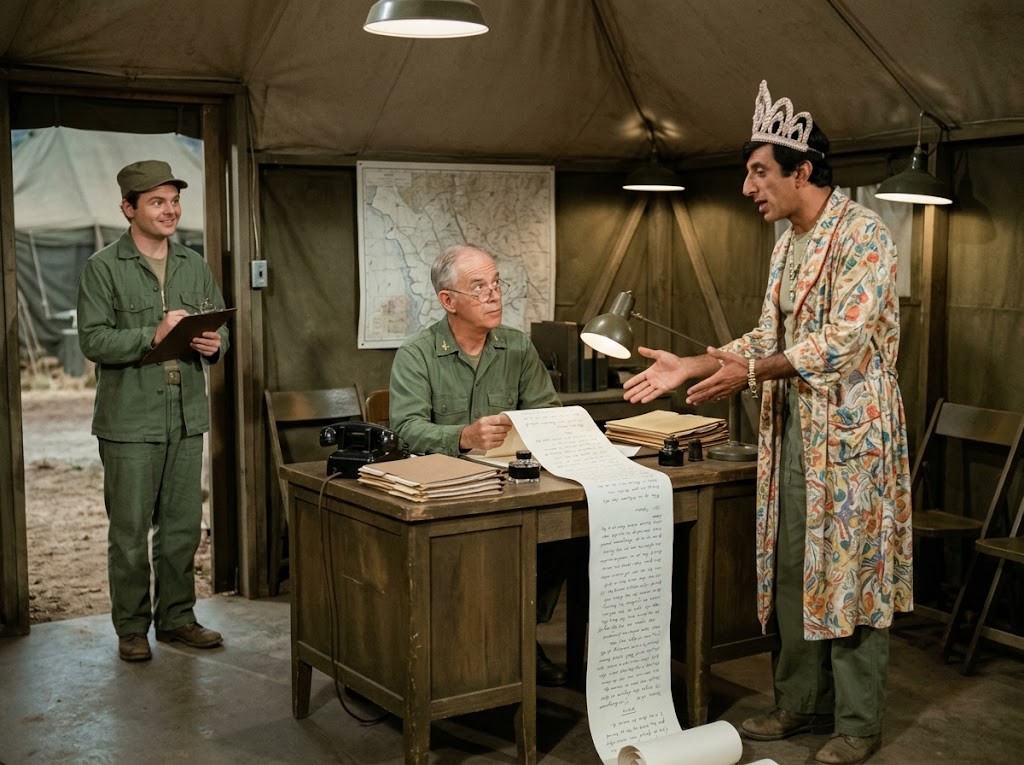
On this particular afternoon, the air inside the tent was thick with the scent of stale coffee and ink. The Colonel sat behind his desk, his glasses perched precariously on his nose, staring blankly at a roll of paper that seemed to have no beginning and certainly no end.
Beside him stood Corporal Radar O’Reilly, holding a clipboard tightly against his chest, a soft, boyish smile playing on his lips as he watched the scene unfold.
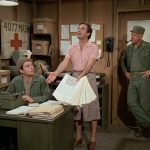
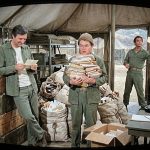
Across the desk stood Corporal Klinger, a vision of absolute, defiant theatricality amidst the olive drab. He wore a brightly patterned, floral-printed housecoat over his standard army trousers, but the crowning glory—quite literally—was the shimmering, faux-diamond tiara resting proudly on his head.
His arms were spread wide, hands open in a gesture of desperate, heartfelt supplication, his dark eyes wide with a mixture of hope and profound fatigue.
“It’s not just a letter, Colonel,” Klinger said, his voice dropping into that familiar, dramatic register that usually preceded a Section Eight request. “It’s an epic. It’s a testament to human endurance, written from the very trenches of despair.”
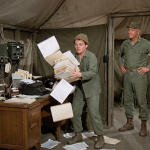
Colonel Potter didn’t move. He simply held the edge of the scroll, letting it cascade off the desk, down past the wooden legs, and coil like a paper snake onto the dirt floor.
His face was a mask of dry, seasoned patience, but his eyes, sharp behind the lenses, were studying the frantic handwriting that stretched across the paper.
“Klinger,” Potter said slowly, his voice like gravel rolling in a riverbed. “I’ve seen grocery lists in Missouri that had more plot than this. What exactly am I looking at?”
“That, sir, is my magnum opus,” Klinger declared, stepping closer, the tiara catching a glint of the low-hanging lamp. “It’s a comprehensive, chronological account of every single slight, every single injustice, and every single broken zipper I have endured since the U.S. Army saw fit to drag me out of Toledo.”
Radar let out a tiny, stifled chuckle from the doorway, quickly covering it with a cough as the Colonel shot him a warning glance.
“According to my calculations, Colonel,” Radar murmured, looking down at his clipboard, “that roll of paper is currently eleven feet long. And he’s only up to November of last year.”
“Eleven feet,” Potter repeated, his thumb smoothing over the rough edge of the paper. He looked from the scroll up to Klinger’s face, taking in the bruised exhaustion under the man’s eyes, the slight tremble in his outstretched hands, and the absurd dignity of that cheap tin crown.
The humor in the room suddenly shifted, the weight of the war pressing down through the canvas roof, leaving everyone silent as the Colonel reached the bottom of the first page.
—
Potter cleared his throat, the dry wit fading into something much quieter, much older. “You went to a lot of trouble for this, son. But the Pentagon doesn’t read poetry, and they certainly don’t care about Toledo.”
Klinger’s hands dropped slowly to his sides, the theatrical energy draining out of him all at once, leaving just a tired kid from Ohio standing in a bathrobe.
“I know, sir,” Klinger said softly, his voice losing its dramatic edge. “But my mother… she wrote to me last week. She said the neighborhood is changing. The old bakery on the corner closed down. She said she forgets what I look like unless she looks at the photo on the mantelpiece.”
He swallowed hard, looking down at the coil of paper on the floor. “I started writing to her. Just to tell her I’m still here. But then the trucks came in last night from the front, and… I just couldn’t stop writing. I had to put it somewhere, Colonel. If I don’t put it on paper, it stays up here.” He tapped his temple, his fingers brushing against the edge of the tiara.
Radar’s smile vanished, his eyes softening with that deep, intuitive empathy that made him the heart of the 4077th. He stepped forward, gently setting his clipboard on the corner of the desk, his eyes fixed on his friend.
“It’s a good letter, Klinger,” Radar said quietly. “You spelled ‘Toledo’ right every single time.”
A small, sad smile tugged at the corner of Klinger’s mouth, but his eyes remained heavy.
Colonel Potter sat back in his chair, the leather creaking under his weight. He looked at the long, winding scroll, remembering the hundreds of letters he had written home during his career—letters to Mildred, letters to his daughter, letters filled with carefully curated truths designed to keep the horror of the world away from the people he loved.
“The army has a lot of rules, Klinger,” Potter said, his voice dropping into that steady, fatherly tone that kept the camp anchored during the worst of times. “They tell you how to march, how to salute, and how to die. But they don’t tell you how to carry the weight of a place like this.”
He picked up a heavy black fountain pen from his desk, dipped it into the inkwell, and turned the long scroll around. At the very top of the paper, in clear, authoritative script, Colonel Potter wrote: *Verified by Command. Soldier is clear, present, and accounted for.*
He signed his name with a sharp, decisive flourish and blew gently on the ink to dry it.
“We can’t mail an eleven-foot scroll through regular army postal channels, Corporal,” Potter said, looking up with a faint, knowing glimmer in his eyes. “The mail clerks in Seoul would have a collective stroke. But Radar here is a magician with a supply jeep.”
Radar beamed, nodding quickly. “I can pack it in one of the empty plasma crates, Colonel. Label it ‘Fragile Medical Records.’ It’ll get straight to Ohio without anybody opening it.”
Klinger looked from the Colonel to Radar, his chest rising and falling as a wave of profound relief washed over him. The absurd tiara on his head tilted slightly to the left, but nobody in the tent minded.
“Thank you, sir,” Klinger whispered, his voice thick. “Thank you.”
“Don’t thank me yet,” Potter grunted, though his expression was entirely warm. “You still owe me a inventory report on the winter blankets, and I expect it to be significantly shorter than eleven feet. Now, get out of here and change into something that doesn’t look like my aunt’s drapes.”
Klinger offered a sharp, surprisingly crisp salute, his colorful housecoat swirling around his ankles as he turned to leave the tent, his posture lighter, his chin held just a little higher.
Radar gathered up the long scroll, handling the paper as if it were made of gold leaf, coiling it carefully into his arms before following Klinger out into the compound.
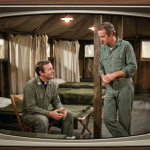
Colonel Potter watched them go, the canvas flap settling back into place, leaving the office quiet once more. He took off his glasses, rubbed the bridge of his nose, and looked out the small screen window at the muddy courtyard where his people—his strange, beautiful, broken family—were simply doing their best to survive another day.
—
In a valley surrounded by shadows, sometimes a tin crown and an eleven-foot letter are the only things keeping the dark at bay.