The Direction of Home
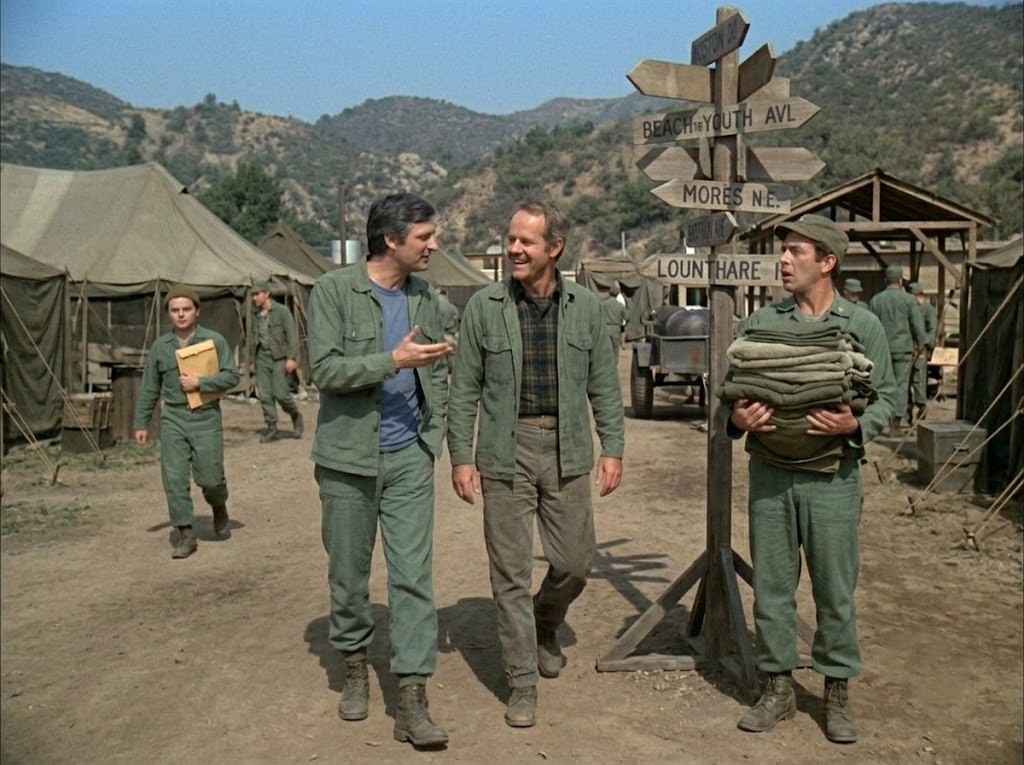
The dust in the compound never really settles; it just waits for a pair of combat boots to stir it back up. Under the pale, unblinking Korean sun, the 4077th felt less like a military outpost and more like a strange, exhausting crossroads where everyone was looking for a way back to where they started.
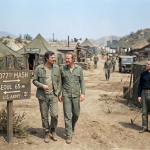
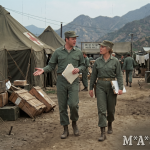
Hawkeye Pierce walked with his hands loose, gesturing mid-sentence to B.J. Hunnicutt as they crossed the dirt lot near the famous signpost. His fatigue jacket hung open over a faded blue undershirt, his shoulders carrying that familiar, loose-limbed slouch that usually meant he was trying to laugh his way through a thirty-six-hour shift in the O.R.
“I’m telling you, Beej, it’s all about perspective,” Hawkeye said, flashing a quick, tired grin. “If you look at the Boston sign long enough, you can actually smell the clam chowder. It’s a medical fact. Or at least, a psychological necessity.”
B.J. chuckled, his mustache twitching with genuine amusement as he walked in step, hands tucked comfortably into his pockets. “I’ll take your word on the chowder, Hawk, but unless that signpost starts pointing toward San Francisco and a certain little girl’s birthday party, it’s just a stack of kindling to me.”
Just a few feet away, standing right beneath the jagged arrows pointing toward Seoul, Death Valley, and Boston, Igor was frozen mid-stride, carrying a heavy, neatly folded stack of olive-drab blankets. His mouth was slightly agape, his eyes wide with a sudden, anxious realization as he looked toward the Swamp.
Behind them, Radar O’Reilly hurried across the compound holding a thick manila envelope tightly against his chest, his eyes darting between the doctors and the main office. Even from a distance, Radar’s tense posture signaled that something had just arrived—something that didn’t belong in the usual stack of supply requisitions or standard army circulars.
“Captain Pierce! Captain Hunnicutt!” Radar called out, his voice cracking slightly under the weight of whatever he was carrying.
Hawkeye stopped, his hand still suspended in the air from his joke, the smile slowly fading from his face as he saw the expression on the young clerk’s face. The easy camaraderie of the moment evaporated instantly, replaced by the heavy, collective breath the camp always took right before bad news landed.
“What is it, Radar? Did the brass finally discover we’ve been running a makeshift distillery out of a closet?” Hawkeye asked, though his voice lacked its usual sharp edge.
Radar stopped right beside the signpost, clutching the envelope so hard the corners crinkled. “No, sir. It’s… well, it’s from the mail clerk down at Seoul. It was misrouted three weeks ago. It’s for the whole camp, but mostly for you and Captain Hunnicutt.”
Igor didn’t move an inch, his arms locked around the blankets as he listened intently, his eyes darting between Radar and the doctors. “Is it another freeze-frame on our rotation points, Radar? Because my mother already bought the ham for my homecoming dinner.”
“No, Igor,” Radar said softly, looking down at the ground before looking up at B.J. “It’s a package of letters from the third-grade class at Crabtree Elementary. The ones you wrote to last winter, Captain Hunnicutt. But… there’s an official note attached to the front from the school district.”
B.J.’s posture stiffened immediately, his hands coming out of his pockets. The warmth that usually defined his face tightened into a look of quiet apprehension. “A note? What kind of note, Radar?”
Father Mulcahy walked up quietly from the direction of the hospital tent, his gentle eyes taking in the small group gathered by the signpost. He didn’t speak, but he placed a reassuring hand on Radar’s shoulder, sensing the heavy air that had suddenly settled over the dirt compound.
“It says… it says there was a fire at the school a month ago,” Radar whispered, his voice small against the backdrop of a distant jeep engine. “The kids are all okay, sir! Every one of them. But the school… they lost everything. The library, the classrooms, their playground.”
Hawkeye let out a long, slow breath, looking up at the wooden signs pointing toward a world that felt thousands of miles away. The contrast was sudden and sharp—they spent their days trying to keep the horrors of war from breaking their spirits, only to find that the fragile peace of the world they left behind could break just as easily.
“They’re teaching them in a church basement now,” Radar continued, pulling a piece of paper from the envelope. “The teacher said the kids were really upset about losing their books, but they wanted to send these drawings anyway to show you they were being brave. Like the soldiers.”
B.J. took the envelope from Radar, his fingers brushing against the rough paper. He opened it slowly, pulling out a handful of colorful, slightly smudged crayon drawings of trees, houses, and smiling faces. On top was a drawing of a giant, awkwardly shaped helicopter with the words *’Thank You 4077’* written in uneven block letters.
A quiet smile finally broke through B.J.’s worried expression, a mixture of profound relief and a father’s deep, aching tenderness. “Look at this, Hawk. They drew you with three arms.”
“An accurate depiction of my last shift,” Hawkeye said, his voice dropping its sarcastic shield entirely, replaced by a quiet, fierce warmth. He reached out, gently tapping the drawing with his finger. “They got the nose right, too.”
Colonel Potter stepped out of the office tent, pausing on the porch as he observed his people gathered around the signpost. He didn’t interrupt; he simply watched the way B.J. held those drawings like they were made of gold, and the way Hawkeye’s shoulder leaned into his friend’s in silent support.
“Well,” Igor said, his voice a little husky as he adjusted the heavy stack of blankets in his arms. “I guess… I guess if those kids can manage in a basement, we can handle another week of Spam.”
“Amen to that, Igor,” Father Mulcahy said softly.
The wind picked up slightly, rattling the wooden arrows above their heads—Boston, San Francisco, Tokyo, Death Valley. The signs told them how far they were from everything they loved, but looking at the drawings in B.J.’s hands, the distance didn’t seem quite as vast.
No matter how far the world pulls us apart, the small pieces of home always find a way back to us.