The Direction of Home
The mud of Korea had a unique way of swallowing everything it touched, from heavy combat boots to the tires of incoming ambulances. Yet, no matter how thick the mire became, it could never quite submerge the fragile, stubborn humanity of the 4077th.
It was a quiet Tuesday afternoon, the kind of deceptive lull that followed a brutal, thirty-six-hour marathon in the Operating Room. The scent of antiseptic and cheap cigars still hung low over the compound, mingling with the heavy summer air. Everyone was moving in slow motion, operating on a dangerous combination of pure exhaustion and running on fumes.
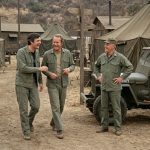
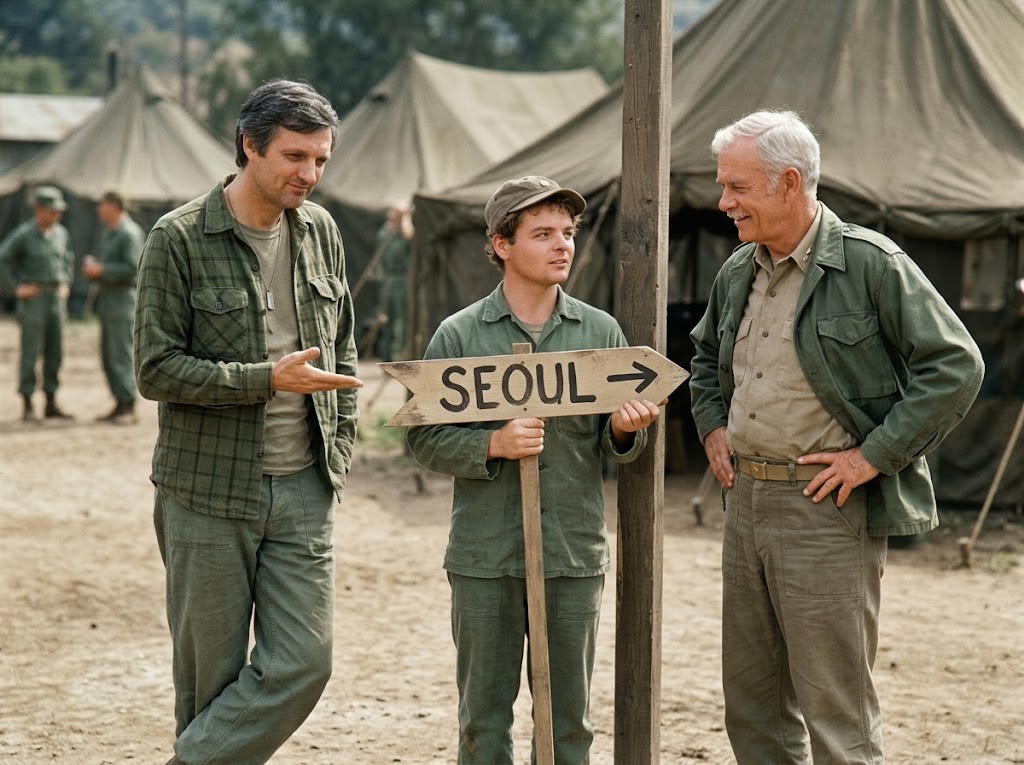
Hawkeye Pierce had finally changed out of his blood-stained scrubs, slipping into his familiar, faded green plaid flannel shirt. To anyone else, it was just an old piece of clothing, but to him, it was a shield against the reality of the tents around him. He stood in the center of the dirt compound, his shoulders slumped with a fatigue that reached all the way to his bones, yet his eyes were fixed on a small, unfolding scene.
A few feet away stood Corporal Radar O’Reilly, looking small and intensely earnest in his oversized fatigue cap. In his hands, Radar carefully held a freshly carved piece of wood shaped like an arrow, with the word “SEOUL” painted in neat, dark lettering, accompanied by a bold arrow pointing to the right.
Colonel Sherman Potter stood just opposite the young corporal, his hands planted firmly on his hips. The old cavalryman’s posture was rigid as always, but his face wore a warm, paternal expression that completely betrayed his tough exterior. He looked at Radar not as a commanding officer inspecting a piece of military property, but as a grandfather admiring a child’s prized drawing.
Hawkeye slowly stepped closer, leaning his frame slightly to one side as he gestured toward the sign with a characteristically wry, open-handed wave. “Well, look at this, Colonel,” Hawkeye said, his voice carrying that familiar, dry cadence meant to mask the ache in his chest. “O’Reilly’s discount travel agency is officially open for business. One-way tickets to civilization, though I hear the local room service leaves a lot to be desired.”
Radar looked up, his cheeks flushing slightly beneath the brim of his cap. “It’s not for a vacation, Captain,” Radar said softly, his voice carrying that pure, untouched innocence that somehow survived the war day after day. “The old signpost got backed into by a supply truck last week, and the original Seoul marker splintered into kindling. I thought… well, I thought we needed it back up.”
Potter nodded slowly, a small smile crinkling the corners of his eyes as he looked at the wooden arrow in the image **G (20).jpg**. “Good work, son. A camp without its directional signs is just a bunch of tents lost in the weeds. A man needs to know which way the rest of the world is turning.”
“Exactly, Colonel,” Hawkeye chimed in, though his smile softened as he looked closely at the freshly painted wood. “Though personally, I think the arrow should point straight up toward Heaven, or at least toward a decent martini glass in San Francisco. What do you think, Radar? Can you carve us a sign that points directly to a plate of ribs from Adams Ribs?”
Radar didn’t laugh at the joke, which immediately caused Hawkeye’s humor to falter. The young corporal gripped the wooden stake a little tighter, his knuckles turning white against the rough grain. He looked down at the arrow, then back up at the two older men, his large eyes suddenly reflecting a weight far too heavy for his young shoulders.
“There was a kid in the pre-op ward last night, Captain,” Radar whispered, his voice trembling just enough to make the bustling sounds of the distant motor pool fade into the background. “A private from Iowa. He kept holding my sleeve, asking me over and over which way the road to Seoul was. He said if he could just keep his eyes pointed in the direction of the ships going home, he knew he’d make it.”
Hawkeye stopped leaning, his extended hand freezing in mid-air as the sarcastic remark died on his lips. The silence that fell between the three men became suddenly absolute, heavy with the unspoken reality of the lives they fought so desperately to save.
“He asked me to promise him I’d fix the sign so he could see it from the ambulance window when they evacuated him,” Radar said, his lower lip quivering as he looked at Colonel Potter. “But Colonel… the evacuation jeep never came for him. He didn’t make it through the dawn. And I still had to finish painting the sign.”
—
The silence that followed Radar’s words lingered over the compound like a low-hanging fog. The dry humor that usually served as the camp’s oxygen suddenly felt inadequate, leaving Hawkeye standing with his hand still pointed toward the wooden arrow, his expression shifting from a playful smirk to a look of quiet, profound sorrow.
Colonel Potter took a long, slow breath through his nose, his chest expanding beneath his fatigue jacket. He didn’t offer a hollow cliché or a standard military platitude. Instead, he reached out and placed a heavy, reassuring hand on Radar’s shoulder, the grip steady and grounding.
“You finished it, Corporal,” Potter said, his voice dropping into that deep, gravelly register that always brought order to chaos. “That’s what matters. You kept your word to that boy, even if he isn’t here to see the paint dry.”
Hawkeye slowly let his hand drop to his side, stepping closer until he was standing right beside Radar. The cynicism that usually protected him slipped away, leaving only the tired doctor who felt every single loss like a physical bruise. He reached out, his long fingers gently touching the tip of the wooden arrow.
“It’s a good sign, Radar,” Hawkeye said quietly, his voice devoid of any theatricality. “It’s straight, it’s clear, and it tells us exactly where the rest of humanity is waiting for us. That Iowa kid… he knew you’d finish it. He went to sleep knowing someone was looking out for the road home.”
Just then, B.J. Hunnicutt strolled over from the direction of the Swamp, his hands tucked into his pockets and his signature mustache twitching with a gentle, curious expression. He had caught the tail end of the conversation, his warm, grounded presence immediately absorbing the somber mood of the group.
“You know, Radar,” B.J. said, offering a small, supportive smile, “every time a driver looks at that sign, they’re going to remember that there’s a world outside this valley. It’s not just a piece of wood. It’s a compass for the soul.”
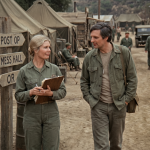
From across the compound, Major Margaret Houlihan marched toward them, her clipboard clutched tightly against her chest. Her uniform was immaculate, her posture commanding, but as she drew near and saw the tearful eyes of the young corporal and the solemn faces of the doctors, her professional armor visibly softened. She looked down at the hand-painted letters on the wood.
“The lettering is exceptionally neat, Corporal O’Reilly,” Margaret said, her tone unusually gentle, lacking its typical military sharpness. “The nursing staff appreciates clarity. When the ambulances arrive in the dark, it helps to know which way the main road lies. See to it that it’s mounted securely.”
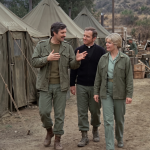
Father Mulcahy appeared from behind the office tent, his quiet steps nearly silent in the dirt. He looked at the sign, then at the faces of the men and woman gathered around it. With a small, understanding nod, he reached out and touched the top of the wooden post.
“A signpost in the wilderness is a powerful thing, my friends,” Mulcahy murmured softly. “It reminds us that our journeys have a destination, and that we are never truly wandering without purpose. I think it deserves a prominent place.”
Together, the small group walked over to the famous central signpost of the 4077th, where markers for Boston, Death Valley, Seoul, and Burbank already pointed toward the far corners of the earth. Radar held the new arrow against the worn wooden pole, his hands steady now, supported by the presence of his found family.
Hawkeye grabbed a hammer from a nearby crate, holding a couple of nails between his teeth. With careful, rhythmic strikes, he secured the “SEOUL” sign back into its rightful place. The sound of the hammer rings out across the quiet camp, a steady, defiant heartbeat against the distant rumble of artillery.
When it was done, they all stepped back to look at it. The arrow pointed resolutely to the right, cutting through the dusty air of the Korean peninsula, a humble guidepost for the weary and the hopeful alike.
Colonel Potter offered a sharp, respectful nod to the sign, then looked at his tired staff. “Alright, people. Let’s get some rest while the skies are quiet. We’ve got a long way to go, and we need to be ready for whatever comes down that road next.”
As the group slowly dispersed, returning to their tents and their duties, Hawkeye remained behind for just a moment longer. He stood in his plaid shirt, looking up at the freshly painted wood gleaming under the afternoon sun, a small, bittersweet smile finally returning to his face.
Because in a place like the 4077th, a simple wooden sign was more than just a direction—it was a promise that someday, we would all find our way back home.