The Quietest Hour in the Swamp
The mud of Korea has a way of seeping into your very bones, turning even the strongest spirits into something brittle and thin.
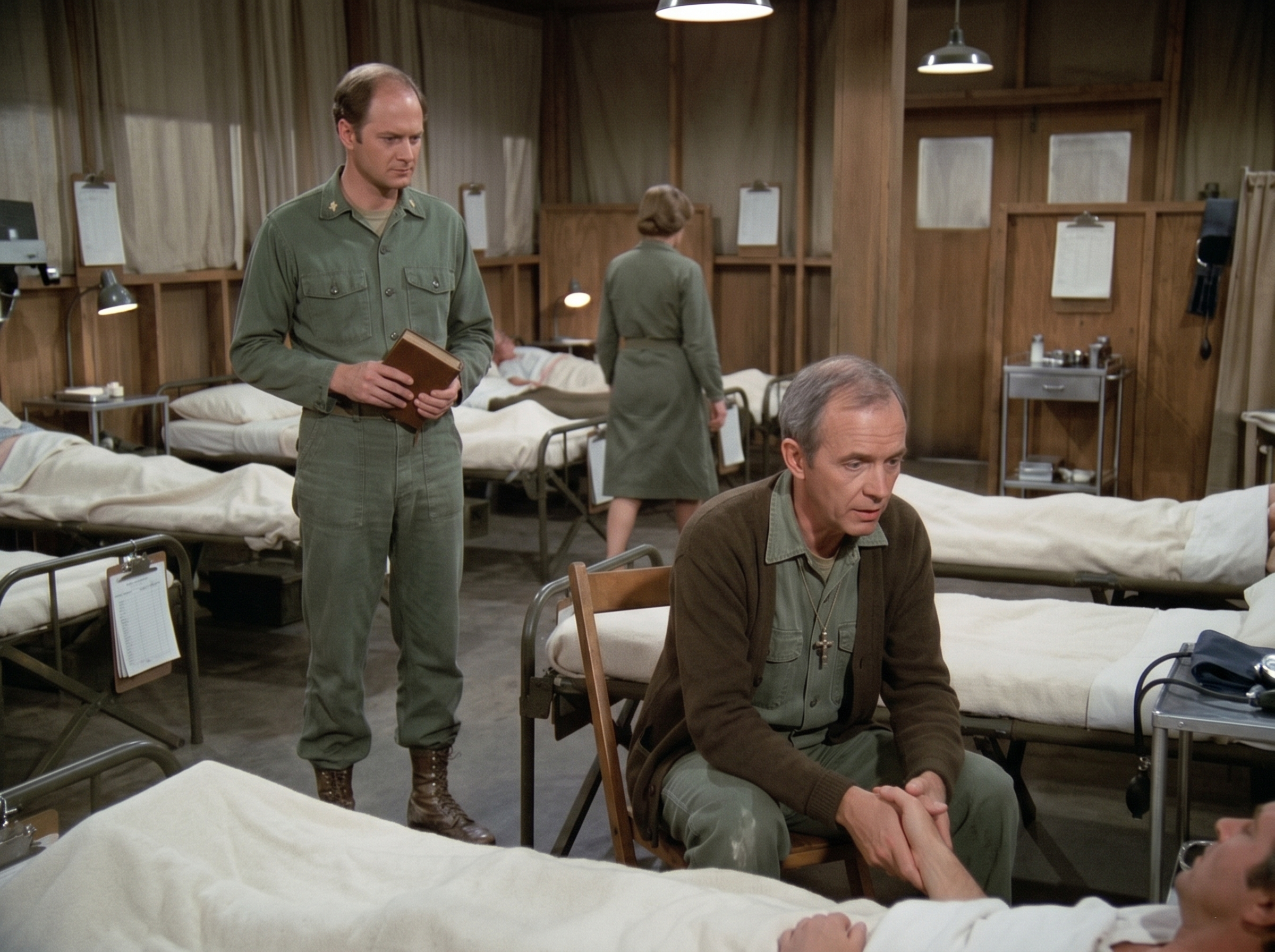
In the Post-Op ward, the air was heavy with the smell of antiseptic, damp wool, and the unspoken fatigue that clings to every soul in the 4077th.
Father Mulcahy sat on a simple wooden chair, his posture slumped with the kind of exhaustion that sleep couldn’t touch.
He held the hand of a young corporal, a boy who had arrived only hours ago with a wound that didn’t match the lightness of his eyes.
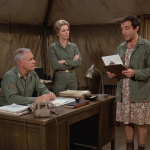
Across from him stood Major Winchester, his usual polished veneer replaced by a look of uncharacteristic, quiet concern.
He gripped a book—likely some dense philosophical tome he’d hoped to digest in solitude—but his attention was tethered entirely to the bed.
Major Houlihan moved through the background, her footsteps soft, her expression a mask of professional control that barely hid the tremor in her hands.
The ward was meant to be a place of healing, but in the long, dark stretch of the night, it often felt like a holding pen for ghosts.
Mulcahy looked up at Winchester, his eyes reflecting the flickering shadows of the overhead lamps.
“He’s holding on, Charles,” the Father whispered, his voice cracking just enough to betray his fear. “But I think he’s waiting for something—or someone—before he’s willing to let go.”
Winchester’s jaw tightened, his fingers white-knuckled against the spine of his book as he looked down at the boy’s pale, unresponsive face.
“He is fading, Father,” Winchester replied, his tone clipped, masking a profound, sudden vulnerability. “And if we do not find the anchor he is searching for, I fear we are merely witnessing the beginning of a silence that will haunt this ward forever.”
The tension in the room was a physical weight, pressing against their chests as they stood in that small circle of light.
Winchester stepped closer, his refined exterior finally crumbling enough to show the man underneath—the one who cared far more than he ever dared admit.
He cleared his throat, the sound sharp in the quiet ward.
“He keeps muttering about a letter,” Winchester said, his voice dropping to a rare, gentle register. “One that never arrived. He believes that if the words aren’t spoken, the journey home isn’t finished.”
Father Mulcahy nodded, understanding dawning in his tired eyes.
He tightened his grip on the corporal’s hand, offering a silent prayer that was less about scripture and more about simple human presence.
Margaret, having finished her rounds, paused in the aisle, watching the two men with a look of unexpected solidarity.
She didn’t offer a medical assessment or a sharp-tongued remark; she simply stood guard over their fragile sanctuary, keeping the rest of the world at bay.
“Talk to him, Charles,” she said softly, her voice devoid of her usual command. “Tell him the words. Maybe it’s not the paper that matters, but the fact that he’s heard.”
Winchester hesitated, his pride warring with his conscience for only a heartbeat.
He opened his book, but he didn’t read from the page; instead, he began to speak of home, of the sights of a life far removed from the stench of trauma.
He described the crisp air of a Boston autumn, the sound of a train whistle in the distance, and the simple, ordinary grace of a Sunday morning.
As he spoke, the lines of pain on the young corporal’s forehead began to smooth.
The boy’s breathing, once shallow and erratic, slowed into a steady, rhythmic cadence.
Father Mulcahy watched, his own eyes brimming with tears, as the boy’s grip on his hand grew firm, then relaxed—not into death, but into a deep, restorative sleep.
The ward remained quiet, but the suffocating atmosphere of doom had lifted, replaced by the warmth of a shared, quiet mercy.
Winchester eventually fell silent, his shoulders dropping as the relief washed over him, leaving him looking smaller, human, and remarkably kind.
Margaret turned away to tend to another patient, a small, knowing smile hidden behind her clipboard.
In the heart of a war they didn’t ask for, in a place built for survival, they had managed to find one more moment of grace.
They weren’t heroes in the classic sense, just a group of tired, broken people trying to keep one another whole until the sun decided to rise again.
The war would be there in the morning, with all its noise and its mud, but for now, there was just the quiet, the comfort of friends, and the profound miracle of another day earned.
Sometimes, the greatest surgery we perform is simply sitting with someone until they realize they aren’t alone.