A Letter Home: The Healers Without Scalpels
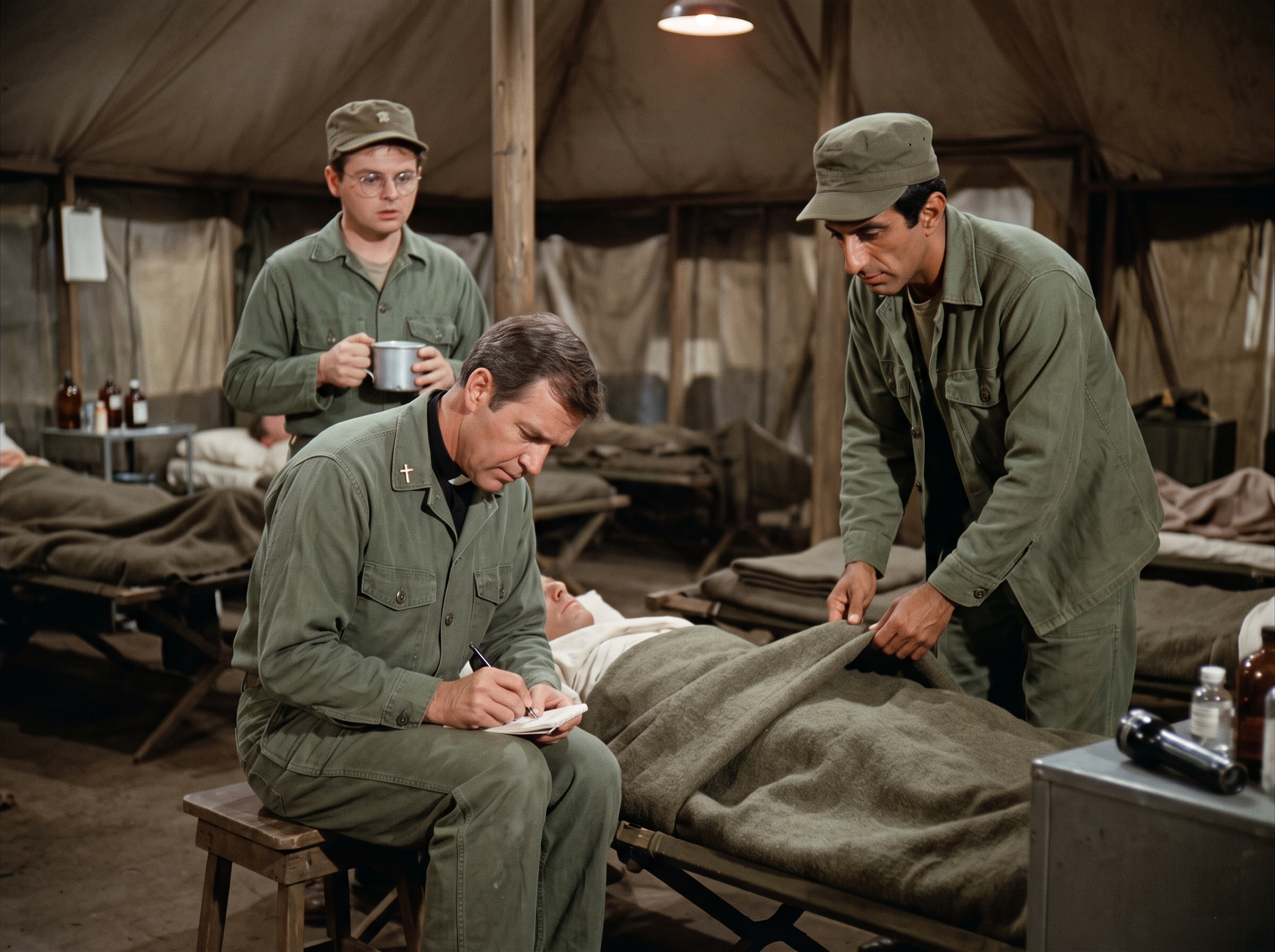
It was three o’clock in the morning, the hour when the war outside the tents usually held its breath.
Inside the Post-Op ward of the 4077th, the air was heavy with the familiar, inescapable smell of canvas, iodine, and sheer human exhaustion. The rhythmic hum of the camp’s diesel generator provided a low, steady heartbeat to the room.
Rows of simple cots stretched into the shadows, bearing the quiet, sleeping forms of boys who were thousands of miles away from everything they knew.
The lighting in the tent was soft, warm, and distinctly gentle against the muted whites and olive drabs of the wool blankets. In the center of the ward, a small pool of light illuminated a moment of pure, quiet tenderness.
Father Mulcahy sat on a low, wooden stool beside one of the cots. He leaned forward with infinite patience, his shoulders slightly rounded from the spiritual weight of the day.
In his hands, he held a small, dog-eared notepad and a stubby pencil. He was waiting, listening, and offering the quiet comfort of his presence to an unseen patient who was simply too weak to hold a pen.
At the foot of the bed stood Maxwell Klinger.
For once, the feathers, the chiffon, and the elaborate Toledo theatrics were packed away. He wore standard, wrinkled fatigues. In this quiet, serious room, Klinger moved with a surprising, earnest dignity. He was carefully adjusting the fraying edges of a blanket around the patient’s feet, making sure the cold Korean night didn’t seep into the boy’s bones.
A few steps back in the shadows, Radar O’Reilly hovered like a guardian angel in an oversized knit cap.
He stood respectfully in the background, gripping a dented metal cup of water in both hands. His wide, innocent eyes were full of quiet empathy, watching the scene unfold with the nervous care of a boy who understood too much about the fragility of life.
No one was looking at each other. No one was putting on a brave face for the doctors. It was a candid, deeply human moment, stripped of all pretense.
The young private in the cot, a boy who looked barely old enough to buy a beer back in the States, was trying to dictate a letter home to his mother. His voice was a raspy, painful whisper.
“Dear Mom,” the boy whispered into the stillness. “I’m doing fine. The doctors here… they patched me up real good.”
He trailed off, a wet cough rattling in his chest. Radar flinched slightly in the background, his knuckles turning white as he gripped the tin cup tighter.
Mulcahy waited, his pencil poised above the cheap paper. “The doctors here are top notch,” the Father offered gently, trying to help the boy find his rhythm.
“No,” the boy breathed heavily, shaking his head against the thin pillow. “She’ll know I’m lying if I sound too brave. Tell her…”
The boy closed his eyes, his breathing growing shallow and fast. The silence in the ward stretched out, thick and heavy with unspoken fears.
“Tell her I’m scared, Father,” the boy finally choked out, his voice breaking into a quiet sob. “Tell her I’m so tired, and I don’t think I can do this anymore.”
Mulcahy’s pencil stopped completely.
Radar looked down at the wooden floorboards, biting his lower lip. Even Klinger froze, his hands resting on the rough olive wool of the blanket. The brutal weight of the war pressed down on their small circle of light, threatening to swallow the young soldier whole.
Father Mulcahy looked up from the notepad, his face a portrait of profound, gentle concern.
He knew he couldn’t lie for the boy. It wasn’t in his nature as a priest to falsify a soldier’s words. But he also knew he couldn’t mail a letter that would shatter a mother’s heart in a farmhouse halfway across the world.
Before the chaplain could find the right words of comfort, Klinger moved.
The corporal from Toledo didn’t offer a quick joke. He didn’t complain about section eight, guard duty, or the injustice of the draft.
Instead, Klinger stepped around to the side of the cot, his dark eyes surprisingly soft. He gave the blanket one final, comforting tuck around the boy’s shoulders, smoothing the fabric with unexpected grace.
“You don’t want to tell her that, kid,” Klinger said softly. His voice was low, entirely stripped of its usual theatrical boom.
The young private opened his tired eyes, looking up at the corporal in the wrinkled olive drab. “Why not? It’s the truth. I’m terrified.”
“Maybe it is the truth,” Klinger nodded slowly, his expression serious and grounded. “But mothers have a special kind of radar. If you tell her you’re scared, she’s going to be scared. And she’s sitting in her living room, thousands of miles away, completely unable to do a darn thing to help you.”
Klinger rested his hands on his hips, looking down at the young man.
“I write to my mother back in Toledo every single week,” Klinger continued, his voice warm with memory. “Half the time, I’m freezing to death. The other half, I’m dodging artillery. But you know what I tell her?”
The boy on the cot shook his head slightly, captivated by Klinger’s quiet intensity.
“I tell her about the food,” Klinger smiled, a small, genuine expression that reached his eyes. “I complain about the powdered eggs. I tell her how much I miss her stuffed cabbage and her fresh bread. It makes her feel needed. It makes her feel like things over here are normal enough that her boy is just complaining about a bad breakfast.”
Father Mulcahy watched Klinger with a look of profound, quiet respect. The chaplain slowly looked back down at his notepad.
“Corporal Klinger makes a very wise point,” Mulcahy said gently, his voice a soothing balm. “Sometimes, the kindest truth we can share with those we love is the one that brings them comfort, rather than the one that brings them our pain.”
In the background, Radar finally stepped forward from the shadows.
He didn’t say a word to interrupt the fragile moment. He just carefully reached down, supported the back of the boy’s head with one hand, and tipped the dented metal cup to the soldier’s cracked lips.
The water was tepid, tasting faintly of iodine, but the boy drank it gratefully. He looked at the three men surrounding his cot. A gentle priest, a quirky company clerk in wrinkled fatigues, and an innocent farm boy holding a tin cup.
None of them were surgeons. None of them held scalpels. But all of them were healers in their own vital, quiet way.
“Okay,” the boy whispered, falling back against the pillow, having found a fraction of his strength. “Let’s try again, Father.”
Mulcahy smiled, a warm, reassuring light reaching his eyes. He readied his stubby pencil against the paper.
“Dear Mom,” the boy started again, his voice steadier this time. “I’m doing okay. The docs here are really good. But I gotta tell you, the food in this place is an absolute crime.”
Klinger chuckled quietly, patting the boy’s leg through the heavy wool blanket. “Now you’re getting the hang of it, kid.”
“Tell her,” the boy continued, his breathing finally easing into a calmer rhythm, “that I can’t wait to get home and have her pot roast. Tell her I miss it. And I miss her.”
Mulcahy’s pencil scratched smoothly and steadily across the cheap paper. The sound was rhythmically comforting in the quiet ward, a small act of creation pushing back against the destruction outside.
Radar took the empty tin cup, stepping back into the shadows. His tense shoulders were relaxed now, and the worried empathy in his eyes had softened into a quiet, profound relief.
They spent the next ten minutes working together, crafting a masterpiece of mundane, beautiful details. They talked about the Korean mud, the cold nights, and the strange, funny characters that populated the 4077th.
Together, they built a bridge of words back to a living room in America, ensuring the boy sounded safe, stubborn, and wonderfully alive.
By the time Father Mulcahy signed the boy’s name at the bottom of the page, the young private had drifted fast asleep. His face, previously tight with pain and unspoken terror, had softened into peaceful rest.
Mulcahy folded the paper carefully, treating it like a sacred document, and slipped it into an envelope. He stood up slowly, his knees popping slightly in the quiet tent.
Klinger gave the blanket one last, entirely unnecessary adjustment at the foot of the bed. It was an act of pure tenderness, a subconscious way of watching over a kid who was far from home.
“You did a very good thing tonight, Maxwell,” Mulcahy whispered, placing a gentle hand on Klinger’s shoulder.
Klinger looked down at his boots, uncharacteristically modest in the dim light. “Just looking out for a fellow drafted man, Father. Toledo’s a long way from here. Somebody’s got to remind them to complain.”
Radar walked up beside them, looking at the sealed envelope in Mulcahy’s hand. “Do you think his mom will send him a care package when she reads that?” he asked earnestly.
Mulcahy smiled, looking down at the sleeping soldier breathing steadily in the cot.
“I have a feeling, Corporal,” Mulcahy said softly, “that this letter is the best care package she could possibly receive.”
The three men stood together for a moment longer in the soft, yellow glow of the Post-Op ward. The bitter war outside was still waiting for them in the dark. The choppers would inevitably return with the dawn.
But in this one small corner of the canvas tent, they had won a quiet victory.
They turned and walked softly down the aisle of cots together, their boots making barely a sound, leaving the young soldier to dream safely of home.
The greatest medicine at the 4077th didn’t always come in a bottle; sometimes it came from a kind word, a warm blanket, and the quiet devotion of friends.