The Safest Harbor in Korea
There were days at the 4077th when the war was deafening, and there were days when it was terrifyingly quiet. But the hardest days were the ones where the noise of the operating room simply refused to stop echoing in your head, long after the last stitch was tied.
That was the kind of day it had been. Eighteen hours of endless meatball surgery. Eighteen hours of standing over young men who looked more like frightened boys playing dress-up in olive drab.
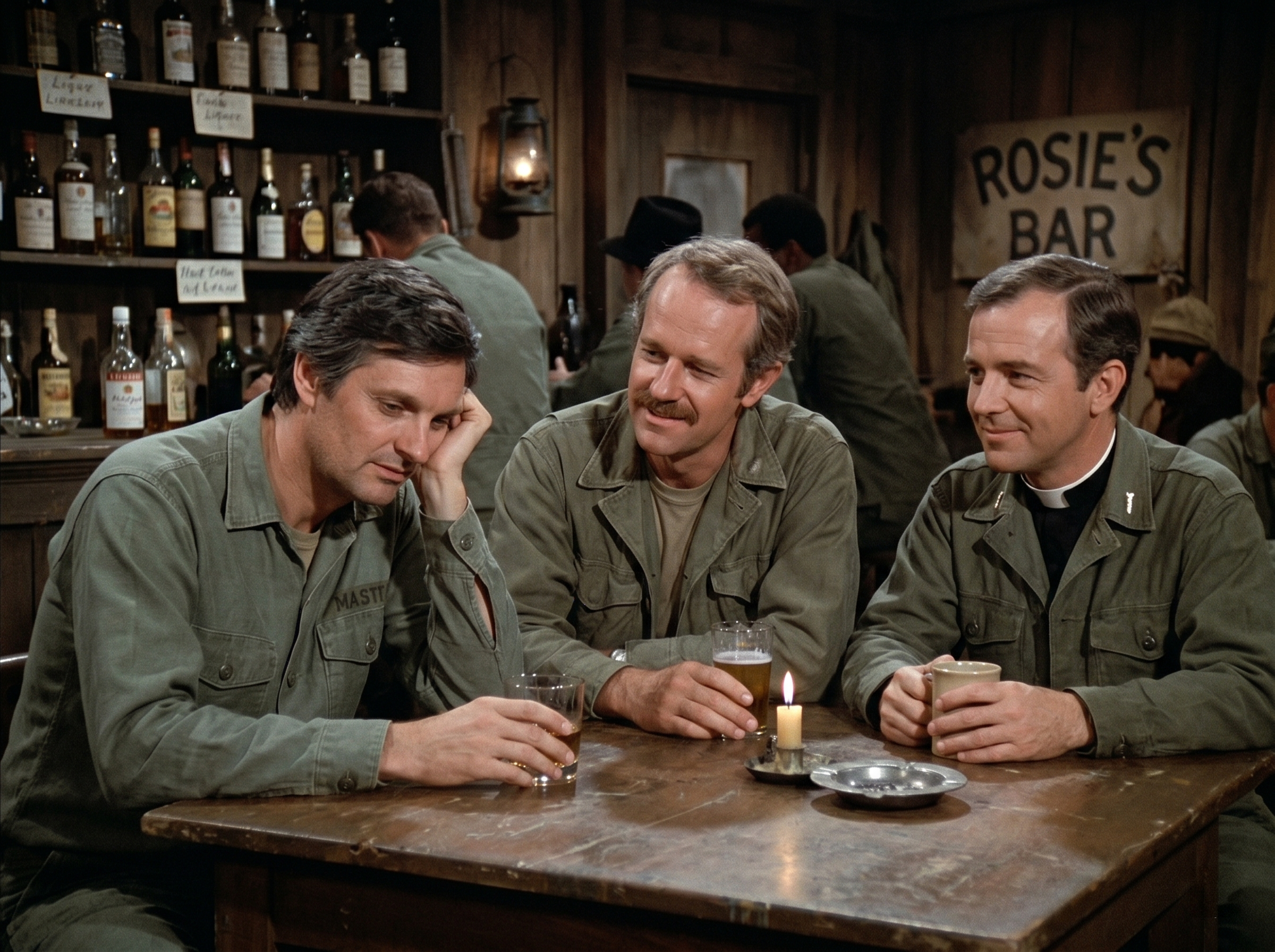
Now, the only sanctuary left in Uijeongbu was a wobbly wooden table in the back corner of Rosie’s Bar.
The air in the room was thick with the smell of spilled beer and the unmistakable, lingering scent of exhaustion. In the background, the familiar hand-painted “ROSIE’S BAR” sign hung slightly crooked on the worn wooden planks, a beacon for weary souls.
At the table, Hawkeye Pierce sat entirely deflated.
Usually, Benjamin Franklin Pierce was a hurricane of words. He survived the madness by mocking it, spinning elaborate jokes, and throwing verbal grenades at the absurdity of the United States Army.
Tonight, he was out of words.
He leaned heavily on his left elbow, the heel of his hand pressing into his cheek as if it were the only thing keeping his head upright. His dark hair was messy, still holding the damp sweat from the OR.
In his right hand, he loosely held a small glass of amber whiskey. He wasn’t drinking it. He was just staring past it, his eyes fixed on some invisible, tragic point on the scarred wooden tabletop.
His face was a portrait of a man who had seen too much. The trademark smirk was completely gone, replaced by a profound, heavy sorrow. He wasn’t crying, but the grief of the day was etched into every line around his tired eyes. He looked older than his years, a brilliant surgeon drowning in the sheer, repetitive futility of putting broken kids back together only to send them back into the grinder.
Sitting directly beside him, close enough for their shoulders to brush, was Captain B.J. Hunnicutt.
B.J. was holding a glass of beer. He wasn’t looking at his drink, nor was he looking around the noisy room. His entire focus was fixed gently, quietly, on his best friend.
Where Hawkeye was visibly crumbling, B.J. was steady. He wore a subtle, dryly amused smile. It wasn’t a smile of mockery, but one of deep, knowing empathy. It was the look of a man who understood exactly the dark neighborhood Hawkeye’s mind was wandering through.
Across the small table, sitting slightly to the side to give the two surgeons their space, sat Father Francis Mulcahy.
The priest looked perfectly out of place in a dingy Korean dive bar, yet exactly where he needed to be. His clerical collar peeked out from beneath his worn, green army fatigue shirt.
His hands, usually folded in prayer, were now wrapped tightly around a thick ceramic mug of something warm.
A single candle burned in a dirty glass ashtray in the center of the table. Its small, flickering flame cast a warm, golden glow across their faces, pushing back the literal and metaphorical darkness.
The silence at the table stretched on, heavy and fragile. The murmur of other soldiers at the bar faded into background static.
Finally, Hawkeye’s voice broke the silence. It didn’t sound like his usual booming, theatrical baritone. It sounded thin. Hollowed out.
“I couldn’t stop the bleeding on the kid from Iowa, Beej,” Hawkeye whispered to the table, not lifting his eyes. “Eighteen years old. He asked me if he was going to make the varsity baseball team next spring. I told him he’d be batting cleanup.”
Hawkeye’s grip on his whiskey glass tightened. His jaw clenched. The emotional dam was cracking, threatening to break completely under the weight of one unkept promise to a dying teenager.
“I lied to him,” Hawkeye said, his voice dropping to a painful, jagged edge. “And then I watched him go.”
He finally closed his eyes, the absolute crushing weight of the Korean War pressing down onto his shoulders. It felt, in that terrible second, like he might never be able to open them again. He was falling into a familiar, terrifying abyss of despair, and he didn’t know how to stop the descent.
B.J. didn’t immediately jump in to rescue him.
He didn’t offer empty reassurances. He didn’t tell Hawkeye that he had done his best, or that it wasn’t his fault, or that this was just the grim reality of war. Hawkeye knew all of that, and right now, none of logic mattered.
Instead, B.J. let the silence hold the weight of Hawkeye’s grief for a few respectful seconds. He took a slow, deliberate sip of his beer.
Then, that warm, steady smile on B.J.’s face deepened just a fraction. He leaned in a little closer, bringing his solid presence fully into Hawkeye’s field of gravity.
“Hawk,” B.J. said gently. His voice was rich, calm, and grounded. It was a voice that sounded like a quiet, safe Sunday morning in Mill Valley.
Hawkeye slowly opened his eyes, but he didn’t turn his head. He just shifted his gaze slightly to acknowledge his friend.
“You didn’t lie to him,” B.J. said smoothly, his tone laced with that quiet, dry humor that always managed to find the humanity in the horror. “You gave him a scouting report. From what I saw of his throwing arm when they brought him in, he had terrible form anyway. You were just protecting the integrity of the game.”
It was a ridiculous thing to say. It was absurd, technically inappropriate, and completely beautiful.
Hawkeye blinked. The dark spell that had been dragging him down suddenly hit a speed bump.
B.J. kept his eyes locked on Hawkeye, radiating an unwavering, brotherly warmth. “Besides,” B.J. continued softly, “you gave him the only thing you had left to give in that moment. You gave him a future to think about while his present was falling apart. That’s not a lie, Hawk. That’s a prescription.”
Hawkeye let out a breath that was half-sigh, half-scoff. The tight, painful grip he had on his whiskey glass relaxed just a millimeter.
The heavy, immovable exhaustion on his face didn’t vanish, but it shifted. The sheer isolation of his grief was broken. He wasn’t alone in the dark anymore. B.J. had just walked right in and brought a flashlight.
Across the table, Father Mulcahy shifted slightly in his wooden chair. He brought his ceramic mug closer to his chest, his gentle eyes crinkling at the corners.
“Captain Hunnicutt is quite right, Hawkeye,” the priest said softly.
Hawkeye finally lifted his heavy head from his hand. He looked over at the chaplain. Mulcahy’s face, illuminated by the flickering candlelight, was a picture of serene compassion.
“I have spent many hours reading the Good Book, my son,” Father Mulcahy continued, his voice carrying that familiar, reedy cadence that always felt like a warm blanket. “And while it has much to say about bearing false witness, I find it notably silent on the subject of offering comfort to a frightened child in the dark.”
Mulcahy offered a small, hopeful smile of pure moral clarity. “I suspect the Almighty is far more forgiving of a merciful fiction than He is of a brutal truth.”
Hawkeye looked at the priest, then turned his head to look fully at B.J.
B.J. raised his beer glass in a tiny, silent toast, his mustache twitching with a suppressed, fond grin. He was offering a lifeline, wrapped in the quiet camaraderie of men who shared the same bloody nightmares.
The tension that had seized Hawkeye’s chest finally began to dissipate. The ghosts of the operating room didn’t disappear—they never truly did—but they stepped back into the shadows, making room for the living.
This was the magic of the 4077th. They were trapped in a nightmare, thousands of miles from home, surrounded by mud, blood, and the constant roar of artillery. But in the middle of that hell, they had somehow managed to build a lifeboat out of bad jokes, cheap liquor, and an uncompromising loyalty to one another.
Hawkeye let out a long, slow breath. The stiffness left his shoulders. He reached down and actually picked up his glass of whiskey.
“A merciful fiction,” Hawkeye muttered, testing the words on his tongue. A ghost of his usual smirk finally touched the corners of his mouth. “You know, Father, if you keep talking like that, the Bishop is going to revoke your union card.”
“I’ll take my chances,” Mulcahy chuckled softly, taking a sip from his mug.
Hawkeye turned back to B.J., tapping his whiskey glass lightly against B.J.’s beer. The clink of the glass was a small, sharp sound in the noisy bar, but to the three men at the table, it was the sound of a heart starting to beat again.
“Thanks, Beej,” Hawkeye said quietly.
“Don’t mention it,” B.J. replied, his eyes crinkling. “Someone has to keep you from turning into a pumpkin before midnight. Peg would never forgive me if I let my bunkmate lose his mind.”
Hawkeye took a slow sip of the terrible local whiskey. It burned going down, but it was a grounding pain. It reminded him he was still alive.
He leaned back in his chair, the crushing weight of the war momentarily held at bay by the two men sitting with him. He looked at the flickering candle, then at the priest, and finally at his best friend.
The bittersweet homesickness was still there. The exhaustion was still bone-deep. But the unbearable loneliness was gone.
They sat together in the dim, warm light of Rosie’s Bar, letting the comfortable silence wash over them. They didn’t need to talk anymore. They just needed to be there, guarding each other’s humanity against the encroaching dark.
Tomorrow, the choppers would come again. The sirens would wail, the loudspeakers would blare, and the madness would restart. They would scrub in, and they would face the fear all over again.
But tonight, for just this one quiet moment, they were safe.
Because in a world gone mad, the only true medicine was the people you shared the madness with.