A Taste of Home, A Shot of Trouble
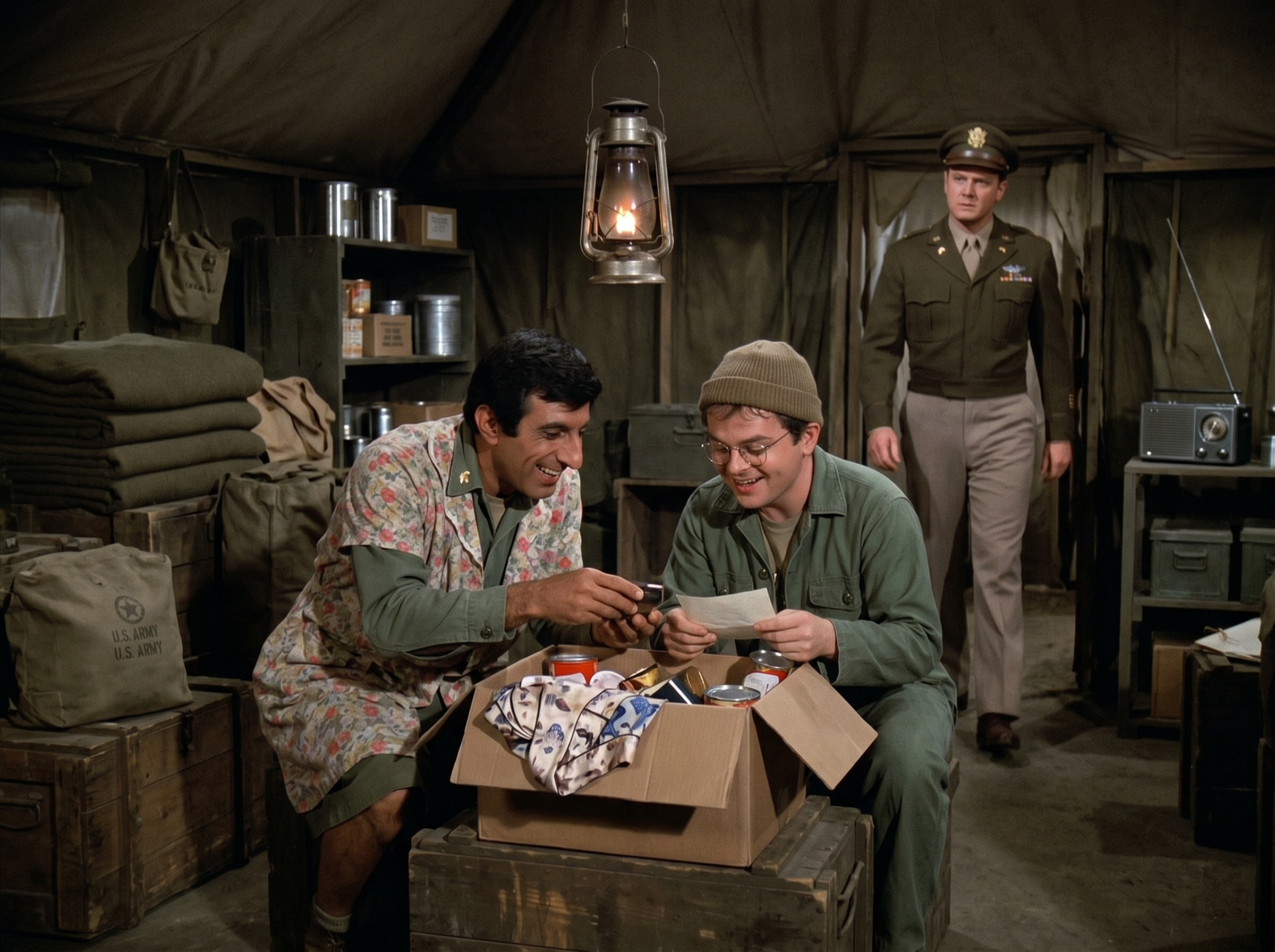
The supply tent always smelled like canvas, stale cigarette smoke, and hope. It was a place where anything was possible—if you knew who to ask.
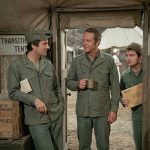
Tonight, the quiet hum of a distant radio battled the silence of yet another long, dusty night in Korea. A hanging oil lantern cast a soft, warm glow, chasing the deepest shadows out of the cramped space filled with stacked wooden crates and supplies.
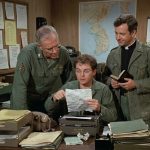
In the center of this cocoon of relative calm, two figures huddled over an open cardboard box like archeologists discovering buried treasure.
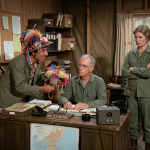
Maxwell Klinger, looking surprisingly festive in a floral housecoat worn over his fatigues, beamed with an expression of pure, conspiratorial glee. His wide eyes were fixed on whatever small artifact his skilled hands were currently retrieving from the package.
Beside him sat Corporal Walter “Radar” O’Reilly, wearing his signature wool beanie. He looked unusually happy, holding a simple letter he was just beginning to read, a rare, genuine smile illuminating his often worried face.
“It’s beautiful, Radar,” Klinger whispered, his voice hushed in genuine appreciation. “Just… beautiful. And it fits perfectly.” He held something up to catch the light, his fingers tracing its contours.
“It’s not just beautiful, Klinger,” Radar said, looking up from the letter. “It’s… special. And the smell!”
Both men leaned over the opened box, their laughter soft and warm. In that single, shared moment, they weren’t just the unit’s master of unorthodox acquisition and the perpetually flustered company clerk. They were just two friends, temporarily transported thousands of miles away by the contents of a single package.
They were so absorbed in their joy that neither one heard the flap of the tent open.
They didn’t register the sudden silence from the radio.
And they definitely didn’t notice the impeccable, starched uniform and the polished brass of Major Charles Emerson Winchester III, who stood just inside the entrance, his expression one of icy, refined disbelief.
“Perhaps,” Winchester’s booming, cultured voice sliced through the warm air, “someone will inform me *exactly* which regulation authorizes a carnival in the middle of a supply depot during hours of darkness?”
Klinger and Radar froze mid-laugh, their faces turning into identical statues of panic.
Winchester didn’t move from his spot, but his presence seemed to take up the entire tent.
Slowly, Radar carefully folded the letter he was holding, treating it as gently as if it were a fragile butterfly. His expression changed from joy to terrified submission. He swallowed hard and stood up, snapping into a rigid, albeit slightly shaky, position of attention.
Klinger, still clad in the floral housecoat that now seemed to scream *conspicuous*, lowered his hands slowly. The grin was instantly replaced by his classic ‘I was just inspecting these supplies, honestly’ look of innocence. He, too, stood, attempting to smooth down the dress as he did so.
“Major,” Radar squeaked, his voice cracking. “We were… just… sorting. Routine sorting, sir. After hours.”
“Sorting?” Winchester raised one skeptical eyebrow. He looked at the open box, his eyes narrowing. “It would appear, Corporal, that you were ‘sorting’ something rather different than band-aids and surgical gauze.”
He stepped closer, the polished boots clicking softly on the floorboards. The warm light from the lantern now illuminated his face, revealing a mix of boredom and curiosity. He didn’t look angry, exactly; he looked like he was about to enjoy a very specific kind of victory.
“And you, Klinger,” Winchester said, gesturing with one gloved hand. “You look like you’re dressed for a lawn party in Boston. While amusing, I assure you it is not conductive to military operations.”
Klinger didn’t miss a beat. “Actually, Major, this is my new camouflage. It blends in perfectly with the flowers of the region.”
Winchester exhaled slowly, a sound like steam leaking from a refined engine. “A likely story. Now, what is in this box that requires clandestine inspection after taps?”
Both Radar and Klinger looked terrified, both starting to stammer at once, but Radar’s voice managed to win out.
“It’s… it’s a package for me, sir. Just a small thing. From my Aunt Martha.”
Winchester walked right up to the makeshift desk and looked down into the cardboard box. His gaze didn’t focus on the floral fabric Klinger had been admiring.
Instead, his eyes stopped on a collection of tins. A very specific, very distinctive color of tin.
He stopped breathing for a second.
Then, slowly, carefully, Winchester reached out and picked up one of the cans. He held it up to the light, turning it. A strange expression, something almost like wonder, began to soften the rigid lines of his face.
“Cousin Willie’s,” he whispered.
He said the words softly, with a distinct lack of sarcasm or condescension.
Radar and Klinger exchanged a surprised, silent look.
Winchester looked at Radar, his eyes different now. They weren’t cold. “Cousin Willie’s,” he repeated, almost like a secret passcode.
“My aunt knows how much I used to love them,” Radar said, his voice quiet.
Winchester put the tin back gently. He ran his fingers over the top of the others. There were half a dozen of them.
“I didn’t think… you couldn’t possibly get these out here,” Winchester murmured. “I used to have them every Christmas. My nanny would order them. My family has bought them for generations.”
For a long moment, the three men simply stood around the supply desk. Klinger in his floral gown. Radar in his beanie. Winchester in his perfect uniform. But in the light of the hanging lantern, the differences fell away.
Winchester took a deep breath, and when he looked up, the condescension was completely gone, replaced by a quiet vulnerability.
“Corporal,” he said, and his voice was almost entirely without its usual edge. “I was on my way to the mess tent for a late-night cup of something they masquerade as tea. If you… if you were so inclined…” He stopped, struggling to find the words, which was rare for Charles Emerson Winchester III.
Radar nodded slowly, a knowing look passing through his eyes. He reached into the box and pulled out two of the tins.
“Major,” Radar said, with a quiet strength. “Why don’t you and Klinger join me? Klinger can make the coffee. Aunt Martha always sends extra. We have plenty to share.”
Winchester paused. He looked from Radar to the tins and finally to Klinger. The supply tent wasn’t the Officer’s Club. But it was private. It was warm. And it had Cousin Willie’s.
“Your offer is… most gracious, Corporal,” Winchester replied. He actually nodded, a genuine, polite gesture. “And Klinger… your coffee, while… unconventional, has at times proved superior to the slop they serve elsewhere.”
Klinger’s face broke into a real, happy smile, not the theatrical one. “Yes, sir, Major! I’ve got the pot right here. We’ll be set in no time. It’ll be just like a, well, like a little party.”
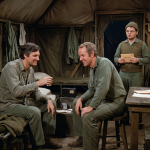
And so they sat down, right there in the dusty supply tent, under the light of the single lantern. Radar carefully opened a tin, and the smell of molasses, ginger, and home filled the air.
As they shared the small, perfect cookies, the war felt a little farther away.
For a brief, impossible hour, they weren’t officer, NCO, and enlisted man. They were just three lonely people, finding a shared moment of warmth and connection in the most unlikely of places.
A little taste of home was all it took to bridge the gaps between them, reminding them all why they were there, and what they had all left behind.
Even in the darkest tents, a little bit of home could still light the way.