One More Little Secret and the Tent 14 Picnic
If these canvas walls could talk, they’d tell stories that defy all sanity.
They’d whisper about the laughter that kept us from breaking.
About the quiet acts of loyalty, tucked between the endless, impossible shifts.
This particular evening, things were almost… well, normal. For the 4077th.
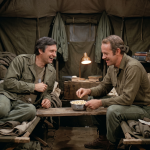
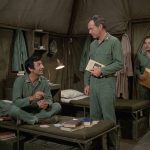
Inside Tent 14, B.J. and I were having our own quiet little retreat.
A whole hour without an OR crisis. It felt scandalous.
The small kerosene lantern, hanging above our heads, cast a sleepy, soft light.
I was sitting on my cot, still in my surgical greens, feeling the exhaustion.
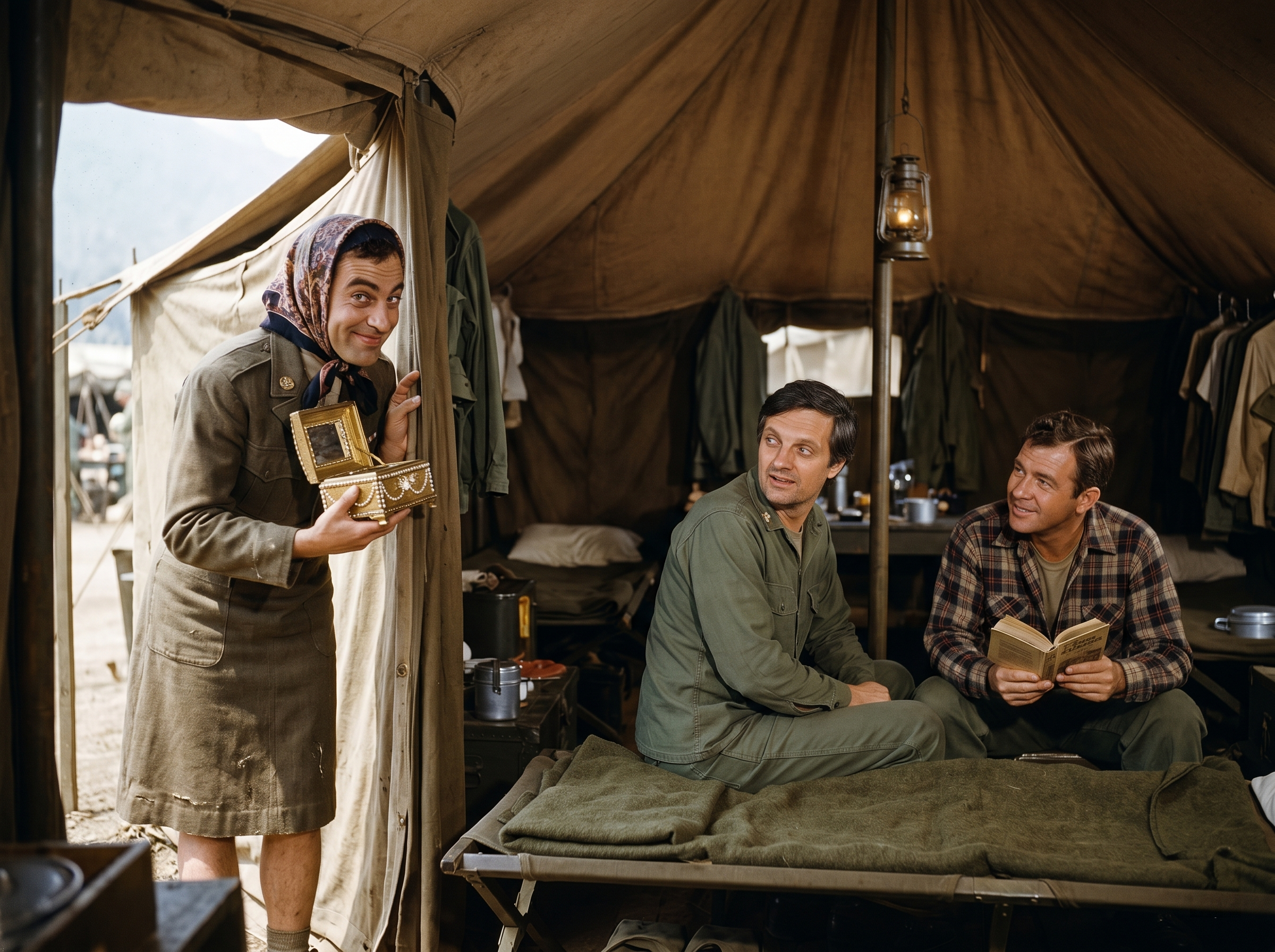
B.J. was on the one across from me, looking downright pastoral in his favorite flannel shirt.
He had a paperback open, pretending to read.
I knew he was just staring at the same paragraph for twenty minutes.
Thinking about home. About Peg and Erin. You could always tell.
Suddenly, the flap of the tent was whipped aside with theatrical stealth.
No knock, just a rapid, whispering presence appearing at the threshold.
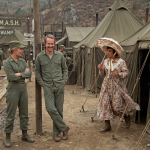
There stood Corporal Maxwell Q. Klinger.
And he wasn’t alone.
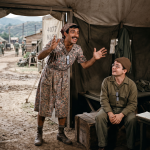
He was wearing a rather smart patterned headscarf and the usual, slightly-too-tight olive skirt.
He didn’t just come in; he *presented* himself, half-hidden, half-flashing us.
Klinger looked at us with a wide, manic grin that meant trouble.
His dark eyes practically sparkled in the lamplight with a ridiculous amount of pride.
He was carefully clutching a small, polished brass box with an ornate latch.
It looked remarkably like a fancy jewelry casket. Not a foot locker.
He tilted his head and smirked at us, a perfect conspiratorial hush on his lips.
We both froze, and I turned my head, my jaw a little slack with genuine surprise.
This wasn’t his usual Section 8 bid.
He didn’t look like he was going to try and sell us a camel this time.
“Klinger?” B.J. asked, lowering his book, smiling but confused. “What in the name of the Prophet is that?”
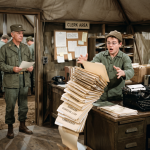
“Sssh!” Klinger hissed, glancing back at the empty compound outside image_0.png.
He dramatically beckoned us closer, his eyes demanding full attention for the treasure.
Part of me thought it might be loaded with explosives.
Part of me was just too tired to handle whatever was inside.
“A little special item, Captains,” Klinger whispered gleefully.
“And it has your names written all over it. Metaphorically.”
He began to slowly raise the lid, creating a dramatic reveal that absolutely hooked us.
We leaned in, captured by the pure absurdity of it.
Klinger didn’t do simple, and this promised a whole new level of ‘found family’ chaos.
He pushed the lid all the way back, his smile widening.
The brass hinges let out a tiny, high-pitched *creak* that sounded louder than any artillery.
There was no gold. No pearls. No diamonds to fund a trip to Seoul.
Instead, nested inside the velvet lining, were eight, neat, little jars.
Pimento spread.
Klinger’s eyes gleamed with triumph. “Straight from my Aunt Rose’s care package. The real McCoy!”
The tension just evaporated.
I burst out laughing, a genuine, shoulder-shaking chuckle.
B.J. just grinned, his face softening with affection for the sheer lunacy.
“You sneaked into Tent 14, past Radar, looking like *that*,” I teased, nodding to the headscarf.
“…To deliver a brass case full of pimento loaf?”
“Captains, this is delicate!” Klinger retorted, though he was grinning broadly now.
“It needs dignity. We’re having a high tea. Right now.”
“We are?” B.J. asked, amused by the immediate invitation.
“Oh, yes. I have crackers, too. Let’s sit. Let’s remember civility.”
He moved into the small space between our cots with the graceful stealth of a dancer.
He gestured dramatically for B.J. to clear his ‘table’ (the trunk next to his bed).
“And I’ve even brought a nice tea towel. Silk, you know.”
And so, Tent 14 held its most bizarre social event of the year.
Three grown men—two surgeons and a corporal—grouped around a trunk in the dim light.
Klinger carefully spread Aunt Rose’s silk tea towel over the worn canvas of the trunk.
He opened a jar of the pimento spread as if it were rare caviar.
He placed the lid of the brass case next to the main supply as the serving dish.
For forty-five minutes, we didn’t talk about shrapnel, or blood types, or home.
We just ate pimento on army crackers, listening to Klinger spin stories about his Aunt Rose.
He described her as having ‘eyes like a hawk and a heart like a peach, with the fashion sense of a giraffe.’
We laughed softly, trying not to disturb the tenuous silence of the camp.
B.J. finally put his book away properly, completely engaged.
The fatigue felt distant.
In that small circle of lamplight, Tent 14 felt safe.
Even the brass casket, which Klinger insisted on calling the ‘Dignified Condiment Caddy,’ didn’t look silly anymore.
It looked like family.
As the last of the spread vanished, we sat back, feeling warmer.
“Thank you, Klinger,” I said quietly. “You’re a real gent.”
Klinger smoothed his skirt and fixed his headscarf with another playful smirk.
“Oh, Captain, please. I am a *lady* with connections. And I remember my friends.”
He collected the ‘Caddy’ and the silk towel, preparing for his departure.
“Next time: maybe some stuffed olives. But you didn’t hear it from me.”
As he slipped back out into the cool Korean night, the tent felt quiet again.
But the air felt less heavy. The silence didn’t press down on us quite as hard.
B.J. and I exchanged a quick smile. The warmth lingered.
That brass box didn’t just hold pimento; it held humanity, when we needed it most.
They say you can’t choose your family, but out here, the 4077th defied that rule, one strange, wonderful secret at a time.