The Unspoken Report
If there was one certainty at the 4077th, it was that the hardest battles weren’t always in the O.R. Sometimes, they were fought over a stack of forms, a cup of lukewarm coffee, and a silent, desperate prayer.
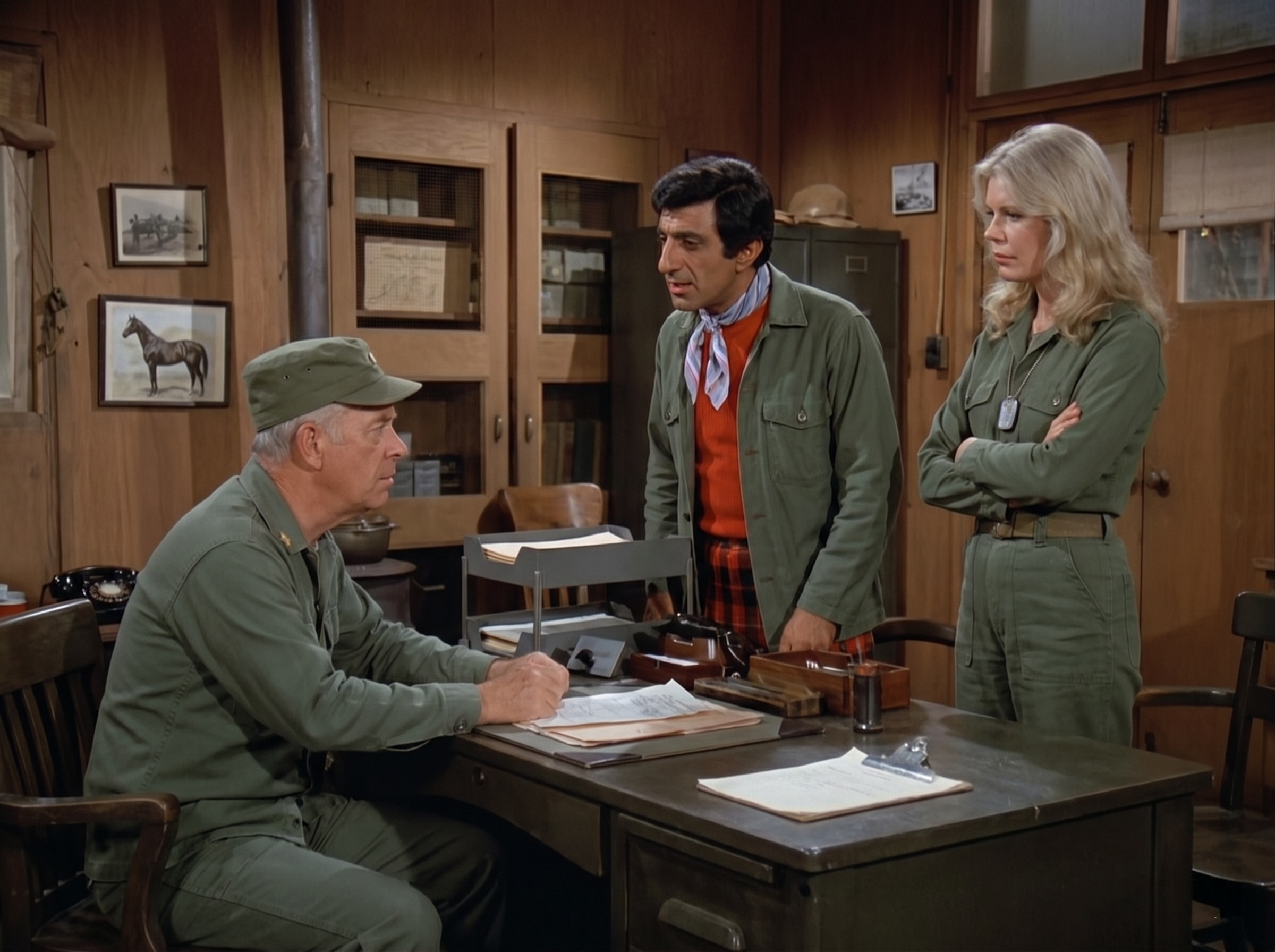
Colonel Sherman Potter sat rigid in his chair, the familiar burden of command settling on his shoulders like a lead poncho. His desk, typically a battlefield of requisition slips and paperwork, seemed exceptionally quiet this Tuesday. All morning, the sound of standard operation—the rhythmic thump of a rubber stamp, the scratch of a fountain pen—was absent. Now, his pen was poised over a single, blank sheet, his eyes fixed on the empty lined paper with an intensity that usually meant he was about to blow a gasket.
The wood-paneled walls of his office felt closer today. The photo of his wife Mildred, the only anchor in this olive-drab sea, offered only distant comfort.
Across the desk, Klinger stood perfectly contained in his green fatigues, but his red turtleneck and the paisley scarf knotted neatly around his neck broadcast his state of high alert. Today, there were no feathered hats, no chiffon gowns, only this understated splash of color against the standard issue. He wasn’t *just* Corporal Max Klinger today; he was the unofficial guardian of the 4077th’s collective morale. And he was worried.
“Colonel, you can’t just… sit there,” Klinger said softly, his natural volume dialed back significantly. “Radar usually handles the morning mail, and he’s not…” He let the sentence hang, unable to finish it.
Colonel Potter’s only response was to tighten his grip on the pen. He looked from Klinger to Margaret. Major Margaret Houlihan stood with arms crossed, her blonde hair catching the meager light, her face a mask of professional fortitude. Her fatigues were, as always, immaculate, but the way she gripped her own elbows revealed a crack in her armor. She looked like a woman trying to hold a bursting dam together with sheer willpower.
The air in the office was so still it was heavy.
“Klinger,” Colonel Potter finally managed, his voice sounding dry and old. “Is there something… specific? Another supply issue? Did the laundry soap requisition get denied again?” He needed an excuse. Any standard, fixable problem would do.
Klinger shifted, his red tartan pants making a soft *swish* sound in the silence. He exchanged a glance with Margaret. “It’s not the soap, sir. It’s… the silence.”
“The silence?”
Margaret stepped forward slightly. “Colonel, the boys haven’t stopped since the last push. Hawkeye is exhausted. B.J. hasn’t spoken. Father Mulcahy just… sits. It’s too quiet out there. It’s unnatural.”
The Colonel knew it. Every surgeon, nurse, and orderly in the camp was moving on muscle memory alone. The jokes, the banter, the sarcasm—the critical vents they all relied on to stay sane—had been choked off.
“I have a camp report to file, Major,” Potter said, gesturing to the blank page. “Headquarters expects it.”
“A report about *what*, sir?” Klinger pressed, leaning slightly over the desk. “They’re just kids. We’re all just tired.”
Colonel Potter didn’t answer. He couldn’t.
Margaret crossed her arms tighter, her stance mirroring the stubborn will that had gotten her through more pushes than she cared to count. “Max is right, Sherman. This isn’t about supply lines. It’s about people.”
Potter’s gaze dropped to the single pen mark he had made. It was just a scratch. A single line, marking nothing.
A low, collective sigh seemed to pass through the office, a shared recognition that went beyond paperwork or rank. It was the sound of three souls acknowledging the weight they were all carrying, each in their own way.
Just then, a commotion erupted outside. Loud, frantic laughter. A crash. Shouting that didn’t sound like pain.
Through the window, a blur of red tartan flashed. Klinger didn’t even say a word; he was gone before Margaret could turn her head. He had seen B.J. Hunnicutt try to make a point with an unstable stack of crates, and he knew that Hawkeye Pierce was too tired to help. Klinger, scarf trailing, was out the door.
Potter and Margaret were alone. The silence returned, different now.
“Go, Major,” Potter said, his voice quiet. He picked up his pen again. “You should check on them. Make sure nobody’s broken any essential limbs, especially their own.”
Margaret hesitated, then uncrossed her arms. Her face softened, just slightly, revealing the compassion she so often masked. “Yes, Colonel.” She turned and left the office, moving with her usual efficient step toward the noise.
Colonel Sherman Potter looked at the blank page. Outside, he could hear Klinger’s loud, stabilizing instructions to his ‘girls.’ He could hear Hawkeye’s dry observation. He could hear B.J.’s genuine belly laugh, cutting through the heavy air.
Potter looked up at the picture of Mildred. He dipped the pen into the ink.
“4077th MASH Report,” he wrote, his pen moving smoothly. “Camp morale: Status: Actively resisting despair with unauthorized laughter.”
He didn’t finish the report. He just capped the pen and stood up, walking to the window to watch Klinger, still wearing that ridiculous scarf, manage to keep two tired surgeons from collapsing while organizing a purely fictional supply delivery.
He watched them. A scruffy, brave, exhausted family.
Sometimes the only thing that kept the darkness out was the quiet, shared strength that only family could understand.