The Seven-Fingered Turnip of Uijeongbu
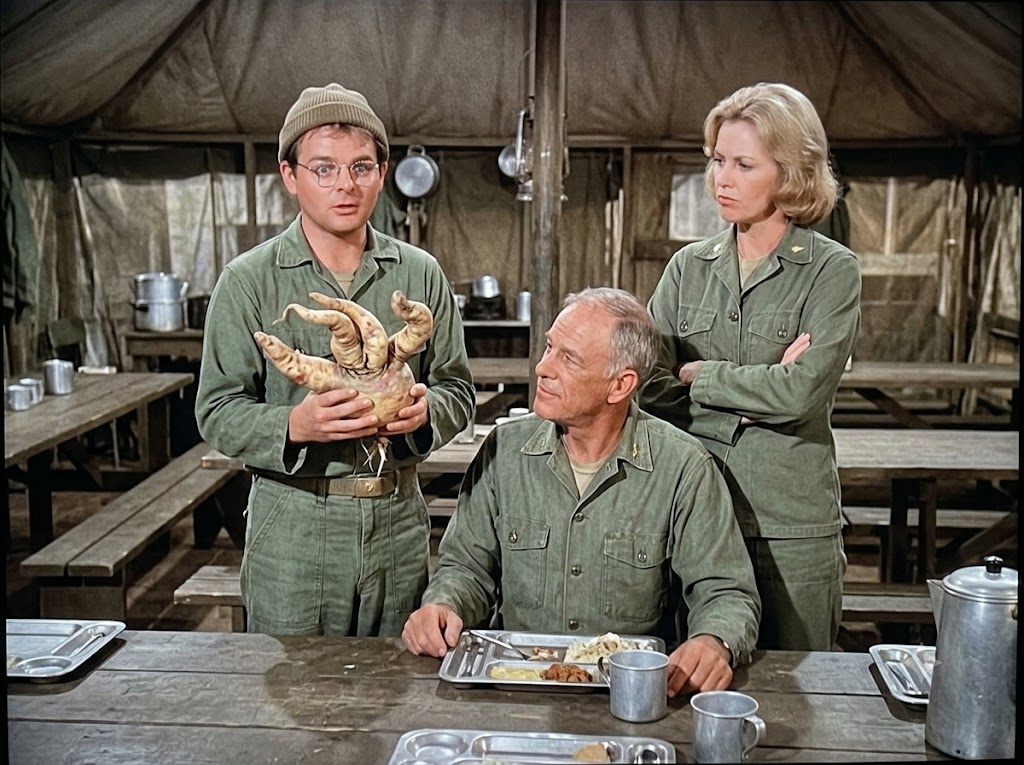
The mud in Korea had a way of getting into everything—your boots, your sheets, and eventually, your soul. But on a Tuesday afternoon after a grueling thirty-six-hour shift in the Operating Room, the only thing the mud was producing was an identity crisis in the mess hall.
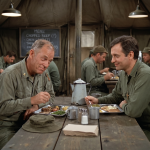
Colonel Sherman T. Potter stared down at his tin tray with the seasoned skepticism of a cavalryman who had seen two world wars and a dozen different ways to ruin a potato.
The steam rising from his mystery meat was the only warm thing in the tent, save for the ambient frustration radiating from Major Margaret Houlihan.
Then came Radar.
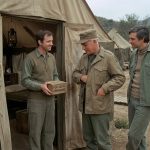
Corporal Walter “Radar” O’Reilly did not just walk into the mess hall; he materialized, clutching something to his chest like a mother hen guarding her final egg.
His wool cap was pushed back on his forehead, his spectacles caught the dim overhead light, and his face held the kind of fierce, fragile hope usually reserved for a letter from home.
“Colonel, sir,” Radar whispered, his voice cracking slightly under the weight of a monumental discovery. “You’ve got to see this. I think it’s a sign.”
He stepped up to the wooden table, carefully extending his hands.
Nestled in his palms was a vegetable that defied every law of agricultural science and common decency. It was a root vegetable—perhaps a turnip, perhaps a deformed parsnip—but it had mutated into a shape resembling a clenched, multi-knuckled fist with seven distinct, writhing fingers.
Colonel Potter paused, a forkful of gray protein hovering inches from his mouth. He slowly turned his head, his sharp eyes tracking from the vegetable up to Radar’s earnest face.
Margaret crossed her arms tightly across her fatigue shirt, her brow furrowing into a deep, unimpressed V. She looked at the root, then at Radar, her jaw tightening with the clinical disapproval of a chief nurse who had seen enough abnormalities for one lifetime.
“What in the name of the Great Caesar’s Ghost is that, Radar?” Potter asked, his voice a low, gravelly rumble. “Did it crawl out of the swamp, or did Sparky send it over the radio wires?”
“It’s a turnip, sir,” Radar said proudly, turning it so the light hit its bulbous, dirt-flecked knuckles. “Old Man Cho brought it by the supply tent. He said it’s an omen. A lucky hand.”
“It looks like a surgical waste product, Corporal,” Margaret snapped, her tone sharp enough to cut gauze. “It’s unhygienic, it’s grotesque, and it belongs in the incinerator, not next to the Colonel’s lunch.”
“But Major, look at it!” Radar pleaded, his eyes wide behind his lenses. “It’s got fingers. It’s like it’s reaching out. Cho said whenever a multi-fingered root grows in dry soil during a hard winter, it means the harvest of peace is coming.”
Potter set his fork down with a small, metallic clatter. The dry humor in his eyes suddenly gave way to something heavy, a shadow that always crept in when the word ‘peace’ was spoken aloud in the middle of a war zone.
Radar didn’t notice the shift; he was too consumed by his own beautiful, desperate theory.
“I was thinking, sir… if we hang it over the door of the post hospital, maybe the luck will rub off. Maybe the choppers will stop coming for a while. Just a few days. Just enough for everybody to sleep.”
The mess hall went completely silent, save for the distant, rhythmic thud of artillery miles away.
Margaret opened her mouth to deliver a textbook reprimand about military discipline and superstitious nonsense, but she caught the look in Radar’s eyes—the raw, unshielded vulnerability of a boy from Iowa who desperately needed to believe a vegetable could stop a war.
She froze, her critique dying in her throat, while Colonel Potter looked at the seven-fingered root as if it held the secrets to the universe.
Potter rubbed his chin, his thumb scraping against the grey stubble of a long week. He looked at Radar, then at Margaret, who was still standing stiffly, though the anger had melted out of her eyes, leaving only a quiet, tired sorrow.
“A lucky hand, you say?” Potter asked softly.
“Yes, sir,” Radar said, his hands trembling slightly under the weight of the root. “Cho said the seven fingers stand for the seven virtues. Or the seven days of creation. He wasn’t real clear on the translation, but he was crying when he gave it to me.”
Margaret took a slow breath, her arms uncoiling from her chest. She stepped a fraction closer to the table, her eyes scanning the bizarre object.
To anyone else, it was a joke—a piece of misshapen produce to laugh at over a beer at the Swamp. But in the 4077th, hope was a rare commodity, and it came in the strangest packages.
“Corporal,” Margaret said, her voice unusually gentle, stripped of its usual parade-ground authority. “The men in the wards… they are superstitious. If they see something like that hanging over the door, they might think it’s a curse instead of a blessing. It looks… well, it looks a bit frightening.”
Radar’s face fell. The bright, luminous hope in his eyes dimmed, and he looked down at the turnip as if it had suddenly turned to ash.
“Oh,” Radar muttered, his shoulders slumping. “I didn’t think of that. I just thought… Hawkeye’s hands are so tired. BJ’s got that blister from the retractors. I thought a few extra fingers around here couldn’t hurt.”
Potter shifted in his seat, his gaze softening as he looked at the young corporal. He had seen men break under the pressure of the shelling, and he had seen them lose their minds over broken supply lines.
But Radar never broke; he just looked for miracles in the dirt.
“Let me take a closer look at that specimen, Radar,” Potter commanded, extending a hand.
Radar handed it over like a sacred relic. Potter held the heavy root, turning it over in his palm. It was ugly, scarred by the rocky Korean soil, and thoroughly ridiculous.
Yet, as he held it, he felt the profound weight of what it represented—the desperate, enduring human need to find meaning in the middle of chaos.
“You know, Major,” Potter said, looking up at Margaret with a wry, knowing smile. “My grandmother back in Missouri used to say that the ugliest trees always bore the sweetest fruit. This thing might not win a beauty contest at the county fair, but it’s got character.”
Margaret looked at the Colonel, a subtle, understanding smile tugging at the corner of her lips. “I suppose it does, sir. It certainly has more personality than the meatloaf.”
A small, surprised laugh escaped Radar’s throat. He wiped his nose with the back of his hand, his optimism instantly flooding back. “So we can keep it, Colonel?”
“We can keep it,” Potter affirmed. “But the Major is right about the wards. We don’t want to spook the patients. Instead, I think this little fella belongs right here in the mess hall. We’ll put him on the central pillar, right where everyone can see him when they’re eating their gravel and grease.”
Potter handed the root back to Radar. “It’ll remind us that if something this strange can survive the Korean winter, then a bunch of misfit doctors and nurses from the States can make it through too.”
Radar beamed, holding the turnip high as if it were a championship trophy. “I’ll go find some twine, sir! I’ll clean the mud off the fingers first so it looks official.”
“You do that, Corporal,” Potter smiled, nodding him away.
As Radar scurried out of the tent, his boots clicking happily against the wooden floorboards, the mess hall felt a little less cold. The distant artillery still rumbled, and the food was still terrible, but the air felt lighter.
Margaret looked down at the Colonel’s tray, then back toward the door where Radar had disappeared.
“He’s a good kid, Sherman,” she said quietly, using his first name in that rare, sacred way she only did when the war felt too big for ranks.
“The best, Margaret,” Potter said, picking his fork back up with a renewed sense of purpose. “The absolute best. Now, sit down and tell me how we’re going to survive tomorrow’s supply inspection.”
In a place where tomorrow was never promised, sometimes all it took to keep going was a little bit of dirt, a lot of heart, and a seven-fingered miracle.