The Weight of a Silver Dollar
Sometimes, the loudest sound in the entire Korean peninsula isn’t the thud of artillery echoing through the mountains, or the frantic, rhythmic chopping of incoming chopper blades cutting through the morning mist.
Sometimes, it’s just the quiet clink of a single silver coin against the metal railing of a hospital bed.
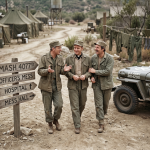
In the corner of the post-op ward, the air smelled of its usual cocktail—stale coffee, rubbing alcohol, and the damp wool of laundry that never quite dried. The late afternoon sun filtered through the high, dusty windows, casting long, tired shadows across the rows of green canvas cots.
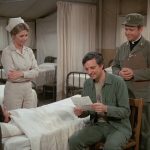
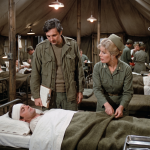
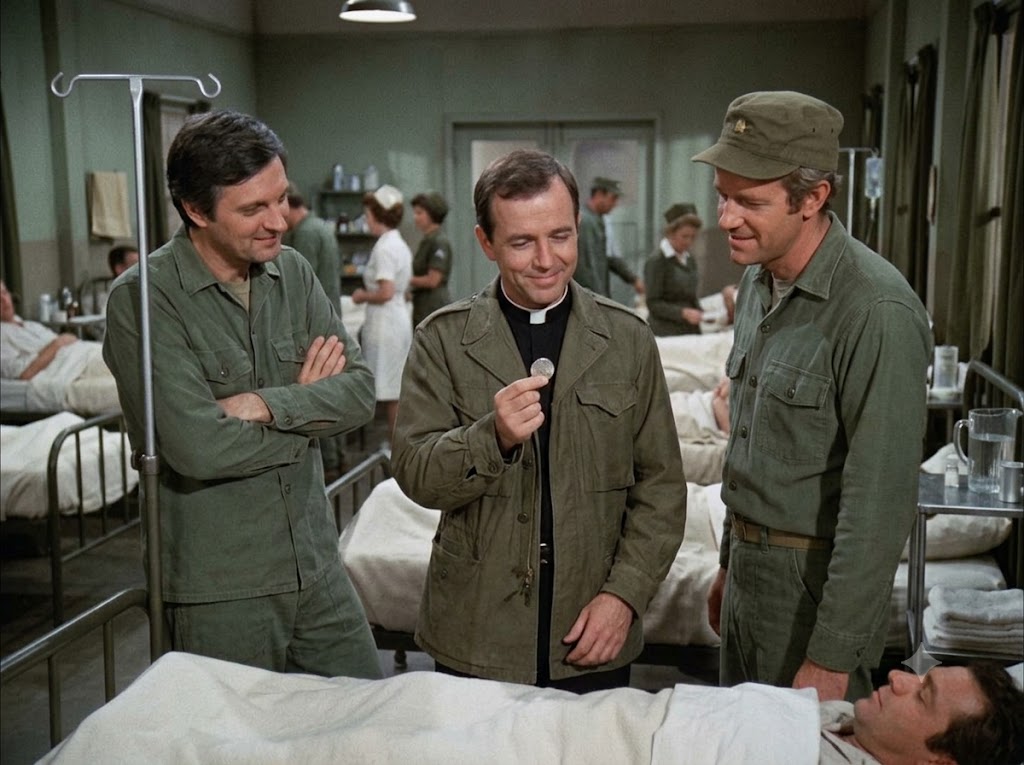
Hawkeye Pierce stood with his arms tightly crossed over his faded olive-drab shirt, leaning his weight back against an IV stand. His face bore the familiar, deep-set lines of a thirty-six-hour shift in the operating room, lines etched by exhaustion and the desperate attempt to keep tragedy at bay with a steady stream of wisecracks. Yet, looking down at the young soldier resting beneath the heavy white blankets, his sharp eyes softened into something intensely quiet and protective.
Beside him stood B.J. Hunnicutt, his utility cap tilted forward just enough to shade his eyes, his hands resting loose at his sides. B.J. looked like a man who had left a piece of his heart in San Francisco and was trying to build a temporary home out of whatever kindness he could find in a tent city. He watched the scene unfold with that trademark, steady warmth—a quiet anchor in a world that spun too fast.
Between them stood Father Mulcahy, the camp’s gentle center of gravity.
In his pale, scrubbed hands, the priest held a single, tarnished silver dollar, turning it over slowly between his thumb and forefinger. The metal caught the pale ward light, gleaming faintly against the dark cloth of his collar and his olive field jacket.
The patient in the bed, Corporal Danny Miller, was barely nineteen, his face pale against the white pillow, his breathing shallow but regular after a long, grueling surgery to remove a piece of shrapnel from his shoulder. When he had first arrived, delirious and terrified, his fingers had been locked in a death grip around that very coin. He wouldn’t let the doctors touch him until Father Mulcahy had promised to keep it safe.
“It’s an old Peace dollar,” Mulcahy murmured, his voice a soft, rhythmic cadence that seemed to lower the blood pressure of everyone within earshot. “1922. The minting year his father returned from the previous war, or so young Danny told me before the anesthesia took hold.”
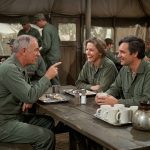
Hawkeye shifted his weight, a faint, lopsided smile playing on his lips, though his eyes remained shadowed. “A silver dollar in Korea, Father. That’s not currency; that’s a small miracle. Down at the Swamp, that could buy you three weeks of Klinger’s finest French perfume, a genuine counterfeit map of Seoul, and maybe a clean pair of socks if you catch Winchester on a generous day.”
“Don’t tease the cloth, Hawk,” B.J. said quietly, though his own smile was wide and fond. “That coin has been across an ocean and back. Look at the edges—completely worn down. That didn’t happen in a cash register. That happened in a pocket, someone rubbing it for luck while waiting for a letter from home.”
Mulcahy smiled, his eyes crinkling at the corners as he stared down at the silver disk. “He told me it was his talisman, Captains. His father gave it to him at the train station in Des Moines. Said as long as he kept it in his pocket, he’d always have a piece of home to anchor him. But when the mortar shell hit his trench… he lost his grip on it.”
The ward grew momentarily still, save for the distant, low murmur of Nurse Able talking to a patient three beds over. The humor softened, leaving only the raw, exposed humanity that the 4077th hid behind its daily theater of the absurd.
“He was terrified when they brought him in,” Mulcahy continued, his voice dropping an octave, thick with a profound, heavy empathy. “Not of the wound. Not of the surgery. But he kept crying out that he had dropped it in the mud. He thought losing it meant his connection to home was broken. That he wouldn’t make it back.”
“But he didn’t lose it,” Hawkeye noted, his voice losing its sarcastic edge entirely, replaced by a deep, fraternal tenderness. “You found it.”
“Not I,” Mulcahy said, looking up, his expression a mixture of reverence and gentle amusement. “Corporal Klinger found it. He was scrubbing the mud off the litter handles outside triage. He spotted it embedded in the tread of a truck tire. He brought it straight to the chapel tent, completely forgetting that he was supposed to be mid-protest in a maternity dress to impress the inspectors.”
B.J. chuckled, shaking his head. “Good old Klinger. A heart of gold wrapped in chiffon.”
“But there’s a problem,” Father Mulcahy said, his smile faltering slightly as his gaze drifted back to the sleeping boy. The priest’s fingers tightened around the silver dollar, and a sudden, sharp look of concern crossed his face. “When Danny woke up for just a brief second an hour ago, he asked me if the coin was whole. I told him it was. But I… I didn’t have the heart to tell him what I noticed when I cleaned the mud away.”
Hawkeye and B.J. both leaned in slightly, their expressions shifting from relaxed affection to professional alertness.
“What is it, Father?” Hawkeye asked, his brow furrowing.
Mulcahy slowly turned the coin around in his palm, revealing the reverse side—the iconic American eagle perched on a mountain crest. Running right through the center of the majestic bird was a deep, jagged, structural fracture. The silver hadn’t just been scratched; it had been deeply gouged by a piece of the very shrapnel that had struck the boy, leaving the coin structurally compromised, barely holding together by a thin fraction of metal at the rim. It looked as though one strong squeeze, or one accidental drop onto the floor, would snap the boy’s lifeline completely in two.
The three men stared at the fractured piece of silver. In the quiet theater of the post-op ward, the broken coin felt incredibly heavy, a fragile symbol of a young life that had been violently disrupted.
“If he sees this,” Mulcahy whispered, his voice trembling with a rare touch of vulnerability, “I fear what it will do to his spirit. In the state he’s in, fighting the infection, missing his family… he’s looking for a sign. If he thinks his luck is broken, I’m afraid he might just give up the fight.”
Hawkeye looked from the coin to the pale face of the sleeping corporal. He knew the medical charts inside and out; he knew the penicillin was doing its job, but he also knew, deeply and intimately, that medicine was only half the battle in this godforsaken valley. The will to survive was the real medicine, and that will was a fragile, elusive thing.
“We can’t let him see it like this,” B.J. said, his voice firm, his paternal instincts flaring. “But we can’t switch it either. He knows every scratch on that silver. He’d know a replacement in a second.”
“So, what do we do?” Mulcahy asked, looking up at the two surgeons as if hoping for a medical miracle that applied to metallurgy. “We can’t weld it. We don’t have the tools, and a clumsy solder job would ruin it.”
Hawkeye stood up straight, his arms uncrossing. A familiar, mischievous spark ignited in his eyes—the look he got right before committing a minor regulatory infraction or inventing a new way to distill gin. “We don’t need a welder, Father. We have something much better. We have the collective, desperate ingenuity of the United States Army’s most dysfunctional unit.”
Before B.J. or Mulcahy could ask, Hawkeye turned and hurried out of the ward, his boots clicking softly against the floorboards.
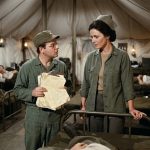
Ten minutes later, the door to the post-op ward creaked open again. Hawkeye returned, but he wasn’t alone. Walking in behind him, looking uncharacteristically serious, was Charles Emerson Winchester III. Charles was still wearing his silk dressing gown over his uniform, holding a small, velvet-lined case that usually housed his finest surgical needles, and behind him slunk Klinger, holding a small bottle of clear liquid and a fine-bristled brush borrowed from the laboratory.
“Pierce,” Charles grumbled in his rich, Bostonian baritone, though his voice was kept to a strict, respectful murmur so as not to wake the ward. “If you have dragged me away from my Brahms concerto for some juvenile parlor trick involving pocket change, I assure you the retribution will be swift and severe.”
“Charles, look at the coin,” B.J. said gently, gesturing to Mulcahy’s open palm.
Winchester adjusted his glasses, leaning over the priest’s hand. He examined the deep fracture in the silver dollar with the precise, analytical eye of a world-class thoracic surgeon. He stayed silent for a long moment, the sarcasm draining from his face, replaced by the quiet dignity of a man who, despite his arrogance, could never bear to see something precious broken.
“The structural integrity is severely compromised,” Charles diagnosed softly, his voice losing its pompous edge. “An elegant piece of minting. It would be a tragedy to let it fall apart.”
“Can we fix it without him noticing?” Hawkeye asked.
Charles looked at Klinger. “Corporal, that adhesive you purloined from the dental clinic last week to fix your high heels—is it water-resistant?”
“Industrial grade, Major,” Klinger whispered proudly, pulling a tiny vial from his pocket. “Guaranteed to hold a heel together through a monsoon, or a silver dollar through a recovery.”
“Excellent,” Charles murmured, taking a pair of micro-forceps from his velvet case. “Father, place the coin on the bedside table, if you please. Ladies and gentlemen, we are about to perform an intricate piece of restoration. Pierce, hold the flashlight steady. Hunnicutt, ensure the patient does not stir.”
For the next twenty minutes, the corner of the ward became a makeshift sanctuary of quiet collaboration. Charles used his finest, most delicate instruments to meticulously clean the microscopic grit from the fracture line. Klinger, with a steady hand that surprised everyone, applied the specialized, clear dental resin into the deep groove using a single-bristled brush, ensuring the adhesive filled the crack from the inside out without altering the coin’s exterior appearance or obscuring the design.
Hawkeye held the light, his gaze moving between Charles’s focused expression and the sleeping boy’s face. B.J. kept a gentle hand on the corporal’s good shoulder, anchoring him in sleep. Father Mulcahy stood over them all, his lips moving in a silent, unspoken prayer that was as much for his friends as it was for the patient.
With a final, masterful stroke, Charles used a soft piece of surgical gauze to wipe away the microscopic excess of resin. The adhesive dried completely clear, sealing the deep fracture from within, binding the two halves of the silver dollar together with an invisible, unbreakable bond. The coin looked exactly as it always had—worn, scratched, and carried through war—but it was whole again. It was strong.
Charles drew back, carefully packing his instruments away, trying to look bored but failing to conceal a small, satisfied smirk. “A rudimentary repair, perhaps, but it will hold. The eagle will fly for a few more decades.”
“Thank you, Charles,” Father Mulcahy said, his voice thick with genuine emotion.
“Do not mention it, Father,” Charles replied, turning to leave, pausing for a brief second to look at the sleeping soldier. “The boy has enough fractures to worry about. He doesn’t need his currency broken as well.”
Klinger gave a soft nod, slipped his vial back into his pocket, and followed Charles out, his steps light and careful.
As the dusk began to settle over the camp, painting the canvas walls in shades of deep blue and purple, Corporal Danny Miller stirred. His eyelids fluttered, and a low, disoriented groan escaped his lips.
“Easy, son,” B.J. said instantly, his voice a warm, grounding presence as he leaned over the bed. “You’re in the 4077th M*A*S*H. The surgery went beautifully. You’re going to be just fine.”
The boy’s eyes opened fully, panicked and unfocused for a split second, searching the unfamiliar faces above him. “My… my dad’s coin,” he croaked out, his voice dry and desperate. “The silver dollar… I dropped it… I lost it…”
Father Mulcahy stepped forward, a serene, radiant smile illuminating his face. He reached out and gently took the young soldier’s hand, pressing the silver dollar firmly into his palm.
“You didn’t lose it, Danny,” Mulcahy said softly, his voice carrying the absolute certainty of a man who witnessed miracles daily in the middle of a wasteland. “It was looked after. It’s right here. Safe and sound.”
The young corporal closed his fingers around the coin. He brought it up to his face, his eyes scanning the worn surface, tracing the lines of the eagle on the back. He felt the weight of it, solid and unyielding in his hand. He didn’t see the clear, invisible resin holding the core together; he only felt the strength of the silver.
A profound, visible wave of relief washed over the boy’s pale face. The tension left his shoulders, and a tear slipped down his cheek as he clutched the coin tightly against his chest, closing his eyes with a deep, peaceful sigh. “Thank God,” he whispered. “It’s still whole. It survived.”
Hawkeye looked at B.J., and then at Father Mulcahy, his arms crossing once more as that gentle, bittersweet smile returned to his face. The fatigue of the long hours seemed to lift, just for a moment, replaced by the quiet, enduring warmth of a family that held each other together with nothing more than tape, string, and an stubborn refusal to let the world break completely.
In a place where everything felt broken, we found out that sometimes, all it takes to keep a soul whole is a little hidden strength and the hands of friends who refuse to let you fall apart.