The Frequency of Hope
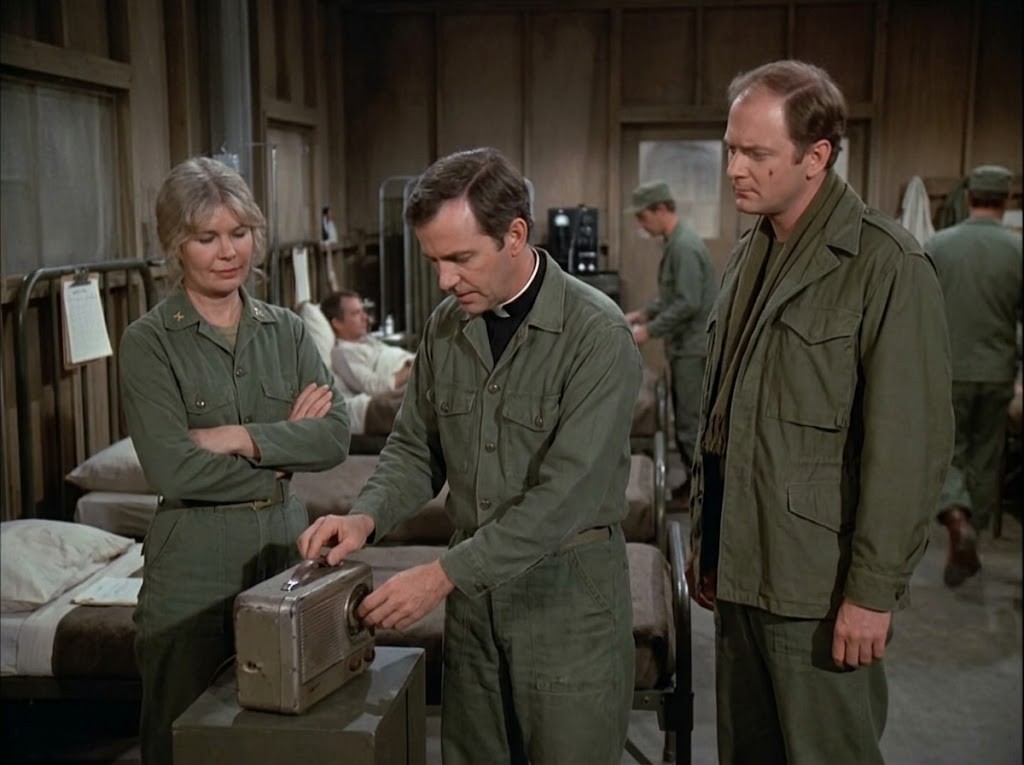
The Swamp was usually the loudest place in the 4077th, but tonight, the entire camp seemed wrapped in a heavy, exhausted silence. A grueling thirty-six-hour session in the O.R. had finally come to an end, leaving everyone with raw hands, aching backs, and minds entirely too loud for sleep.
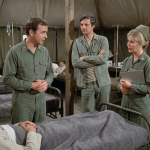
In the quiet sanctuary of the post-op ward, the dim overhead lights caught the lingering dampness of the evening air.
Margaret stood near the row of cots, her arms crossed tightly over her olive-drab fatigues. Her posture was as rigid as ever, a habit born of military discipline, but her eyes gave her away. They were heavy, clouded with the profound fatigue that only a head nurse after a long triage could truly understand.
Beside her, Father Mulcahy leaned over a small, battered metal radio resting on a gray cabinet. His fingers moved with meticulous care, gently turning the tuning dial a millimeter at a time. The radio gave off a harsh, rhythmic static, a crackling white noise that seemed to amplify the tension in the room.
Charles Emerson Winchester III stood just on the other side of the chaplain. He wore his heavy winter coat, a woolen scarf draped loosely around his neck, looking every bit the displaced Boston aristocrat enduring the elements. His face was etched with a deep, solemn concentration, his gaze fixed entirely on the small radio.
In the background, a patient lay quietly in a cot, while another soldier moved softly through the ward, a silent ghost in the periphery of their shared anxiety.
“Still nothing but the wind and the wires, Father?” Charles asked, his voice lower than usual, stripped of its typical theatrical arrogance.
“Just a moment, Charles,” Mulcahy murmured softly, his eyes narrowed as he focused on the dial. “The atmospheric interference tonight is quite severe. But it should be coming through soon. It has to.”
They were waiting for a specific shortwave broadcast from San Francisco—a special holiday program featuring recorded messages from families back home. For weeks, a rumor had circulated that a few families from New England and the Midwest had managed to get their voices onto the tape.
To anyone else, it was a scratchy audio recording thousands of miles away. To the souls trapped in the mud of Korea, it was a lifeline.
Margaret took a quiet breath, her eyes tracking Mulcahy’s steady hand. She wouldn’t admit it aloud, but she was desperate to hear a voice that didn’t sound like a wounded soldier or a barking colonel. She needed to remember that a world existed outside the canvas tents and the smell of ether.
Mulcahy gave the knob another microscopic turn. The static flared, a high-pitched whine that made Charles wince slightly.
Suddenly, through the sea of white noise, a faint, rhythmic sound began to emerge. It wasn’t music, and it wasn’t a voice. It was a rhythmic, frantic tapping, followed by a sudden, sharp pop from the radio’s speaker.
Mulcahy froze. His fingers stayed glued to the dial, his breath catching in his throat.
The radio went completely dead.
The sudden silence in the post-op ward felt heavier than the static.
Charles stepped a fraction of an inch closer, his brow furrowing deeper. “Did we lose the signal entirely, or did the vacuum tube finally surrender to this wretched climate?”
“Let’s not jump to conclusions,” Margaret said, though her voice lacked its usual commanding edge. She stepped forward, her arms finally dropping to her sides. “Father, try turning it back just a hair.”
Mulcahy didn’t move immediately. He closed his eyes for a brief second, offering up a silent, uncharacteristic prayer for a piece of terrestrial electronics. Then, with the patience of a saint, he nudged the dial back a fraction of a millimeter.
The speaker sputtered. A low hum filled the space, followed by a sudden, clear burst of a familiar big band melody. The music was faint, floating over an ocean of distance, but it was unmistakable.
And then, the music faded down, replaced by the crackling warmth of a human voice.
It was an announcer, speaking with that crisp, comforting American cadence. *”To our boys and girls overseas… we bring you the voices of home.”*
Charles closed his eyes. A subtle shift passed over his face, the hard lines of his Boston pride softening into something deeply vulnerable.
The first voice on the broadcast was an older woman from Ohio, her words halting and nervous as she sent love to her son in an infantry division. Then came a young girl, her laughter cutting through the static like a bell, wishing her father a safe return.
None of the names belonged to anyone in the 4077th. They were strangers, thousands of miles away, speaking to other strangers.
Yet, as the voices washed over the quiet ward, Margaret’s shoulders visibly relaxed. A soft, incredibly tender smile touched the corners of her lips. She looked at Mulcahy, whose face had illuminated with a quiet, joyful peace.
“It’s beautiful,” Margaret whispered, her eyes shining in the dim light. “Just hearing them… it means the world is still there.”
Charles didn’t say a word. He simply adjusted his scarf, staring at the small metal box. For all his love of Mozart and the high culture of Boston, the scratchy, imperfect voices of ordinary citizens on a distant continent was the most magnificent symphony he had heard in months.
They stood together in silence for a long time, listening to the stream of love, hope, and longing being broadcast into the night. It didn’t cure the exhaustion, and it didn’t change the reality of the morning to come, but it gave them a moment of profound grace.
Father Mulcahy finally let go of the knob, keeping his hand close, a gentle guardian of their small miracle.
“Yes,” the Father said softly, looking around at his tired friends. “The world is still there, Margaret. And we are going to help these boys get back to it.”
Sometimes, the greatest medicine the 4077th ever found didn’t come from a bottle, but from a scratchy speaker in the dark.