The Five-Minute Truce from Tokyo
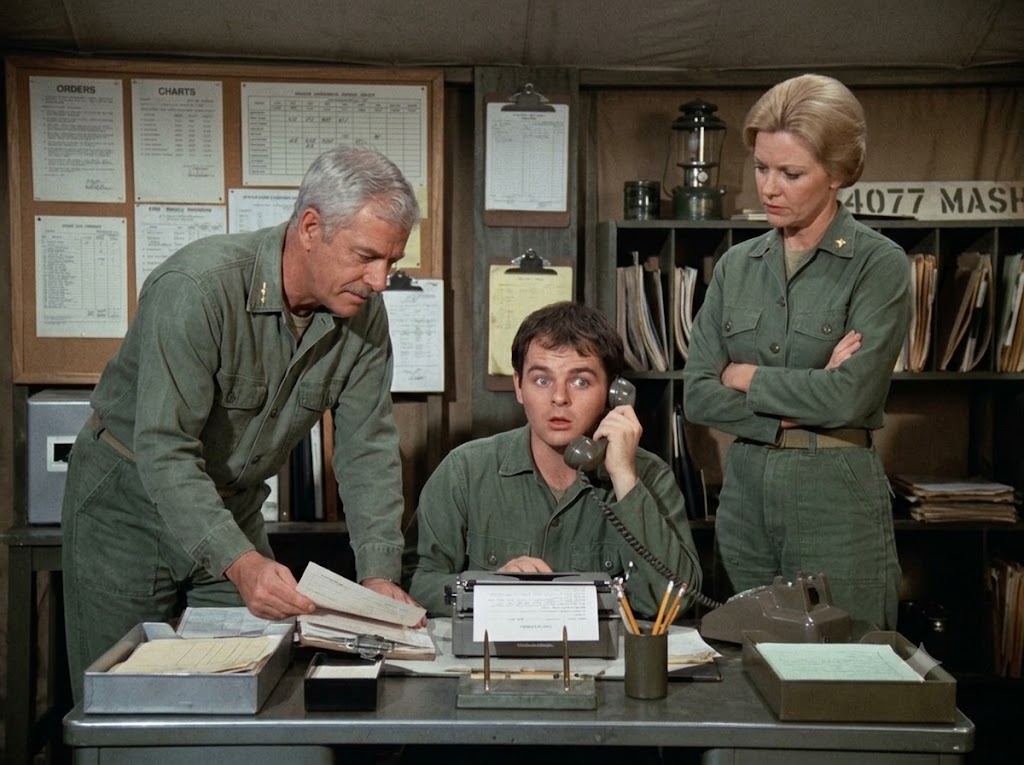
 The single-line telephone in the clerk’s office of the 4077th didn’t just ring; it complained.
It rattled against the scarred wooden desk, a shrill, metallic sound that cut through the heavy, humid silence of an unusually quiet Tuesday afternoon in Korea.
Radar O’Reilly’s hand shot out before the first ring could even finish, his fingers wrapping around the receiver with the practiced reflex of a boy who lived in the space between the rings.
“4077th MASH, Corporal O’Reilly,” Radar muttered, his eyes wide, his voice cracking slightly as it always did when the connection came from somewhere beyond the immediate horizon.
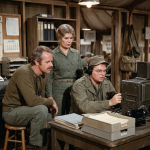
Beside him, Colonel Sherman Potter stood hunched over the metal desk, his reading glasses perched precariously on the bridge of his nose as he studied a stack of transfer orders.
Major Margaret Houlihan stood just behind them, arms crossed tightly over her olive-drab fatigues, her blonde hair perfectly pinned, her posture rigid but her eyes fixed entirely on the young corporal.
The camp had been quiet for exactly fourteen hours—no incoming choppers, no distant thud of artillery, just the heavy, exhausting heat of a valley trying to forget there was a war going on.
But in Korea, a quiet afternoon usually meant the universe was just taking a deep breath before hitting you with a shovel.
“Yes, sir… No, sir… Wait, who?” Radar’s voice suddenly climbed an octave, his pencil freezing an inch above his green logbook.
Colonel Potter froze mid-gesture, a piece of paper gripped between his thumb and forefinger, his sharp eyes darting instantly to Radar’s face.
Margaret took a half-step forward, the starch in her uniform rustling softly in the cramped, wood-paneled office.
Radar’s face went entirely pale, his blue eyes widening to the size of half-dollars as he stared blankly at the wall, listening to the crackle of static and the distant voice on the other end of the wire.
“Corporal, what is it?” Potter demanded, his voice low, a paternal edge cutting through his usual military gruffness. “Is it a push? Are we getting casualties from the grid?”
Radar didn’t answer right away; his mouth opened slightly, his jaw slack as he listened to the voice coming all the way from the command headquarters in Tokyo.
He didn’t look at the Colonel, and he didn’t look at Margaret—he just gripped the black plastic receiver until his knuckles turned a chalky white.
“Radar,” Margaret said, her voice dropping its usual command authority, replaced by a sudden, sharp spike of genuine concern. “Talk to us. Who is on that line?”
Slowly, Radar pulled the receiver an inch away from his ear, looking at it as if it had suddenly turned into a live grenade, his breath hitching in his chest.
“Colonel…” Radar whispered, his voice trembling so hard the words almost fell apart. “It’s… it’s General Hammond’s office. They’re calling about the morning roster. They say there’s been a mistake.”
Potter’s brow furrowed, his mustache twitching as he leaned closer into the desk light. “What kind of mistake, son? Speak up.”
Radar swallowed hard, looking up at the old cavalryman with a look of pure terror. “They say one of our doctors isn’t supposed to be here anymore.”
The silence that followed inside the small office was heavier than any mortar shell that had ever dropped near the 4077th.
Potter’s hand remained steady on the clipboard, but his face hardened into a mask of pure, concentrated focus, the lines around his eyes deepening.
Margaret’s arms tightened against her chest, her breathing shallow as her mind immediately raced through the names of the surgeons who kept the place running on coffee, sarcasm, and sheer willpower.
“Give me that,” Potter said, reaching down to take the receiver from Radar’s trembling hand.
“No, sir, wait—” Radar sputtered, holding up a finger, his eyes darting across the typed sheet still rolled into his typewriter. “They’re… they’re reading the serial numbers right now. They say the orders came down from the Pentagon three weeks ago, but the mail pouch got diverted through Seoul.”
“Which one, Radar?” Margaret demanded, stepping closer, her professional veneer cracking just enough to let the raw human anxiety show through. “Is it Pierce? Hunnicutt? Charles?”
Every person in the 4077th was a piece of a fragile puzzle; if you pulled one out, the whole operating room threatened to collapse under the weight of the endless, bloody triage.
Radar listened for three more agonizing seconds, his pencil finally dropping onto the desk with a dull thud.
“It’s… it’s Captain Pierce, sir,” Radar whispered, looking up at Potter. “They say his active duty rotation was completed at the end of last month. He’s supposed to be on a transport ship heading for San Francisco right now.”
Potter didn’t speak. He slowly straightened his back, pulling his hand away from the desk, his eyes looking out the small screened window toward the Swamp where Hawkeye was likely asleep, or nurse-chasing, or making gin out of old copper tubing.
“San Francisco,” Margaret repeated, the words tasting foreign and heavy in her mouth.
For all her talk of army regulations and proper decorum, the thought of the chaotic, brilliant, insufferable Captain Benjamin Franklin Pierce suddenly vanishing from the camp felt like losing a wall from a house during a storm.
“They want him out on the next supply truck, Colonel,” Radar said, his voice small. “The one leaving for the airstrip in twenty minutes. If he misses it, they say he’s AWOL from his own discharge.”
Potter rubbed the back of his neck, a deep sigh escaping his chest. “Twenty minutes. The man has lived in mud and blood for two years, and they want him to pack his life into a duffel bag in twenty minutes.”
“I’ll go get him,” Margaret said instantly, turning toward the door, her stride purposeful, her usual hostility toward Hawkeye’s antics completely forgotten in the face of something as monumental as a ticket home.
“Hold your horses, Major,” Potter said softly, stopping her with a gentle lift of his hand. “Look at the boy.”
Margaret stopped and turned back to the desk.
Radar was looking at the piece of paper in his typewriter, his lower lip quivering slightly as he stared at the official military font.
To Radar, the doctors weren’t just officers; they were the older brothers who protected him, the men who mended the broken world every night, the ones who made the terrifying reality of Korea feel like something a boy from Ottumwa, Iowa, could survive.
“Colonel?” Radar asked, his voice barely audible over the hum of the desk lantern. “Do I… do I type up the clearance?”
Potter walked around the side of the desk, putting a heavy, warm hand on Radar’s shoulder. “You do your job, Walter. We always do our job.”
Just then, the door to the office creaked open, and B.J. Hunnicutt walked in, a half-eaten apple in one hand and a stack of charts in the other, his mustache curled into a casual smile.
“Hey, folks,” B.J. said cheerfully, glancing around the room. “What’s with the faces? Did someone tell Winchester we ran out of classical records, or did Klinger finally find a dress that matches the Colonel’s jeep?”
The smile died on B.J.’s face the moment he saw Margaret’s eyes and the way Potter’s hand was resting on Radar’s shoulder.
“What is it?” B.J. asked, his tone shifting instantly, the casual warmth evaporating into the steady, defensive alertness of a MASH surgeon. “Is it Hawk? Did something happen to Hawk?”
“He’s going home, Beej,” Potter said simply. “The Pentagon found his paperwork. He’s got twenty minutes to catch the truck.”
B.J. stood perfectly still in the doorway. The apple in his hand felt suddenly heavy.
He thought of the long nights in the Swamp, the shared bottles of terrible hooch, the unspoken understandings between two men who spent their days looking into the chests of young boys.
He thought of how Hawkeye had held him together when he missed his daughter’s birthday, and how they had laughed to keep from crying when the generator failed mid-surgery.
“Twenty minutes,” B.J. muttered, a dry, humorless laugh escaping his lips. “The bastard didn’t even give me time to win my twenty bucks back from poker.”
“He doesn’t know yet,” Margaret said, her voice softer than anyone in the room had ever heard it. “The call just came through.”
Down in the camp, the sound of an old, sputtering truck engine coughed to life—the supply transport was warming up near the motor pool.
Radar began to type, his fingers moving slowly, methodically, hitting the keys with a rhythmic *clack-clack-clack* that sounded remarkably like a ticking clock.
Potter looked around his small office—at the charts on the wall, the clipboard in his hand, the tired, dedicated faces of the people who had become his family in the middle of a wasteland.
“Major,” Potter said, looking at Margaret. “Go tell the kitchen to pack whatever fresh bread we have left. Put it in a sack for him.”
“Yes, Colonel,” Margaret said, nodding sharply, her eyes shining slightly in the dim light before she quickly turned and exited into the bright, dusty afternoon.
“Beej,” Potter continued, turning to his other surgeon. “Go help him pack that miserable excuse for a duffel bag. Don’t let him leave his extra socks. It gets cold on the water.”
B.J. nodded, tossing his apple into the wastebasket. “I’ll make sure he takes the gin still, Colonel. It’s a medical necessity.”
But as B.J. turned to leave, his steps were slower than usual, the reality of a Swamp without Hawkeye Pierce beginning to settle into his bones.
Potter turned back to Radar, who was pulling the finished clearance form from the typewriter with a sharp *zip*.
The young corporal looked up, his eyes bright with unshed tears, holding out the paper that would send his best friend across the ocean and back to a world where people didn’t wear green every single day.
“You did good, son,” Potter said, taking the paper and signing his name with a quick, decisive stroke of his pen. “Go on down there and say goodbye. That’s an order.”
Radar wiped his nose with the back of his hand, a small, brave smile appearing on his face. “Yes, sir. Thank you, Colonel.”
As Radar scrambled out of the office, his boots thudding against the dirt path outside, Colonel Sherman Potter walked over to the window, watching the small, chaotic family of the 4077th gather around the back of a dusty olive-drab truck.
It was just another ordinary, exhausting day in the middle of a forgotten war, but for the next five minutes, the world was going to stop spinning just long enough for a friend to say goodbye.
There are no permanent addresses in a war zone, only the temporary homes we build inside each other’s hearts.