The Weight of a Good Story
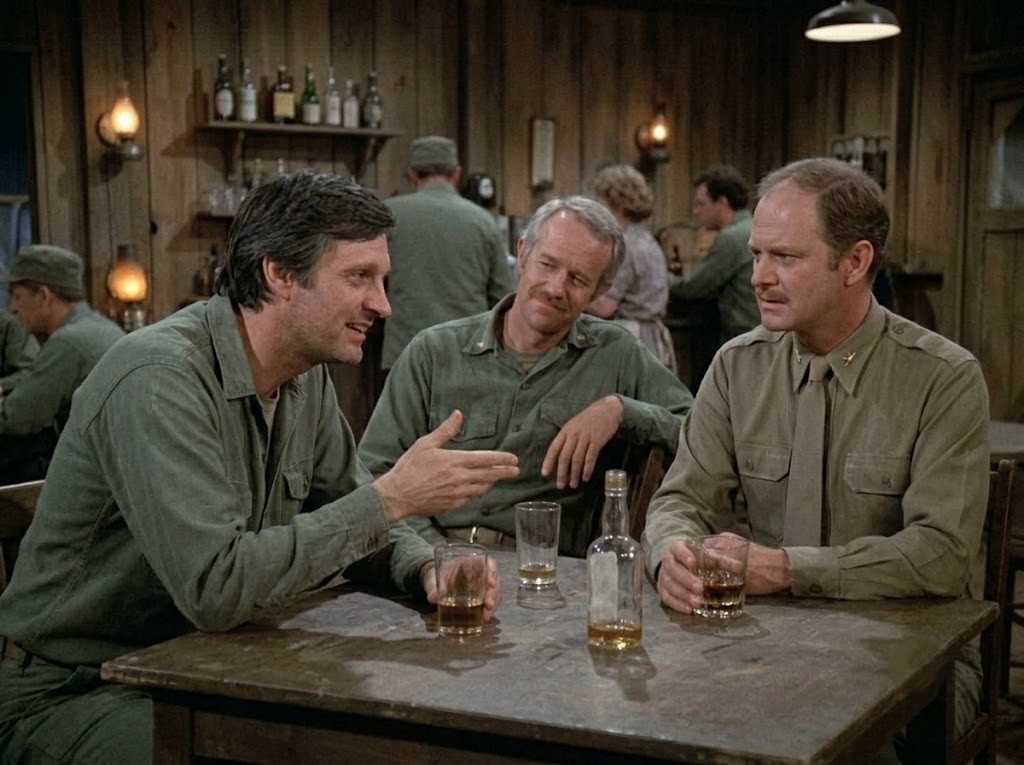
The Swamp can be too small on days when the operating room is too big.
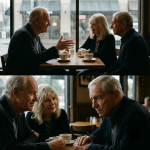
When the brass-colored dust settles over the 4077th and the generator’s low hum is the only sound left in the camp, you find your feet moving toward the Officers’ Club.
It isn’t much—just rough-hewn wooden walls, a shelf of mismatched bottles, and a few tables that have seen too many spilled drinks and tired elbows. But tonight, it’s the only sanctuary that makes sense.
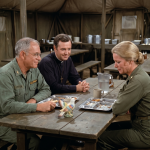
Hawkeye sat at the corner table, his olive-drab shirt unbuttoned at the collar, lean frame slouched but his hands moving with an restless, nervous energy.
Across from him sat Charles Emerson Winchester III, looking remarkably intact despite eighteen straight hours of stitching together broken boys, his tie still knotted, though his shoulders carried a heavy, uncharacteristic sag.
Between them, B.J. Hunnicutt leaned against the back of his chair, a quiet, knowing smile resting under his mustache, his eyes moving between his two tentmates like a man watching a delicate, familiar play.
“The thing about a proper New England winter, Charles,” Hawkeye said, his voice a low, gravelly rasp as he gestured with an open palm toward the half-empty bottle between them, “is that it has the decency to freeze your misery solid. Here, the mud just keeps oozing into your socks, your thoughts, and your morning coffee.”
Charles looked down at his glass, amber liquid catching the dim overhead light, his expression a mask of aristocratic weariness. “Pierce, your obsession with meteorological self-pity is as exhausting as it is uninspired. Back in Boston, winter is an elegant affair of crisp air and crackling hearths, not… whatever damp purgatory we currently inhabit.”
Hawkeye leaned forward, his face sharpening, the humor in his eyes giving way to something deeper, raw and unprotected. “Then let’s talk about something else. Let’s talk about the kid from Ohio on table three who spent twenty minutes asking me if the corn was knee-high back home yet because he couldn’t remember.”
The air at the table shifted instantly, the playful banter evaporating into the dark wooden beams above them.
B.J. stopped swirling his drink, his gaze dropping to the scarred table as the memory of the afternoon’s casualties rushed back into the room, uninvited and heavy.
Hawkeye reached out, his fingers nearly touching Charles’s glass, his voice losing its edge and turning into a quiet, desperate plea for distraction. “Give us a story, Charles. A real one. Tell us about a place where nobody wears green and the only bleeding is done by a steak on a silver platter. I need to hear it. Right now.”
Charles tightened his grip on his glass, his jaw clenching as he stared into the amber whiskey, his usual sharp retort dying on his lips.
For a long, agonizing moment, the prideful Bostonian looked completely hollowed out, his eyes mirroring the exact same fracture Hawkeye was trying so hard to hide.
Charles took a slow, deliberate breath, the silence stretching between the three men until the distant clatter of a tin tray in the mess tent broke the spell.
“Beacon Hill,” Charles began, his voice dropping an octave, losing its theatrical, defensive boom and settling into a soft, melodic cadence. “In December, the snow covers the cobblestones like a thick, expensive linen. If you stand near the common, you can smell roasted chestnuts from the vendors, and the frost on the gas lamps makes the entire street look as though it’s been dipped in sugar.”
Hawkeye didn’t interrupt; he just leaned his chin on his hand, his eyes fixed on Charles, drinking in the words like water after a long march.
B.J. smiled softly, his eyes looking past the wooden walls of the club, imagining his own home, his own wife and daughter, transposed onto the beautiful, cold picture Charles was painting.
“My mother,” Charles continued, a faint, genuine warmth softening the rigid lines of his face, “would insist on keeping the grand piano in the parlor tuned precisely for the holiday season. She played Chopin. Not very well, mind you—she always fumbled the transition in the Nocturne in E-flat—but she played with an earnestness that made the flaws entirely endearing.”
Hawkeye let out a soft, breathy laugh, the tension leaving his shoulders. “A Winchester who fumbles? Charles, I thought your lineage was immaculate.”
“In art, Pierce, as in life, perfection is the domain of the uninteresting,” Charles replied smoothly, though there was no malice in it, only a shared, quiet understanding. “But when she played, the heat from the fireplace would carry the scent of pine through the entire house. For an hour or two, the rest of the world simply ceased to exist.”
The three of them sat quietly for a minute, letting the image of a warm Boston parlor rest over their small, battered table in Korea.
It didn’t erase the mud outside, and it didn’t change the fact that the sirens would eventually wail again, but for a few precious moments, the war was pushed back into the shadows.
B.J. raised his glass, his eyes bright with a mixture of melancholy and gratitude. “To Chopin,” he said softly. “And to mothers who play the wrong notes for the right reasons.”
Hawkeye raised his glass to meet B.J.’s, then looked at Charles, his expression filled with a quiet, profound respect that rarely made an appearance in their daily bickering. “To Boston, Charles. Thanks for the rent-free trip.”
Charles looked at his two companions, the defensive walls he spent so much energy building around himself lowering just enough to let the kinship in. He raised his own glass, the amber liquid catching the light one last time before they all drank.
“You are entirely welcome, Pierce,” Charles murmured, setting his glass down with a gentle click. “Though I expect you to pay your passage by keeping your feet off my footlocker tomorrow.”
Hawkeye smiled, a real, tired, beautiful smile, and leaned back in his chair, the warmth of the whiskey and the comfort of his brothers-in-arms enough to keep the cold night at bay.
In the middle of nowhere, surrounded by green uniforms and endless gray skies, they had found a way to look home in the face, together.
Pull up a chair, pour a drink, and remember that even in the darkest corners of the world, friendship is the one thing that never wears out.