The Great Blanket Crisis
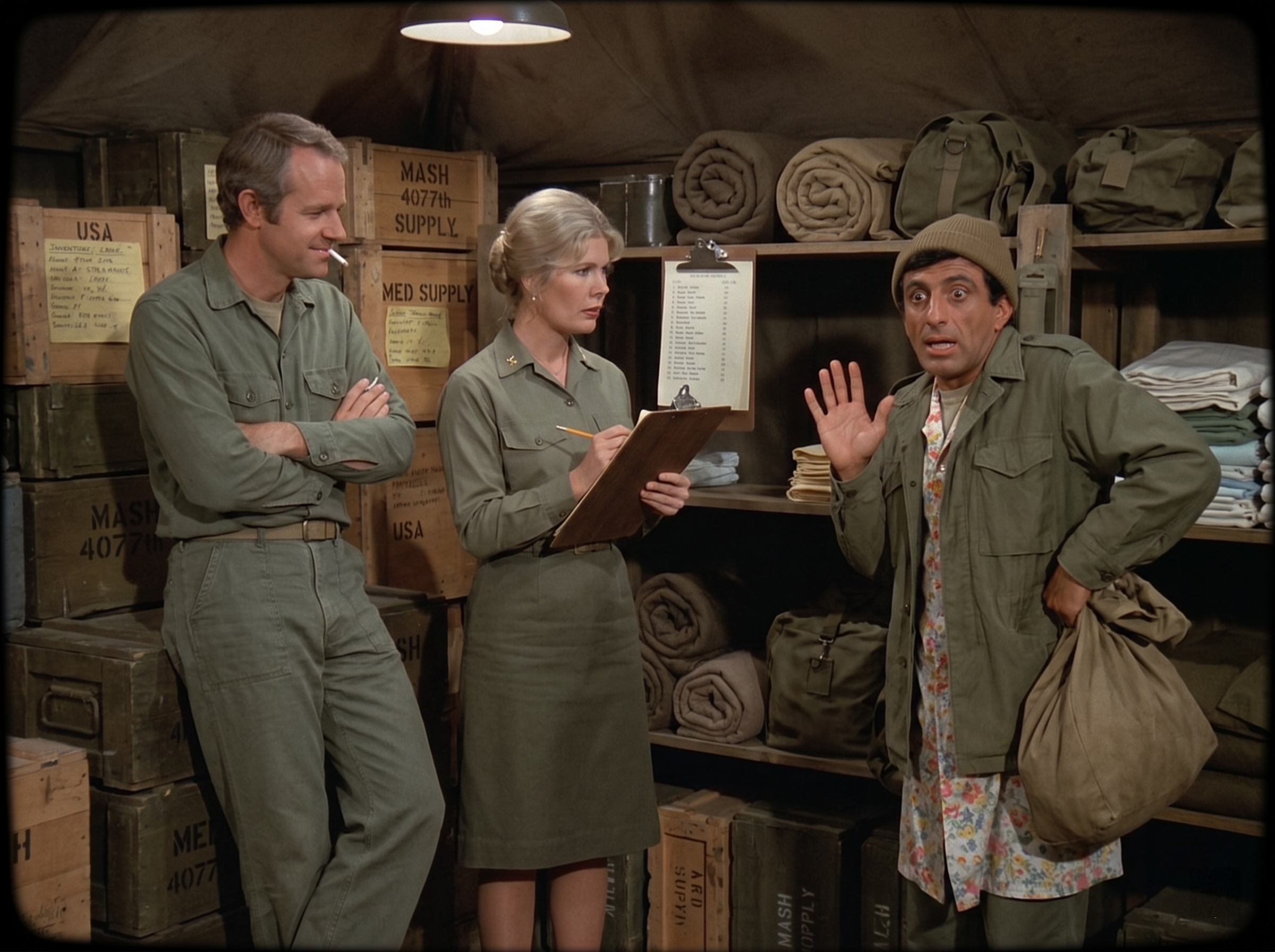
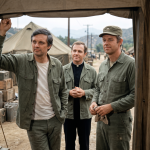
If there’s one place more stressful than the OR at the 4077th, it might just be the supply tent when a “re-count” has been ordered. The image I want to share today, h6_clean.jpg, shows exactly that kind of moment—a single overhead bulb cutting through the dusty dimness of the storage area.
Major Margaret Houlihan stood in the center, looking every inch the head nurse. Her posture was ramrod straight, and her eyes held a serious, focused edge as they moved from the clipboard in her hand to the shelves behind her. The inventory was more than a list to her; it was the order that held their chaotic little world together.
Next to her, leaning casually against a stack of crates marked “MED SUPPLY,” was Captain B.J. Hunnicutt. He had that warm, slightly amused smile playing on his lips, arms crossed over his chest, cigarette dangling. B.J. always seemed to provide the calm, observant counterpoint to Margaret’s intensity, finding the humor in even the dreariest tasks.
And then there was Klinger. He wasn’t in his usual silk-and-sequins finery today, just his fatigues, the iconic brown beanie, and a glimpse of an unusual floral shirt beneath his jacket. His right hand was raised, palm open, standard “Klinger-pleading-innocence” posture.
But it was his left hand that drew all the attention. It gripped a heavy canvas bag, suspiciously stuffed and slung low. The bags on the shelves behind him were tidy and rolled; this one looked rushed.
Klinger’s face was a masterpiece of manufactured panic.
“Major,” Klinger said, his voice a theatrical blend of desperation and innocence. “I swear on my Aunt Louise’s prized pickled peppers, this bag contains nothing but… highly sensitive, personally significant, non-regulation laundry!”
Margaret fixed him with a stare. “You know, Klinger, the sheer creativity of your stories almost makes me believe you. Almost.”
She tapped her pencil against the clipboard. “But when twelve olive-drab blankets go missing from this tent during the cold snap, and I find *you* here at 0200 hours, ‘sensitively’ laundering?”
B.J. chuckled softly, blowing a smoke ring. “Come on, Margaret. Maybe he’s just worried about the environmental impact of military detergent.”
“Captain, this is a serious logistical failure,” Margaret snapped, turning on him, though without her usual fury. “We are in Korea. Blankets mean survival. Not for trading.”
She turned her sharp gaze back to Klinger and his heavy sack. “What is *really* in that bag, Klinger? Tell me the truth, or you’ll be answering to Colonel Potter himself.”
Klinger’s eyes went wide. He looked at the major, then he looked at B.J. as if for support. Finally, he looked at his hand on the bag, and a flicker of *actual* hesitation, perhaps even shame, crossed his face. For a moment, his usual smooth defiance faltered.
“It’s not for trading, Major,” he said, his voice dropping to a low, sincere mutter. “I promise you that.”
But he still wouldn’t let go of the sack. The tension in the tiny, lamp-lit space was suddenly electric, far beyond a simple supply dispute, as everyone waited to see if Klinger’s ultimate bluff was about to finally be called.
PART 2 continues directly from that tense silence. Margaret held her pencil poised, the silence stretched thin by the hum of the single electric bulb and the distant sound of a jeep engine. B.J. watched them both, his amusement fading into quiet concern.
“Then open it, Corporal,” Margaret commanded, her voice steady but lacking its typical bark.
Klinger’s shoulder slumped. The fight went out of him all at once. He didn’t say a word. He just slowly lifted the bag and set it heavily on the wooden crate beside him.
With his right hand still raised in that “don’t shoot” gesture, he slowly untied the canvas knot with his left. B.J. leaned in slightly. Margaret braced herself.
When the top of the sack fell open, it wasn’t blankets they saw.
It was knitted caps.
Dozens of them. Crudely made, inconsistent, of various muted browns, greens, and even a single, startling pink one. They were packed tight, smelling of cheap, scratchy wool.
Margaret stared. “What in the name of…”
Klinger let his hand drop to his side, defeated. “They’re not 4077th supply. They’re for the kids. At the orphanage in Uijongbu.”
The silence returned, but this time it was different. It wasn’t tense; it was heavy with understanding. B.J. moved from his lean and stepped closer, looking at the clumsy knitted things with a gentle smile.
“Where did you get these, Klinger?” B.J. asked, his voice soft.
Klinger picked up the pink cap, turning it in his rough hands. “A couple of the guys from the motor pool and I… we started knitting. We trades some cigarettes to the local market for the wool. Father Mulcahy, he was worried about the kids getting sick. This winter is brutal.”
Margaret looked from the sack to Klinger, the professional veneer completely cracked. Her eyes were warm, and her face held an expression of pure, disarmed respect. The major who valued regulations saw, in that moment, the human cost of the war and the unexpected heart of the camp.
“Why didn’t you just tell us, Klinger?” she asked gently. “You could have requested a run.”
“It’s not army issue, Major,” Klinger said, shrugging, trying to regain some of his sass but failing. “Plus, the guys were worried about getting teased, you know? Soldiers with knitting needles.”
“And the missing 12 blankets?” Margaret prompted, though she already knew.
Klinger shuffled his feet. “They are at the orphanage, Major. A temporary loan. Until the hats were ready. I was just swapping them out.”
Margaret let out a long, quiet exhale. She looked at her clipboard and, for the first time in documented history, drew a straight line through an entire row of numbers.
“The missing blankets were lost in a paperwork error, Captain,” she stated, looking at B.J.
“An unfortunate, yet completely understandable error,” B.J. agreed, grinning. “I’ll make a note in the ledger.”
Margaret turned back to Klinger. “Corporal, this is still a serious logistical matter. You are out of uniform, and you are in a secure supply area after hours.”
Klinger stood a little straighter, preparing his defense.
“However,” Margaret continued, her tone crisp again, “since your unauthorized transportation unit—the canvas sack—seems robust, I believe you are the most efficient person to personally ensure this ‘personal laundry’ reaches its correct destination. Tonight.”
Klinger’s eyes nearly popped out of his head. A huge, genuinely joyful smile split his face. “Yes, Major! Absolutely, Major!”
He grabbed the heavy bag again, his floral shirt peeking out, his beanie askew, and nodded vigorously at them both. B.J. just smiled and took a final drag from his cigarette. The warmth that filled the dusty supply tent had nothing to do with the lamp.
In a place where everything was rationed, Klinger always managed to find a supply of human heart.