The Boston Suit in the Mud: A Tribute Story
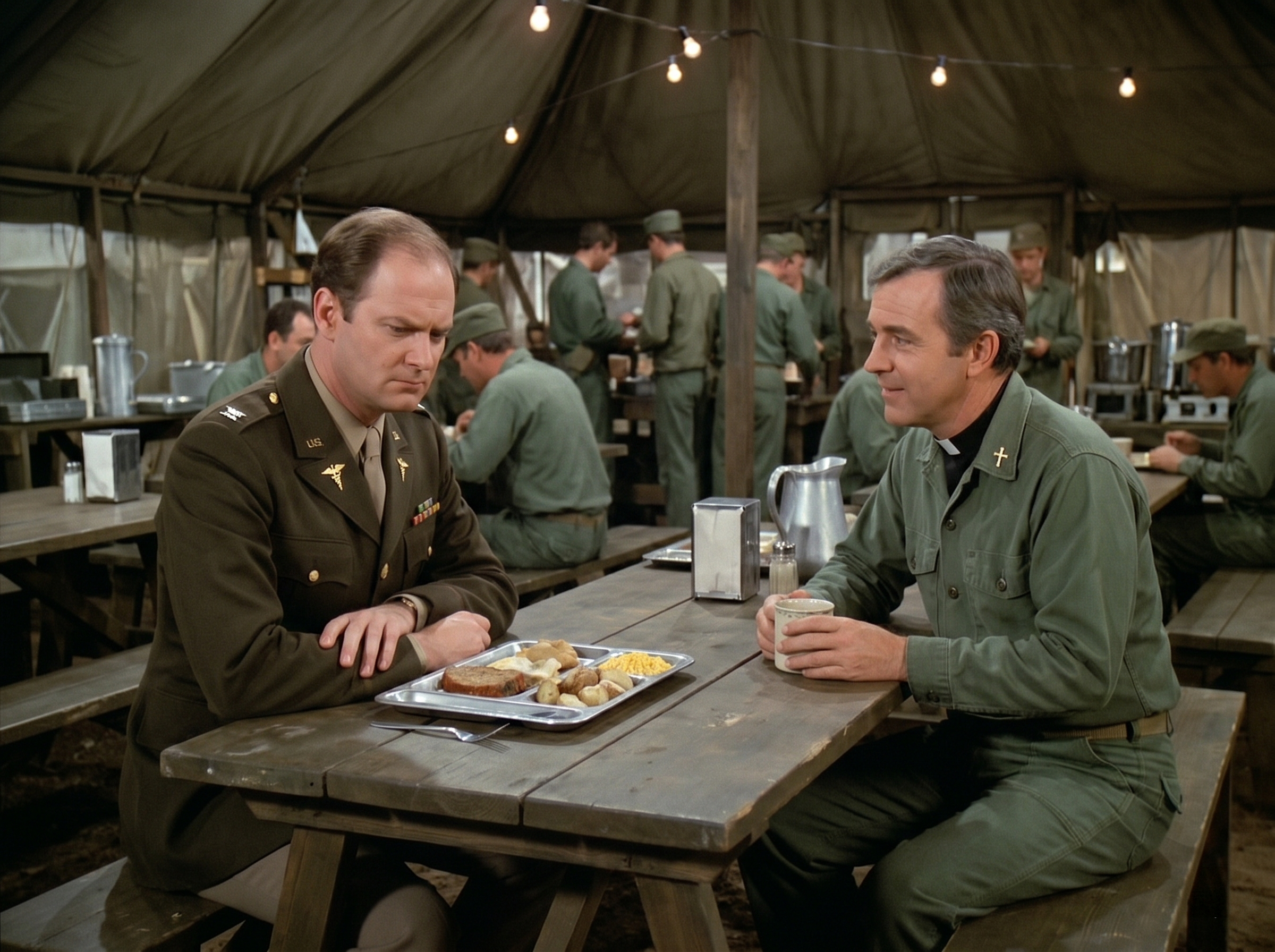
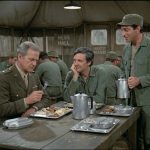
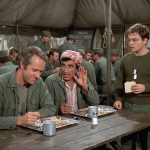
The mess tent at the 4077th was never, ever confused with the fine dining establishments of Boston. Still, there was one guest at the communal table who clearly had different expectations. In a sea of rumpled olive drab and mud-splattered fatigues, Charles Emerson Winchester III sat in his crisp, full dress blue uniform, complete with medals and the sharpest crease in the Korean peninsula. Every enlisted man walking past him on his way to the steaming slop barrels gave him a second, sometimes third, look, before hurriedly turning away. They were used to Major Winchester making a scene, complaining about the standard issue, and demanding refinement, usually from the comfort of his silk bathrobe. But this… this was a statement. This was Charles, declaring that even here, especially here, standards must be maintained, no matter how absurd.
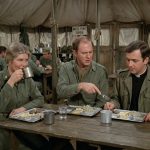
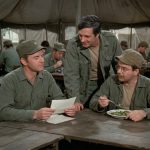
Across from him, Father Mulcahy, in his usual, lived-in fatigues, could feel a mild headache forming behind his eyes. He watched Charles looking down at his metal food tray with an expression that could best be described as profound moral injury. It was an expression usually reserved for seeing a patient in the O.R. who had been improperly sutured by an intern, but today, it was directed at the dinner special: two unrecognizable golden, somewhat cylindrical pucks, a pale yellow scoop of something that might once have been corn, and a singular, sad potato. Behind them, the background was alive with the casual bustle of tired men grabbing sustenance. Charles, meanwhile, seemed trapped in a localized bubble of aristocratic disdain. He had spent the previous evening at ‘The Swamp,’ delivering a moving (to himself) lecture about an ancestor who, while serving in the Continental Army, had refused to eat anything but locally sourced venison served on china. He had insisted he would respect the *spirit* of the tradition, even in Korea. The results, however, were on his tray.
Father Mulcahy, patient and practiced in mediating between the worldly and the profane, waited for the inevitable explosion. He held his coffee mug tightly, his own simple expression a mix of strain and quiet compassion. He knew that the uniform was less about vanity and more about maintaining a crumbling sense of identity. “Charles, my son,” Mulcahy said, his voice a soothing counterpoint to the distant rattle of trucks outside. “It is… *interesting*… that you chose to wear your, ah, formal attire today. I was under the impression it was for the, um, hypothetical inspection that never materializes.” Charles did not lift his gaze from the metal tray. He spoke through gritted teeth, each word a crisp, targeted missile. “I am upholding a tradition, Padre. The Winchesters, for centuries, have understood that the measure of a man is the dignity with which he faces adversity. I am facing my meal with appropriate… sartorial defiance.” He paused, and then added with a devastating sigh, “Though I must admit, I had envisioned something more like a crisp potato galette and less like… this offensive potato nodule.”
His fingers clutched his fork as if it were the last weapon in his arsenal against a cruel universe. He finally looked up at Mulcahy, and the sheer, defeated vulnerability in his eyes momentarily cracked the facade of haughty indifference. “Father, this entire exercise was to remember home. To feel, for a moment, that I am still *me*. The Single Sad Potato seems to be the very embodiment of how utterly impossible that feeling is.” He didn’t eat. He simply stared, the entire, vibrant mess tent seemingly holding its breath as Major Winchester wrestled with a solitary root vegetable.
The silence between them stretched, thicker than the gravy on some bad nights. Charles’s knuckle whitened on the fork handle. Mulcahy, seeing the internal struggle, knew he couldn’t let the moment sit unresolved. The priest leaned forward, his gentle eyes locking onto Charles’s troubled gaze.
“Charles,” Mulcahy said softly, a small smile appearing at the corner of his mouth. “That potato… it may not be a galette from Boston. But it is here. It is real. It has survived the soil of Korea, the heat of that oven, and the indignity of this metal tray. Just like all of us in this tent, it is doing its best in an environment that is not of its choosing. We are all survivors, Charles. Sometimes the dignity isn’t in what you eat, but in simply showing up to the table.”
Charles’s sarcastic veneer softened just a fraction. “Show up? Yes. But one must show up in character, Padre. My family did not send a single, sorry soldier; they sent a Winchester. This suit, however ridiculous it may seem to Captain Pierce, is my armor.”
Just as Mulcahy was preparing another gentle rejoinder, Hawkeye Pierce swept past them with a tray, having grabbed his own food in a rush. He paused right behind Charles’s chair, leaning slightly. “Major!” he chirped, “If I didn’t know any better, I’d say you were about to lead an orchestra in a particularly moving rendition of ‘General MacArthur’s Greatest Hits.’ Though I doubt even they could make that food sing.” Before Charles could deliver a biting retort, B.J. Hunnicutt, following behind Hawkeye, quickly slipped a perfectly wrapped, non-standard-issue piece of gum—one of the precious few from Peg—onto Charles’s tray. He winked at Charles and kept walking. “Keep the tradition alive, Major. Even if the potato needs a side of Bazooka.”
The small interaction was a jolt. Charles watched them leave, his expression shifting from offense to an unusual, quiet contemplation. The humor from Hawkeye had landed, but the small, tangible gesture from B.J. had a different weight. He looked at the gum, then at Mulcahy, and finally back at the single sad potato.
A slow, wry smile touched Charles’s lips. It wasn’t his usual sneer; it was closer to a genuine acceptance of circumstances. He took his fork and, with the practiced, meticulous grace of a surgeon, sliced the sad potato into perfect, uniform halves. He took a bite of the scoop of corn, finding it surprisingly tolerable when combined with the idea that some dignity truly *was* just about showing up. “Very well, Father,” Charles declared, with a sudden return of his characteristic, commanding tone. “I shall have my galette. Though I suppose I will have to imagine the chives.”
Father Mulcahy laughed, a quiet, relieved chuckle. He raised his coffee mug. “To the galette, Major Winchester. And to the strength to find a little bit of home, wherever we are.” Charles raised his own imaginary wine glass (his empty metal mug). “To finding sanity, Father. And to colleagues who understand that a good tailor is essential for fighting a war.”
He didn’t finish the entire tray—the mysterious gold pucks remained a bridge too far—but he ate the potato and some of the corn, and even shared a piece of the precious gum with Mulcahy afterwards. The light inside the tent began to fade as the afternoon wore on. Outside, the sounds of the camp resumed their steady hum, the trucks rolling, and the muddy reality of the 4077th asserted itself. Charles Emerson Winchester III sat in his dress blues, having eaten an imperfect meal with imperfect people. He was not in Boston. He was in Korea, in a tent full of soldiers and a gentle priest. It wasn’t the life he planned, and it certainly wasn’t the life he deserved, but for a few minutes, surrounded by found family, it had felt a little less impossible. The smell of burnt toast still filled the air, and the mud was just as deep, but for a moment, the distance to the Charles River had felt a little shorter.
The mud might never wash out, but the warmth of a shared meal and a brief connection made it a little lighter to carry.