The Arithmetic of a Meatball
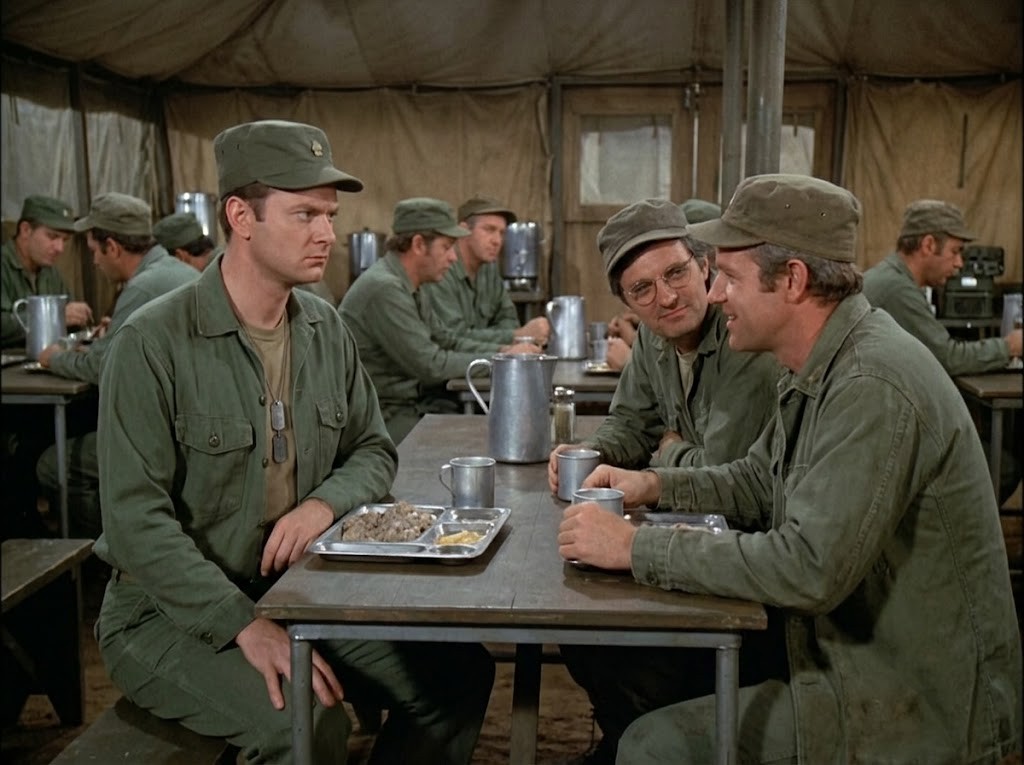
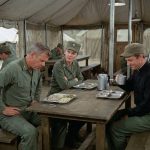
The grease on an aluminum tray has a way of reflecting the tent canvas, turning everything the color of a rainy Tuesday in Iowa.
After thirty-six hours straight in the operating theater, your eyes don’t adjust to the light so much as they surrender to it. The mess tent always smelled of old onions, boiled cabbage, and the specific brand of desperation that only an army cook can manufacture out of thin air.
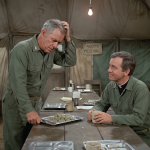
Hawkeye Pierce stared down at his tray with the intense, localized concentration of a jeweler examining a flawed diamond.
“I’ve done the math, Beej,” Hawkeye said, his voice carrying that familiar, gravelly edge born of too many unfiltered cigarettes and too little sleep. “There are exactly four distinct geological strata in this meatball. I believe the third layer is an old army boot from the Spanish-American War.”
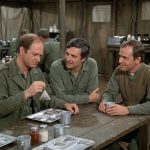
B.J. Hunnicutt looked up, a slow, tired smile tugging at the corners of his mustache. His cap was pushed back just an inch, his shoulders slumped with the heavy, dead-weight exhaustion that always followed a major push.
“You’re being ungrateful, Hawk,” B.J. remarked, gesturing with a dull aluminum spoon. “Private Igor poured his heart and soul into that vintage footwear. It’s a family recipe.”
Across the narrow wooden table sat Major Charles Emerson Winchester III. Even in a faded olive-drab utility shirt, with his dog tags hanging over his chest like a penance, Winchester managed to look as though he were presiding over a high court assembly rather than a makeshift soup kitchen in the middle of a Korean mudflat.
Charles was looking at Hawkeye, his expression a masterpiece of aristocratic disdain mingled with something deeper—a profound, non-negotiable irritation that had been simmering since three o’clock yesterday morning.
“Pierce,” Charles said, his Boston accent cutting through the low hum of the mess tent like a blunt butter knife. “The mere fact that you possess the lung capacity to complain after the marathon we have just endured is an affront to human endurance. Eat your anonymous protein, or throw it at the wall, but do it in absolute silence.”
Hawkeye didn’t blink. He leaned forward, resting his forearms on the table, his eyes locked onto Charles with a sudden, mischievous intensity that signaled danger to anyone who knew the 4077th.
“Silence, Charles? In the face of culinary tyranny?” Hawkeye countered, his voice dropping an octave. “No, no. I owe it to the folks back home. I owe it to the cow that gave its life so that its less desirable parts could be pressed into a sphere of pure sorrow.”
He slid his tray exactly three inches toward the center of the table.
“I’ll tell you what,” Hawkeye said softly, a dangerous glint in his eye. “I will give you my dessert—which appears to be a cup of yellow translucent spackle—if you can look me in the eye and tell me you don’t miss the sound of a real porcelain plate breaking on a hardwood floor.”
Charles froze, his hand tightening around his metal mug. The casual bickering of the mess hall suddenly felt very thin, stretched over a hollow space that none of them wanted to look into.
B.J. watched the two of them, the humor fading from his eyes, replaced by that steady, quiet vigilance that kept the tent from collapsing when the wind blew too hard from the north.
“Drop it, Hawk,” B.J. said quietly, his voice lacking its usual playful bounce. “Don’t start a war over a side dish. We’ve already got one outside.”
But Charles didn’t explode. He sat perfectly still, staring at the small, sad mound of gravy on Hawkeye’s tray. The arrogant posture didn’t change, but his jaw tightened until the bone showed white against his skin.
For a long moment, the only sound was the distant clink of a ladle against a pot at the serving line, and the low, murmuring drone of the enlisted men two tables over, talking about a baseball game that had been played three years ago in Ohio.
“A hardwood floor,” Charles repeated, his voice dropping its theatrical volume, turning strangely small. “In the dining room on Beacon Street, Pierce, the floor is quartersawn oak. It has a grain that resembles the ripples on a pond at dusk.”
Hawkeye’s sarcastic retort died somewhere behind his teeth. He looked at Charles, really looked at him, seeing the dark purple shadows under the man’s eyes and the slight tremor in his hand as he held his coffee.
“My mother,” Charles continued, his eyes fixed on a scratch in the wooden table, “had a set of Limoges porcelain. White, with a very delicate gold rim. If you dropped one… it didn’t sound like these miserable tin cans. It sounded like a bell.”
The silence that followed wasn’t the angry kind. It was the heavy, shared silence of three men who had spent twenty-four hours looking at things that shouldn’t happen to human beings, now trapped in a canvas room with nothing but their memories to keep the cold out.
B.J. reached out and picked up his metal cup, tapping it lightly against Charles’s mug. The clink was dull, flat, and entirely lacking in music.
“To the Limoges,” B.J. said softly.
Charles looked up, his defense mechanisms stumbling for a second before he recovered his dignity. He nodded once, a sharp, aristocratic gesture, and took a slow sip of his terrible army coffee as if it were a vintage port.
“To the gold rim,” Hawkeye added, his voice losing every trace of its edge. He picked up his fork and finally took a bite of the meatball, chewing with an expression of stoic martyrdom. “You know, Charles, if you look at it the right way, this gravy actually has a lovely oak finish.”
“Do not provoke me, Pierce,” Charles muttered, though the corner of his mouth twitched upward by a fraction of a millimeter. “I am currently too exhausted to properly despise you.”
“Take your time, Charles,” Hawkeye smiled, leaning back on the bench, his eyes growing heavy as the warmth of the tent finally began to work its way into his bones. “We’re not going anywhere.”
Outside, the rain began to patter against the canvas roof, a steady, rhythmic sound that washed over the camp, burying the war beneath a few inches of quiet gray water.
Sometimes the best medicine they had wasn’t in the pharmacy, but in the quiet understanding shared across a grease-stained table.