Under the Sputtering Sun
It had been fourteen hours since the choppers first broke the morning silence, and the operating room of the 4077th felt like the inside of a canvas oven. The air was thick with the sharp scent of iodine, the metallic tang of copper, and the heavy, humid breath of exhausted people. Outside, the Korean summer was relentless. Inside, it was somehow worse.
At table three, Captain Benjamin Franklin Pierce was running on nothing but stale coffee and pure, stubborn adrenaline. His green scrubs were hidden beneath a damp, blood-stained surgical gown. His shoulders ached with a deep, grinding pain that he had stopped noticing sometime around noon.
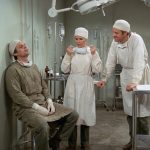
Across the table stood Major Margaret Houlihan. She was perfectly composed, her blue eyes sharp and focused above her surgical mask. Even in the sweltering heat, she moved with a crisp, practiced efficiency. She was handing him instruments before he even realized he needed them.
The rhythm of the OR was a familiar, grim dance. The snap of rubber gloves, the clatter of steel dropped into enamel basins, the low murmur of B.J. Hunnicutt telling a terrible joke at the next table to keep himself awake. It was the soundtrack of their strange, isolated little world.
Hawkeye was bent over a nineteen-year-old kid from somewhere in Ohio, navigating a delicate maze of damaged tissue. He was holding his breath, his hands steady despite the bone-deep fatigue rattling his frame. He just needed three more minutes. Three minutes of steady hands and bright light.
Then, the noise began.
It started as a low, vibrating hum, distinct from the usual background rumble of the camp. It sounded like an angry hornet trapped inside a tin can.
Hawkeye froze. He didn’t move his hands, but his head snapped back, his eyes widening as he looked straight up. Suspended directly above them, the massive metal dome of the surgical lamp was trembling.
“Tell me that’s just Charles practicing his French horn,” Hawkeye muttered, his eyes glued to the flickering bulb.
Margaret paused, her gloved hands hovering over the instrument tray. She followed his gaze upward. “It’s the generator, Doctor,” she said, her voice tight. “It’s been missing a beat all afternoon.”
“Well, it can’t miss one now,” Hawkeye said, his voice rising in pitch. He stared at the giant lamp, offering up a silent, desperate prayer to the patron saint of internal combustion. “Come on, Betsy. Don’t quit on me. I’ve got a kid here who really wants to see his mom again.”
The bulb hissed, a sharp, electrical crackle that made the hair on the back of Hawkeye’s neck stand up. The brilliant white light above the table dimmed to a sickly, jaundiced yellow.
“Clamp,” Hawkeye said quickly, urgency edging into his tone. He lowered his eyes back to the patient. “Margaret, give me a clamp, right now, before we—”
He never finished the sentence.
The surgical lamp gave one final, violent pop. The bulb shattered behind its glass shield, and the sputtering hum of the camp generator outside died with a pathetic groan. In an instant, the canvas tent was plunged into absolute, suffocating darkness.
“Nobody move!” Colonel Potter’s voice rang out from across the room, carrying the weight of decades of command. “Stay exactly where you are! Keep your hands in the field!”
The darkness was total. It was a heavy, disorienting blackness that erased the entire room. The only things left were the sounds: the ragged breathing of the surgical staff, the rhythmic squeak of a hand-pumped respirator, and the distant, muffled thump of artillery rolling over the hills.
Hawkeye stood frozen. His fingers were deep inside the young soldier’s abdomen, pinching a torn vessel. He could feel the slick warmth of the boy’s life beneath his gloves, beating against his fingertips. But he couldn’t see a single thing.
A cold spike of genuine terror hit his chest. This wasn’t a joke. This wasn’t a drill.
“Well,” Hawkeye said, his voice echoing loudly in the blind tent. “I always knew the army would keep me in the dark, but this is ridiculous. Who forgot to feed the hamsters on the wheel?”
“Pierce, save the comedy routine,” Potter barked from the black void. “Houlihan, can you see anything?”
“Negative, Colonel,” Margaret’s voice came back. It was steady, professional, and right across the table from Hawkeye. “It’s pitch black. We are mid-ligature on a femoral artery.”
“I’m holding the fort, Colonel,” Hawkeye said, his forced cheerfulness masking the tremor in his hands. “But my fingers are getting awful lonely down here. If this kid sneezes, we’re going to have a very messy situation.”
He took a slow, shaky breath. The darkness was playing tricks on him. He felt like the canvas walls were closing in, squeezing the oxygen out of the room. He needed to tie off the vessel, but doing it blind was impossible. One wrong move in the dark, one slip of the fingers, and the boy on the table would bleed out before the lights ever came back.
“Hawkeye.”
It was Margaret. Her voice was barely a whisper, meant only for him. It had dropped the military crispness, leaving only a quiet, urgent warmth.
“I’m here, Margaret,” he whispered back.
“Don’t move your left hand,” she said.
A second later, he felt her. Through the thick, bloody rubber of their gloves, Margaret’s fingers found his in the dark. She didn’t fumble. She didn’t hesitate. She traced the line of his wrist, moved down to his knuckles, and gently, firmly, covered his hand with her own.
“I have the clamp,” she whispered softly. “I’m sliding it down your index finger.”
Hawkeye exhaled, a breath he didn’t know he was holding. “You sure you want to hold hands on the first date, Major? People will talk.”
“Shut up and feel for the groove, Doctor,” she murmured, but there was no bite in her words. Only an intense, grounding solidarity.
In the pitch black of the operating room, surrounded by the chaos of a forgotten war, they performed an impossible dance. Relying entirely on touch, memory, and a profound, unspoken trust, Margaret guided the steel instrument down Hawkeye’s hand. He felt the cold metal press against his skin, felt her fingers apply the pressure, and together, they locked the clamp into place.
“Got it,” Hawkeye breathed out. He slumped forward slightly, the tension leaving his shoulders. “Vessel is secure. Thank you, Margaret.”
“You’re welcome, Hawkeye,” she replied quietly. Her hand lingered over his for just a fraction of a second longer than medically necessary, a silent communication of relief, before she pulled away.
Outside the tent, the chaotic sounds of the 4077th erupted. Somebody was yelling about spark plugs, and the unmistakable, frantic voice of Corporal Klinger was threatening the generator with physical violence.
“Give it a kick, son!” Potter yelled toward the doors.
A loud metallic clatter echoed from the compound, followed by a cough, a sputter, and a roaring, triumphant mechanical rumble.
The surgical lamps flared back to life, blindingly brilliant.
Hawkeye squinted, throwing an arm up to shield his eyes from the sudden glare. As his vision cleared, the chaotic canvas room came back into focus. The bloody gowns, the green walls, the exhausted faces of his friends.
He looked down. The clamp was perfectly placed. The boy was stable.
Hawkeye slowly raised his head and looked across the table. Margaret was already reaching for the surgical silk, her face a mask of total professionalism. But as she caught his eye, the corners of her eyes crinkled. It was the smallest, most invisible smile, hidden entirely behind her white mask.
Hawkeye let out a long, tired breath and offered a tiny nod of gratitude. He adjusted his stance, wiggled his aching fingers, and looked back down at the sleeping soldier.
“Alright, folks,” Hawkeye said, his voice dry and steady once again. “Let’s close this kid up before the electric company realizes we haven’t paid the bill.”
The snap of rubber gloves resumed. The clatter of steel returned. The war waited for them just outside the canvas doors, but for now, they had exactly enough light to see each other through.
Some families are born of blood, but the best ones are forged in the shadows of a canvas tent, sharing the weight of a heavy world.