The Toledo Housewife and the Boston Brahmin
The dust of the 4077th settled on absolutely everything, but it never quite managed to dull the vibrant, desperate madness of Corporal Maxwell Klinger.
It was mid-afternoon, during one of those rare, heavy lulls where the distant rumble of artillery faded into the background, leaving the camp to bake in the Korean sun. The air was thick, smelling of canvas, diesel, and stale coffee. Major Charles Emerson Winchester III had stepped outside the Swamp, desperately seeking a solitary moment to breathe air that didn’t smell like Hawkeye Pierce’s distilled socks. He stood rigid, his green fatigues perfectly arranged, his olive scarf tied at his neck with the precision of a Beacon Hill cravat. He closed his eyes, attempting to summon the opening chords of a Mozart concerto in his mind.
Instead, he was greeted by the loud, theatrical crunch of combat boots marching deliberately toward him.
Winchester opened his eyes and sighed, a long, weary exhalation that seemed to carry the weight of his entire draft notice. Standing before him on the dusty path was Klinger.
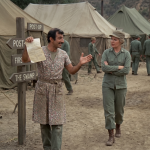
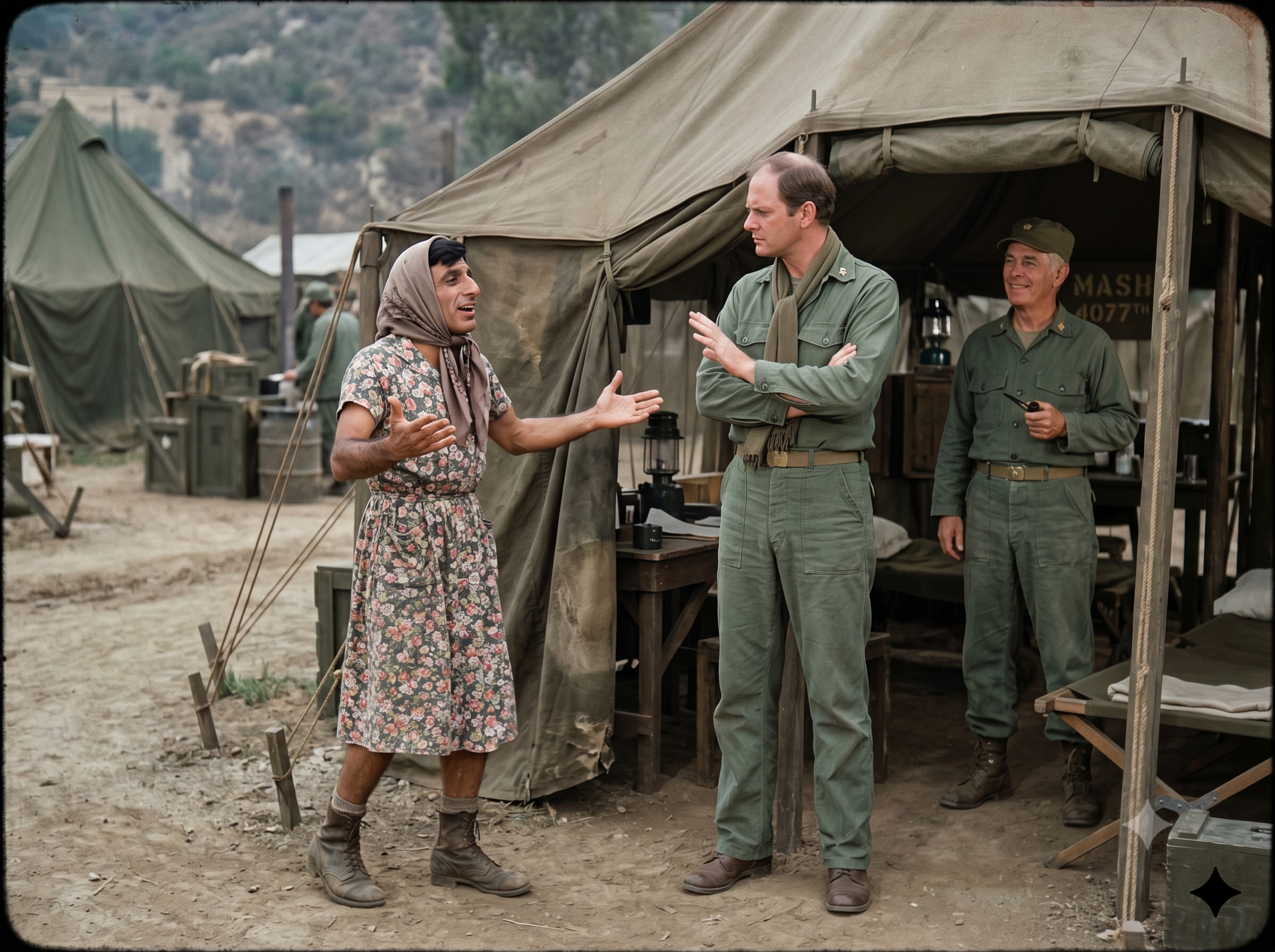
The Corporal had outdone himself today. He was not dressed as a glamorous starlet or a whimsical mythological figure. Instead, he stood in the blinding daylight wearing a modest, faded floral house dress, the kind favored by grandmothers sweeping front porches in the old country. Over his hair, a brown headscarf was tied tightly beneath his chin, framing a face twisted into a mask of theatrical, profound suffering.
“Major!” Klinger wailed, throwing his hands wide open in a gesture of pure operatic tragedy. “I can go on no longer! The vapors of this wretched land have finally consumed me! I am but a fragile, simple peasant woman, wandering the steppes, lost to the ages!”
Winchester did not flinch. He simply crossed his arms over his chest, his posture becoming a fortress of utter, impenetrable disdain. He looked down his nose at the floral-clad Corporal, his eyes narrowing.
“Corporal,” Winchester said, his voice dripping with aristocratic ice. “You do not look like a peasant woman. You look like a remarkably ugly sofa that has somehow grown a mustache.”
Just inside the shadowed doorway of the adjacent tent, Colonel Sherman T. Potter leaned comfortably against the wooden frame. He held his unlit pipe in his right hand, his face relaxed into a wide, genuine grin. Potter rarely intervened when his people put on a floor show; he considered it essential for unit morale. He watched the clash of Toledo and Boston with dry, fatherly amusement, waiting to see who would crack first.
Klinger, refusing to break character, took a step closer, his hands still pleading with the sky. “You have no heart, Major! Look at me! Look at this delicate calico! It is practically disintegrating in this foul, dusty breeze. My constitution is ruined! A Section 8 is the only humane medical option left for this withered blossom!”
Winchester’s posture tightened. The tired lines around his eyes deepened. He had spent twelve hours the previous night up to his elbows in shattered limbs, and his tolerance for Klinger’s vaudeville routine was critically low.
He uncrossed his arms and took a single, sharp step forward, closing the distance between them. The air suddenly shifted. The comedic energy evaporated, replaced by a sudden, heavy tension. Winchester’s face was uncharacteristically hard, his gaze locking onto Klinger’s with a fierce, aristocratic intensity.
Klinger froze, his hands dropping slightly. The theatrical mask slipped for just a second, revealing a flicker of genuine uncertainty beneath the headscarf.
“Corporal,” Winchester began, his voice dropping an octave, losing its usual pompous theatricality and becoming dangerously quiet. “Do you truly believe that this pathetic, bargain-basement charade is going to mask what is actually wrong with you today?”
From the doorway, Potter’s smile faded just a fraction. His pipe hovered inches from his mouth. The afternoon heat suddenly felt suffocatingly real.
Silence hung over the dusty path, broken only by the lazy buzzing of a persistent fly.
Klinger lowered his hands completely, letting them fall to his sides. The Toledo street kid peeked through the floral print, his shoulders slumping just a fraction. He looked up at the tall, imposing surgeon.
“I don’t know what you mean, Major,” Klinger said. His voice was stripped of the high-pitched peasant act. It was just Max now, standing in a dress in the middle of a war zone, sounding incredibly tired.
Winchester maintained his rigid stance, but the harshness in his eyes began to soften. The defensive wall of his Boston pride cracked, just enough to let a sliver of reluctant, weary compassion shine through.
“Mail call was two hours ago,” Winchester said softly, his gaze remaining fixed on Klinger’s face. “I happened to be standing near the clerk’s desk. You received nothing. Again. For the third week in a row.”
Klinger swallowed hard. He looked down at the dusty toes of his combat boots poking out from beneath the flowery hem. He didn’t say a word, which, for Maxwell Klinger, was the loudest sound in the world.
Winchester slowly crossed his arms again, but this time, the gesture felt less like a barrier and more like an attempt to hold himself together. He looked at Klinger’s dress, his eyes tracking the cheap, faded floral pattern.
“That fabric,” Winchester murmured, his tone remarkably gentle. “It is an absolute atrocity of fashion, of course. But… it is also precisely the sort of pattern one might find in a modest, bustling kitchen back in the States. A kitchen smelling of… whatever heavily garlic-laden dishes your people consume. Stuffed grape leaves, I imagine?”
Klinger looked up, genuinely caught off guard by the accuracy of the aristocratic doctor. He blinked, a sudden, bright sheen of moisture appearing in his dark eyes.
“Yeah,” Klinger said, his voice barely above a whisper. “My Ma. She has curtains over the sink. Just like this pattern. Same faded pink flowers. When the afternoon sun hits ’em… the whole kitchen turns pink.” He gripped the fabric of the skirt in his tough, hairy hands. “I just… I found this in the village today. I just wanted to feel like I was standing in her kitchen for a minute, Major. That’s all.”
Winchester closed his eyes for a brief moment. Behind his eyelids, he wasn’t seeing the mud of Korea; he was seeing the mahogany dining room of his family’s estate, smelling the sharp, salty air of the Charles River. He opened his eyes, his expression carefully neutral but his voice carrying a profound, shared ache.
“I myself,” Winchester said, looking just past Klinger’s shoulder, “am suffering from an acute, agonizing deprivation of fresh Atlantic seafood and intelligent, civilized conversation. We are all starving here, Klinger. Some of us hunger for a ticket home. Some of us simply hunger for the symphony.”
Winchester looked back at Klinger, his aristocratic mask sliding back into place, though it fit a little more loosely than before. “Therefore, I am diagnosing you with a severe case of melancholia, brought on by the squalor of our surroundings. It is a temporary condition. And it certainly does not warrant a Section 8.”
Before Klinger could reply, Colonel Potter finally stepped out of the shadows of the tent doorway. He walked slowly out into the sunlight, tapping his pipe against the heel of his hand.
“The Major is right, son,” Potter said, his voice rich with gravelly, fatherly warmth. He looked at Klinger with a profound, quiet understanding. “That calico won’t get you a boat ride back to Toledo. The army doesn’t care if you dress like a peasant or a princess, as long as you can type the morning reports.”
Potter stepped up beside Winchester, putting a hand on his hip. He offered Klinger a small, reassuring smile.
“But,” Potter continued gently, “if wearing those curtains helps you smell your mother’s cooking for a few hours, then you have my official permission to wear it. This place takes enough from us. We have to hold onto whatever pieces of home we can carry. Even if they clash with our combat boots.”
Klinger stood up a little straighter. The deep sadness in his chest didn’t vanish, but it felt suddenly lighter, shared among the three of them. He reached up and adjusted the babushka, tying it with renewed dignity.
“Thank you, Colonel,” Klinger said earnestly. He then turned to the tall surgeon. “And Major… thank you for the… medical consultation.”
Winchester huffed, turning his head away to inspect a perfectly ordinary patch of dirt, his pride wounded by the simple act of being kind.
“Just see that you don’t wear it to the mess tent, Corporal,” Winchester muttered dismissively, waving a hand. “It is a culinary offense just to look at it. Now, if you will excuse me, I must return to the Swamp and pretend I am anywhere but here.”
Winchester turned on his heel and marched away, his posture rigid once more, though he walked slightly slower than usual. Potter chuckled softly, lighting his pipe and blowing a small cloud of sweet smoke into the Korean air. Klinger smiled, a real, genuine Toledo smile, and smoothed down the front of his floral dress. The dust continued to settle, but for just a moment, the front lines felt remarkably like home.
In a place built on blood and dirt, the strongest medicine they had was simply the grace to let each other be homesick out loud.