The Day Hawkeye Ran Out of Jokes in the Clerks’ Office
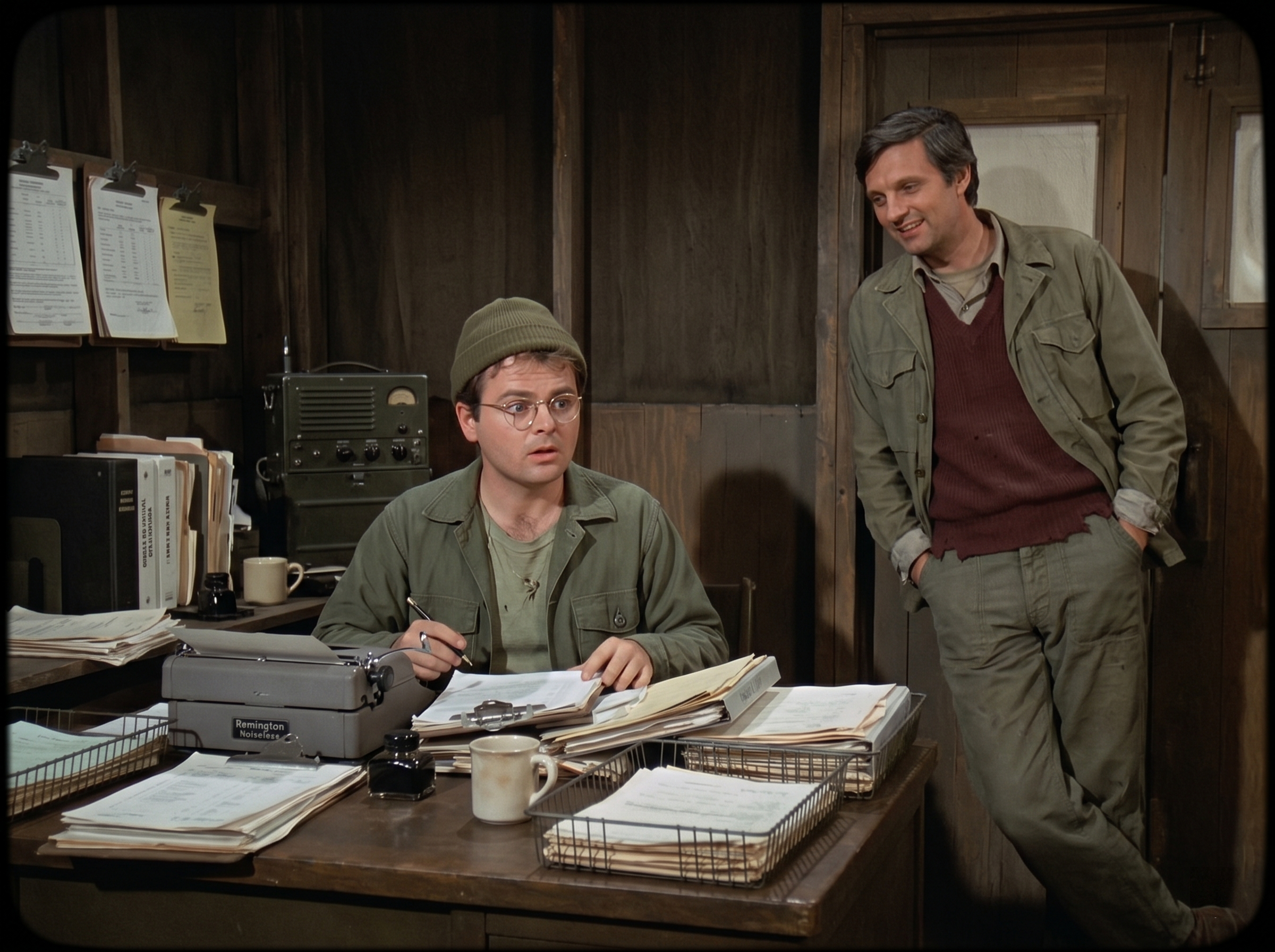
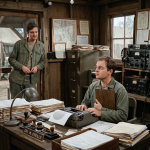
Radar looked stunned, his eyes wide and unblinking behind his spectacles. In his hand, a pencil poised over a fresh form on the clipboard, ready for the next supply request from I-Corps, but time seemed to have frozen in Colonel Potter’s outer office. His expression was a perfect portrait of quiet shock, his breath catching in his throat as if he’d just heard a distant explosion and was waiting for the dirt to fall.
Behind him, casually leaning against the rough wooden doorjamb, was Hawkeye Pierce. He had his hands jammed deep into his trouser pockets, and a smile on his face that was as familiar as the sound of incoming choppers. The red cardigan peeking out from under his olive fatigue jacket was his standard uniform of rebellion, a small flare of warmth in the grey-green gloom of the 4077th. He looked exactly like the Hawkeye who could find a punchline in a Foxhole or a surgery tent, the one whose wit could defuse a bomb or at least distract from the ticking. He’d just launched into his signature barrage of one-liners, ready to ease the tension after a brutal three-day push.
“So I say to the general, ‘I didn’t just operate on your driver, I practically built him a new engine. That’ll be seventy-nine fifty, and don’t give me any lip about the labor,'” Hawkeye had said, his voice a comforting buzz against the quiet, his face beaming.
But Radar wasn’t laughing. He wasn’t rolling his eyes. He was just looking up, stunned, at the captain who had just delivered the joke. The Remington noiseless typewriter sat in front of him, silent as a grave.
Radar’s eyes, magnified by his lenses, locked onto Hawkeye’s. The silence, initially funny to Hawkeye, began to grow teeth. It wasn’t the silence of confusion; it was the silence of recognition. The look on the young corporeal’s face was complex: part shock, yes, but mostly a profound, almost painful, *something else* that was quickly draining the humor from the room.
Hawkeye felt his smile slip. He knew that look. Radar saw things before they arrived. He could hear choppers nobody else could. He could see pain nobody else would acknowledge. He could see…
Hawkeye’s eyes darted past Radar to the bulletin board covered in carbon copies. The wall was cluttered, efficient, and achingly lonely, and right then, Hawkeye realized the punchline hadn’t just been delivered. It had just been felt.
Hawkeye’s bravado evaporated in that quiet, brown room. He stared at Radar, and a cold dread settled in his stomach, a realization sharper than any of his instruments. The silence stretched between them, becoming something heavy and brittle, ready to break, but nobody dared move.
Radar slowly looked down at the clipboard. His gaze went right to the top document on the stack in the basket in front of him. With agonizing slowness, he lifted the form and turned it over, his hands trembling.
Then he looked back up at Hawkeye. This time, the look wasn’t stunned. It was heartbroken. It was a child who has just understood that the magic trick wasn’t magic after all.
Hawkeye leaned his head against the wood, closed his eyes for a second, and then stood up straight. The casual lean, the hands in pockets, the whole persona of a smart-aleck surgeon who can laugh at everything—it all felt like a costume that was now too small and too hot. He saw the form. He saw the date. He knew.
It was the first casualty list of the month. It was the list containing the name of Pvt. Benjamin ‘Hawkeye’ Pierce, not listed as a soldier, but listed on a transfer order *as a casualty* because of a typo he had signed off on hours ago to get a jeep. The joke he’d just made about ‘building a new engine’ suddenly connected with the list. It was a terrible, cosmic pun, and both men had just understood that the universe was sometimes as cruel and petty as an orderly.
The only sound in the office was the hum of the old radio. For a long, fragile moment, they were two survivors staring at an impossible truth. Radar’s gaze, once a target for Hawkeye’s jokes, was now a mirror reflecting something raw. The innocence was gone, replaced by a quiet, protective understanding.
Finally, with a gentle touch that was uncharacteristic of Hawkeye’s typical sharp movements, the captain reached out and took the clipboard. He didn’t read the list again. He just laid it face-down on the typewriter. He didn’t make a joke. He didn’t offer a flippant comment.
Hawkeye met Radar’s eyes, and for a beat, all his defenses were down. There was only a shared sadness and a profound respect for the boy who could hear the heartache of a typo across a battlefield.
He reached for the mug of coffee in front of Radar, not asking, just taking. He nodded at Radar. Then Hawkeye Pierce, the man who was never short of a word, turned silently and walked out the door, the small, maroon flare of his cardigan the only sign that he was ever there.
Some silences speak a truth too heavy for any punchline.