The Weight of a Left-Handed Glove
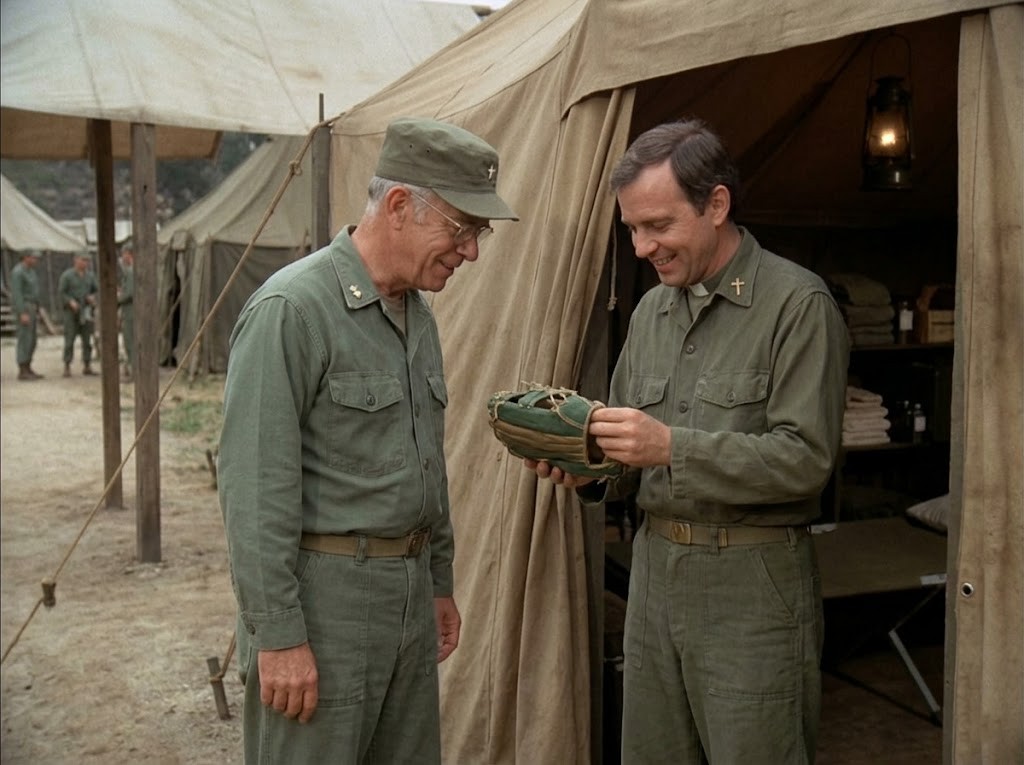
There is a specific kind of quiet that only descends on the 4077th after a grueling forty-eight-hour session in Post-Op. It’s the kind of silence where the roar of helicopter blades still echoes in your ears, even though the skies have been clear for hours.
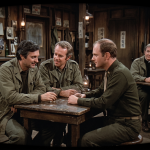
Colonel Sherman Potter stood outside his tent, the damp Korean air settling into his old bones. His eyes were heavy, his shoulders slumped under the weight of too many operating table decisions, but his gaze was fixed on the man standing across from him.
Father John Mulcahy was looking down at his hands, his usual gentle smile replaced by something far more fragile. Between his fingers, he held an old, faded green baseball glove. It was cracked at the seams, the leather stiff from years of moisture and neglect, yet he cradled it as if it were made of spun gold.
“Found it in the bottom of a donation crate from a parish in Boston, Colonel,” Mulcahy said, his voice barely louder than a whisper. He slid his left hand into the leather, his fingers stretching against the hardened pocket. “A bit worn around the edges, but the pocket… the pocket is still true.”
Potter stepped closer, leaning in to inspect the glove with a practiced, nostalgic eye. He adjusted his cap, a faint, wry smile touching his lips as he saw the faint, handwritten name ink-stained onto the strap. It belonged to a boy who had likely grown up, gone to war, and left his childhood on a muddy field somewhere far from home.
“A lefty, Padre?” Potter asked softly, his voice carrying the dry, warm gravel of a man who had seen too many boys leave their toys behind. “A bit rare out here in the sandbox.”
“More than just rare, Colonel,” Mulcahy replied, looking up with a sudden, sharp glint of profound sorrow in his eyes. “It’s exactly what young Corporal Higgins was asking for before he went into surgery last night. He kept crying out for his brother’s glove. He told me they used to play catch until the sun went down in Ohio.”
Potter’s smile faded, replaced by the grim reality that always hovered over the camp. He remembered Higgins—a nineteen-year-old kid with a severe abdominal wound who had spent three hours under Hawkeye’s knife.
“Higgins is still touch-and-go in ICU, Father,” Potter said quietly, placing a steady, fatherly hand on the priest’s shoulder. “The boy might not even wake up to see it.”
Mulcahy looked up from the glove, his eyes locking onto the Colonel’s with an intensity that stopped Potter cold. “That is precisely why I need to bring it to him now, Colonel. Because if he doesn’t wake up… I don’t want him crossing over without holding a piece of home.”
The silence between the two men stretched, heavy with the shared understanding of what it meant to comfort the dying. Potter looked from Mulcahy’s earnest face down to the green glove. He knew the toll it took on the priest to carry the spiritual weight of the entire camp, always offering hope when the world offered nothing but mud and shrapnel.
“Let’s go see him together, John,” Potter said softly, his tone shifting from commander to a protective older brother.
They walked side by side through the compound, the gravel crunching beneath their boots. The afternoon sun was beginning to dip below the ragged Korean hills, casting long, tired shadows across the tents.
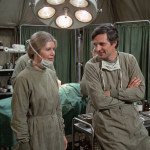
Inside the ICU, the air was thick with the scent of rubbing alcohol and sweat. Hawkeye Pierce was sitting on an upturned crate near the back, his surgical gown hanging loose around his neck, eyes staring blankly at the floor. B.J. Hunnicutt was checking an IV line, his face etched with a fatigue that no amount of swamp juice could cure.
As Potter and Mulcahy approached the corner cot, the rhythmic, shallow breathing of Corporal Higgins was the only sound. The boy looked incredibly small beneath the olive-drab blankets, his face pale, his lips chapped.
Mulcahy stepped forward with a quiet reverence. He didn’t say a prayer out loud. Instead, he gently took the boy’s limp left hand and guided it into the stiff green baseball glove.
For a long, agonizing moment, nothing happened. Hawkeye looked up, his usual cynical wit entirely absent, replaced by a look of raw, vulnerable hope. B.J. stopped what he was doing, stepping closer to the bed.
Then, Higgins’ fingers twitched.
The boy didn’t open his eyes, but his knuckles whitened as his hand instinctively curled inside the leather pocket. A faint, almost imperceptible sigh escaped his lips, and the tension in his forehead seemed to melt away. The shallow, ragged breathing began to slow, settling into a deep, healing sleep.
Hawkeye let out a breath he seemed to have been holding for hours, a small, tired smile breaking through his stubble. “Well, Padre,” Hawkeye whispered, his voice cracking slightly. “I think you just wrote a better prescription than anything I’ve got in the pharmacy.”
“It’s not medicine, Pierce,” Potter said, his voice thick but steady as he looked at the boy holding the glove. “It’s just a reminder that there’s a world waiting for him outside this tent.”
Mulcahy stood by the bedside for a few more minutes, his hand resting gently on the boy’s covered shoulder. The overwhelming fatigue of the past forty-eight hours seemed to lift from his face, replaced by that quiet, enduring strength that kept the 4077th grounded when everything else was falling apart.
As the three doctors and the priest stood around the cot in the dimming light, the war felt a million miles away, defeated for one evening by an old green glove and a piece of home.
In the mud of Korea, sometimes a three-finger catch was the only thing holding a soul to the earth.