The Ledger of Small Mercies
Some days, the war in Korea didn’t announce itself with the chop-chop-chop of oncoming choppers or the frantic shouting outside the OR.
Sometimes, it just announced itself with the squeak of a wet boot on linoleum and the heavy, exhausting silence of a rainy Tuesday afternoon.
Inside the Swamp, the air was thick with the smell of damp canvas, stale gin, and the underlying scent of rubbing alcohol that nobody could ever truly wash off their skin.
Hawkeye Pierce was lying flat on his cot, staring up at the roof of the tent, watching a single drop of water slowly gather at the intersection of two canvas seams.
“If that drop falls on my nose, I’m volunteering for the infantry,” Hawkeye muttered, his voice dry and raspy from a thirty-hour shift that had ended just before dawn. “At least in the infantry, you get to move around while you freeze to death.”
Across the tent, Charles Winchester was meticulously polishing a pair of leather loafers, his expression one of profound, aristocratic misery.
“Do try to control your existential despair, Pierce,” Winchester sniffed, not looking up. “Some of us are attempting to maintain a semblance of civilization in this wretched mud hole you call a home.”
Before Hawkeye could fire back a retort, the tent flap flew open, and Radar O’Reilly practically skittered into the room, clutching a clipboard to his chest like a shield.
His oversized glasses were fogged from the humidity, and his uniform looked two sizes too big, but his eyes were wide with genuine, unadulterated panic.
“Sirs! You gotta come quick,” Radar stammered, his voice cracking slightly as he looked between Hawkeye and B.J. Hunnicutt, who had just walked in behind him. “It’s Colonel Potter. And Major Winchester… I mean, the other Winchester. The formal one.”
Hawkeye sat up slowly, his joints popping. “Radar, use your words. Is the Colonel hurt? Did General Clayton find out about the still again?”
“No, sir,” Radar whispered, looking around as if the canvas walls had ears. “A special investigator from Seoul just arrived. An efficiency expert. He’s up in the office right now with the Colonel, and he’s holding a leather-bound ledger. He’s looking for ‘irregularities’ in our supply lines.”
B.J. sighed, tossing his muddy cap onto his cot. “We’re a M*A*S*H unit in the middle of a peninsula that time forgot, Radar. Our entire existence is an irregularity.”
“But you don’t understand!” Radar insisted, his knuckles turning white on the clipboard. “He’s asking about the penicillin. The extra crates we ‘borrowed’ from the 8063rd last month when the convoy got delayed. He says if we can’t produce the official authorization forms, someone is going to the stockade.”
The banter in the room died instantly, replaced by a cold, sudden tension.
Those extra crates of penicillin hadn’t been authorized by any paperwork; they had been acquired through a complex web of trades involving Klinger’s finest silk stockings, a bottle of Scotch from Winchester’s private stash, and a lot of fast-talking by Hawkeye.
Without those crates, twelve boys from the 2nd Infantry division wouldn’t have made it back home to their mothers.
Hawkeye stood up, his playful demeanor completely vanishing, replaced by the hard, protective edge of a surgeon who cared too much. “Let’s go see this efficiency expert.”
When they entered the administrative tent, the scene was exactly as Radar had feared.
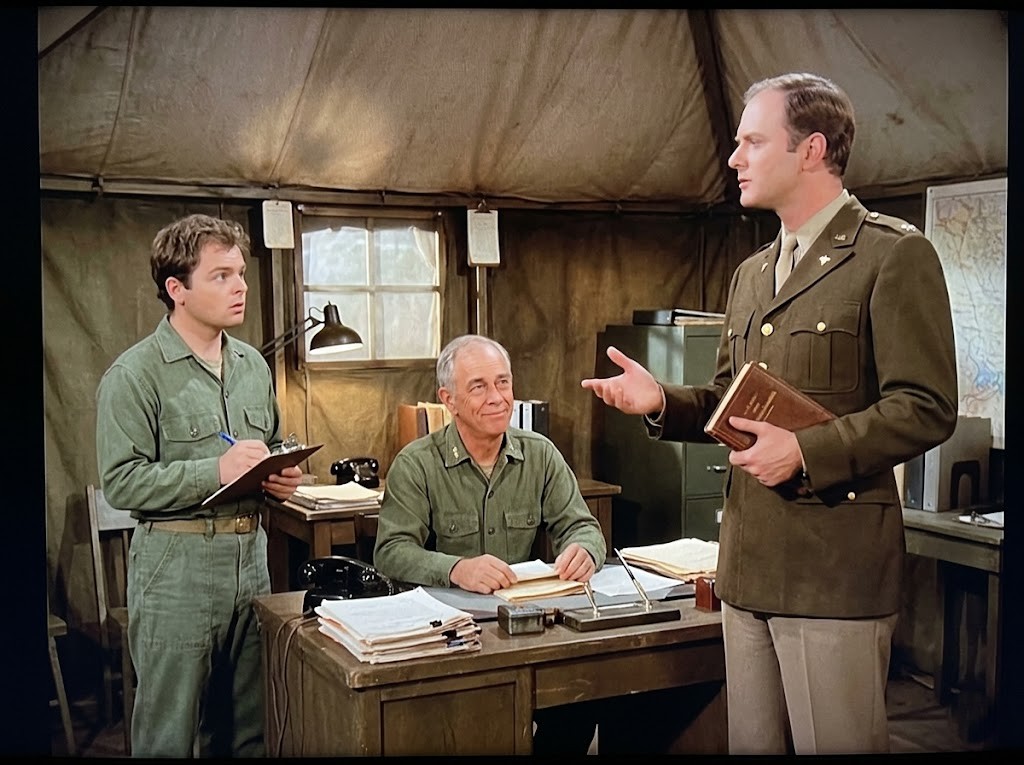
Colonel Potter was seated behind his desk, looking incredibly small and incredibly tired, his hands folded over a stack of yellowed requisition forms.
Standing before him was Major Higgins, a man whose dress uniform was so perfectly pressed it looked like it had never seen a day of actual field service.
Higgins held a thick, brown leather ledger in his hand, gesturing with it as if it were a weapon, his voice carrying the clipped, arrogant tone of a man who viewed human life as a series of columns to be balanced.
“Colonel Potter, I am not questioning your dedication,” Higgins was saying, his voice echoing off the canvas. “I am questioning your math. According to the official ledger from Seoul, the 4077th is currently holding three hundred vials of unauthorized antibiotics. That is a federal offense, Colonel. I need a name, or I need a signature.”
Radar stood to the side, his pen poised over his clipboard, his face pale as he looked at Potter, waiting for the axe to fall.
Colonel Potter didn’t flinch, but the lines on his face seemed to deepen, reflecting every mile of the long road from the trenches of World War I to the frozen hills of Korea.
“Major Higgins,” Potter said softly, his voice carrying the quiet authority of a man who had earned his rank through blood, not ink. “In this camp, we don’t trade in numbers. We trade in heartbeats. If my boys used those vials, it’s because someone was dying.”
“The regulations do not make exceptions for sentimentality, Colonel,” Higgins replied coldly, tapping the leather book. “The paperwork must balance. If you cannot provide the proper requisition form, I will be forced to file a formal report of theft against this unit.”
Hawkeye stepped forward, his eyes flashing with anger. “Theft? You sit back in Seoul with your shiny boots and your air-conditioned office, and you call it theft? We saved lives, Major! If you want a name to put in your little book, put mine. I’m the one who used the penicillin.”
“No, put mine,” B.J. interrupted, stepping up beside Hawkeye, his voice steady but fierce. “I administered half of those doses myself.”
Higgins looked at them, completely unmoved by the display of solidarity. “Very touching, Captains. But a confession without a signed military order is just a confession to a crime. Unless you can produce an authorized signature from the supply depot commander before 1700 hours, I am grounding your supply lines pending investigation.”
A heavy silence fell over the tent. Grounding the supply lines meant no new bandages, no fresh plasma, and no fuel for the generators. It was a death sentence for the next batch of wounded.
Radar looked at the Colonel, his lip trembling slightly. He looked down at his clipboard, then back up at the arrogant Major.
Suddenly, a strange, knowing look crossed Radar’s face. He blinked, tilted his head, and seemed to listen to something no one else could hear.
“Uh, Major Higgins, sir?” Radar squeaked, stepping forward.
Higgins didn’t even look at him. “Not now, Corporal.”
“But sir,” Radar insisted, his voice growing surprisingly firm. “I think you might want to look at the addendum to Section 4, Paragraph B of the Far East Command supply code.”
Higgins paused, frowning. “What are you talking about?”
“Well, sir,” Radar said, a faint, innocent smile touching the corners of his mouth. “According to the code, any emergency medical supplies transferred during a period of active hostilities can be retroactively authorized by the senior medical officer on site, provided they are logged in a temporary ledger…”
Radar looked directly at the brown leather book in Higgins’ hand. “…which is then signed by the inspecting officer to verify the inventory.”
Higgins stared at Radar, his eyes narrowing. “That regulation applies only to frontline aid stations under direct fire.”
“Sir,” Radar said softly, pointing a small finger toward the open window of the tent.
In the distance, the faint, low rumble of artillery echoed through the valley—a sound so constant the rest of them had long since stopped noticing it. But to an outsider from Seoul, it was the sound of immediate danger.
“We’re seven miles from the front line, sir,” Radar said, his voice entirely devoid of malice, pure and earnest. “The whole camp is an aid station. And we’re always under direct threat.”
Colonel Potter watched the interaction, a slow, proud smile spreading across his weathered face. He cleared his throat, leaning forward.
“Well, Major? It seems my clerk has a better grasp of the fine print than either of us. You sign the verification in your book, we sign the retroactive form, and the army gets its paperwork. Balanced and beautiful.”
Higgins looked at the ledger in his hand, then at the united front of the doctors, and finally at the small, unassuming Corporal who had just outmaneuvered him using the army’s own red tape.
For a long moment, the only sound was the distant rumble of the guns and the steady patter of rain on the tent roof.
With a sharp, defeated sigh, Higgins slammed the ledger onto Potter’s desk, pulled a fountain pen from his pocket, and scribbled his signature across the bottom of the page.
“Have the retroactive forms on my desk in Seoul by Friday, Colonel,” Higgins snapped, snatching his book back and turning on his heel. He marched out of the tent without another word, his pristine boots splashing into the mud outside.
The moment the tent flap closed, the tension evaporated, replaced by a collective exhale that felt like a prayer.
“Radar,” Hawkeye said, clapping a hand on the boy’s shoulder, a look of genuine awe in his eyes. “You are an absolute beautiful genius. I could kiss you. In fact, if you don’t mind the stubble, I will.”
“No thank you, Captain,” Radar blushed, pulling back with a grin, tucked his clipboard securely under his arm. “I just remembered reading that section while I was bored last winter.”
B.J. smiled, shaking his head. “To the U.S. Army, a life is just a number. Thank God we’ve got Radar to fix the math.”
Colonel Potter stood up from his desk, walking over to Radar and placing a fatherly hand on his shoulder. His eyes were warm, filled with a deep, quiet affection for the boy from Iowa who kept the soul of the 4077th alive every single day.
“Good work, Walter,” Potter said softly, using Radar’s real name—the highest honor the Colonel could bestow. “You saved more than just a few crates of medicine today. You reminded us why we’re here.”
Radar nodded, his cheeks turning pink as he looked down at his boots. “Just doing my job, Colonel.”
Outside, the rain continued to fall over the muddy compound of the 4077th, but inside the small administrative tent, the world felt just a little bit warmer, and the heavy burden of the war felt just a little bit lighter, carried together by a family found in the middle of nowhere.
In a place where human lives were reduced to columns of numbers, it was the quiet heart of a boy from Iowa that always kept the balance.