A Compassionate Map in the supply tent
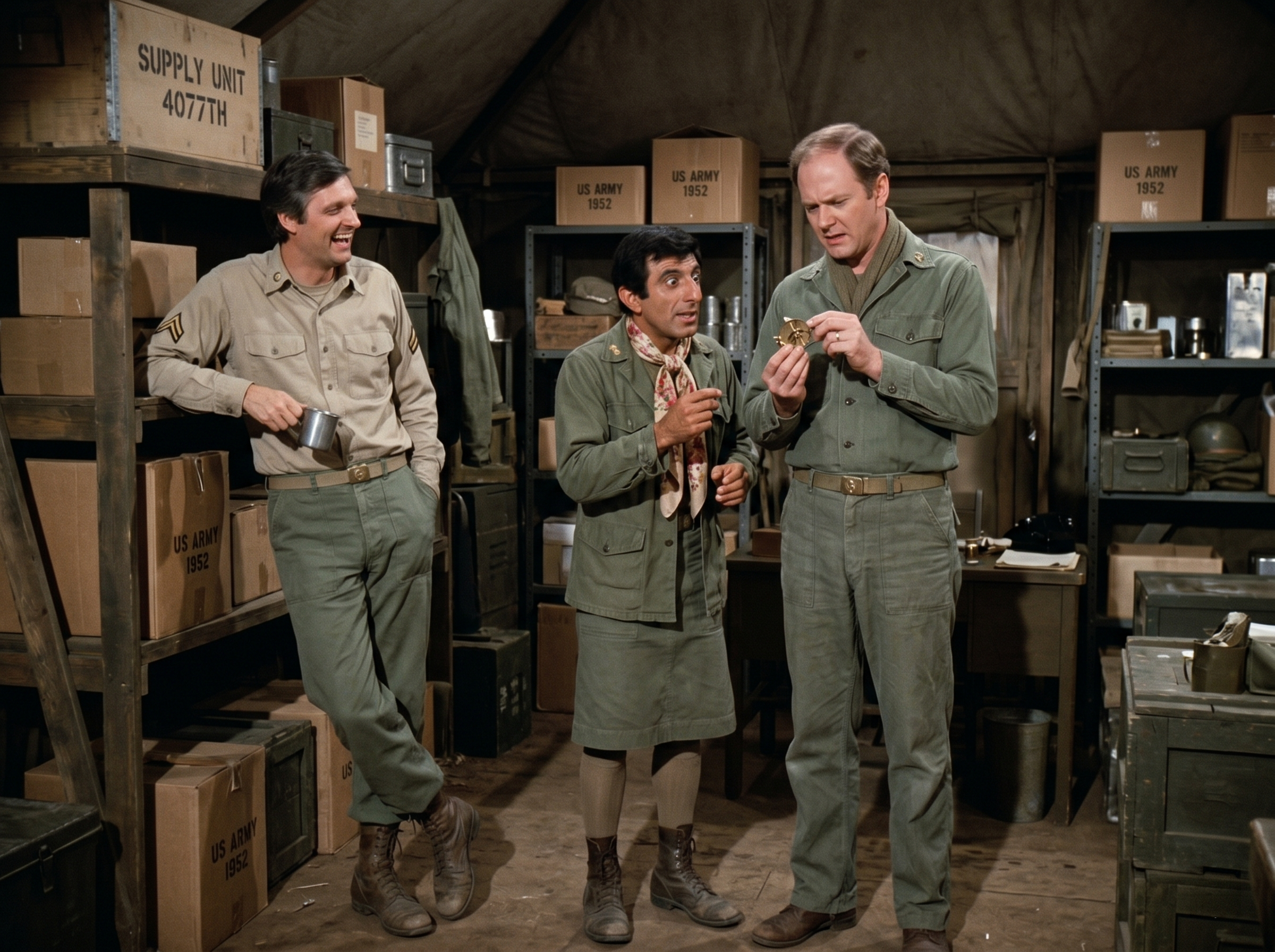
The air in the 4077th supply tent always seemed twice as thick as anywhere else in the camp. It smelled of canvas, dry rot, and standard-issue Army dust, mixed with the faint perfume of Klinger’s latest acquisition. That afternoon, the heat outside was a distant enemy; the real battle was simply staying awake.
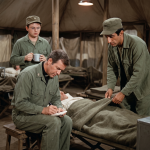
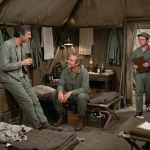
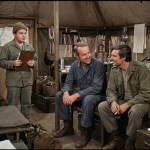
Three men stood center stage, each defined by their reactions to the humidity. Hawkeye, relaxed enough to fall over if the heavy wooden shelving weren’t holding him up, leaned back with a relaxed grin. His fingers lightly gripped the handle of his ubiquitous metal coffee mug, which was mostly full of the morning’s bitter black mud and not, surprisingly, his usual tonic from The Swamp.
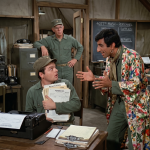
Across from him, Winchester was examining a small, brass object with the focus he usually reserved for intricate cardiovascular surgery or a difficult movement by Mahler. Klinger, the accidental ringmaster of this low-stakes drama, hovered between them, his face expressive, his multi-colored scarf providing the only break from the endless sea of drab green and cardboard brown box-tops.
Winchester adjusted his grip on the item. “Klinger, I must protest. This… this *trinket* is not a compass. It is a child’s toy. One that points, quite persistently, to my left shoelace. And even then, with a lack of conviction that is truly disheartening.”
He didn’t mean to be cruel, only accurate. The object was a compass, technically, but its needle spun lazily, stopping with random indirection.
Klinger, not to be deterred by Bostonian skepticism or literal interpretations, launched into his explanation. He was fighting hard for a specific narrative.
“Aha, and *that* is precisely where your sophisticated New England schooling has failed you, Major!” Klinger said, gesturing with earnest, elegant hands. “This is no ordinary compass. It doesn’t tell you *your* location. It tells you *the* location. The *place* you need to go next. Think of it less as geometry and more as destiny. A mystical, navigational guiding light.”
Hawkeye let out a low chuckle, shifting his weight. “Hear that, Charles? All this time, you thought the war was random. Turns out it’s just a GPS with a spiritual connection. And Klinger’s the travel agent.”
Winchester, whose family likely navigated entire oceans on principle, gave Hawkeye a flat look. “Pierce, your flippancy is as predictable as your medical improvisation. My *shoes* are not my destiny. My shoes are simply dirty. And now, thanks to this brass anomaly, my left shoelace is apparently some sort of divine directional signal.”
The humor was dry, but the fatigue underneath was real. Every conversation was a brief vacation from the operating tent.
Klinger’s eyes widened. “Major, you missing the bigger picture. Captain Hunnicutt needs a compass for that special map project with the orphanage. Something reliable. Something that won’t point him straight into a minefield. A truly compassionate, trustworthy compass.”
The atmosphere in the tent subtly changed. Mentioning B.J. and his tireless work with the local children, with the map that was supposed to help them learn and dream of a world beyond the border, was a quick emotional lever in the camp. It wasn’t about funny items and strange sales pitches anymore.
Winchester, sensing a loss of intellectual dominance, felt his cheeks flush. His pride was a fragile thing, easily bruised, and even the slightest perception that he, Charles Emerson Winchester III, would unknowingly deliver a *faulty* instrument to *a colleague* to use *for children* was an offense that went deep into his moral framework.
He lowered the brass object, his face tight. His knuckles, though unseen inside his tight grip, were surely white. The silence that followed was heavy with a rare tension that had nothing to do with medical emergencies.
“Are you implying, Klinger,” Winchester started, his voice deceptively low, “that *I*, even unknowingly, would be a conduit for delivering a defective navigational tool to Hunnicutt, a tool intended for children who already have precious little stability? Are you suggesting my endorsement, however sarcastic, carries such ethical weight that *I* must answer for its flaws? Because if you *are*, that is a line that you do *not* want to cross.”
Klinger, a master of navigating subtle conversational currents, was instantly deflated. The theatricality vanished. He hadn’t meant to criticize Winchester; he was just doing his usual sales patter, emphasizing the specialness of the (defective) item. He saw the genuine, rare wound in the aristocrat’s eyes.
“Major,” Klinger began, his voice now quiet and earnest, the scarf looking less like a costume and more like a simple accessory to his vulnerability. “I… I meant no disrespect. I was just talking. Fast. The way I do. I value Captain Hunnicutt. And the orphanage. The *compassionate compass* was… just a joke. About compassion. Not incompetence.”
For once, Klinger wasn’t trying to manipulate the situation; he was genuinely apologizing.
The moment stretched. Winchester held the object like it was radioactive. His pride was battling his humanity, and humanity, surprisingly, won out faster than anyone expected.
Hawkeye, who had watched the exchange with growing concern, knew when to deploy humor not as a shield, but as a bridge. He slowly push his mug from the shelf and took a long sip.
“Careful, Charles,” Hawkeye drawled. “That brass is so thin it probably has feelings. If you squeeze it any harder, it might start to cry. Then *I’d* have to operate, and I have no experience in pocket-watch psychology.”
Winchester glared at him. A brief, cold flash before his expression softened just a fraction. He turned back to Klinger. “Your humor, Klinger, is as lacking in subtlety as your navigation. However, your… apology… is noted.”
The Bostonian took a deep, measured breath, the kind he used to prepare for a complex suture. He held the compass up, looking at it not as a joke, but as an object that had just hurt someone’s dignity, and perhaps even their belief in *their own* trustworthiness.
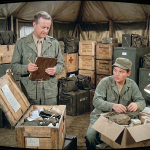
Slowly, Winchester’s gaze traveled around the tent. He looked at the shelves filled with boxes. Boxes of bandages, boxes of medicine, boxes of standard-issue pain, all labeled ‘US ARMY 1952’. He looked at Hawkeye, who was watching him with a knowing, tired softness. And then he looked at Klinger, who was holding his breath.
Winchester gave a quiet huff. “This object is functionally a disaster. However,” he looked at Klinger, his eyes no longer cold, “perhaps its unique ability to always find my left shoelace is precisely the kind of stability these children need. A constant. A known destination. At least for that particular lace.”
A slow, genuine smile spread across Hawkeye’s face, and he raised his mug in a silent toast. Klinger’s face broke into a broad grin, the relief evident.
“You know, Major,” Klinger beamed, already shifting back into salesman mode but with a new layer of warmth, “I *do* have another one. Also points left. I could do you a package deal for two compassionate compasses. One for each boot.”
Winchester’s face returned to its usual expression of controlled, superior disdain. “I think one is quite enough instability for the orphanage, Klinger. And *for my shoelaces*.” He slid the compass into his chest pocket.
Hawkeye finished his drink and gestured to the supply counter. “Alright, navigator, travel agent. Now that the world is a safer place, let’s talk supplies. I believe I ordered some surgical masks, not spiritual guidance.”
Klinger laughed, a loud, clear sound that filled the tent and made the boxes rattle just a little. “Right away, Captain Pierce! One order of surgical supplies, coming up. And for the next shipment, I’m working on a divining rod that points directly to a good haircut.”
Hawkeye scoffed, but the smile stayed on his face as he watched Winchester carefully button his pocket. He saw the man who would take this useless compass and turn it into a genuine gift, perhaps for B.J., perhaps just to prove himself right in the most compassionate way possible.
They would soon be back in the OR, chest deep in another reality, but for a moment in the supply tent, there had been a map to a different kind of destination. One made not of copper and brass, but of trust, vulnerability, and the simple understanding that sometimes, the only direction you can truly find is a connection with another person.
Winchester adjusted his uniform. “Now, Klinger, let us locate those masks. I trust they will be slightly more functional than this compass, and significantly less interested in my feet.”
Klinger began pulling boxes, his colorful scarf swinging as he worked, and Hawkeye stayed leaned against the shelf, nursing his empty mug and finding, in the chaos of a supply tent and a dysfunctional compass, something that felt surprisingly stable.
In the 4077th, even a broken compass could always help you find your way home to friendship.