Stitch by Stitch, We Keep Each Other Warm
The mud in Korea has a way of seeping into your boots, but the cold—the cold is what gets into your bones.
In the chaotic, olive-drab world of the 4077th, warmth is the ultimate commodity, usually found only in a rare cup of decent coffee or the fleeting embrace of a radiator that actually works.
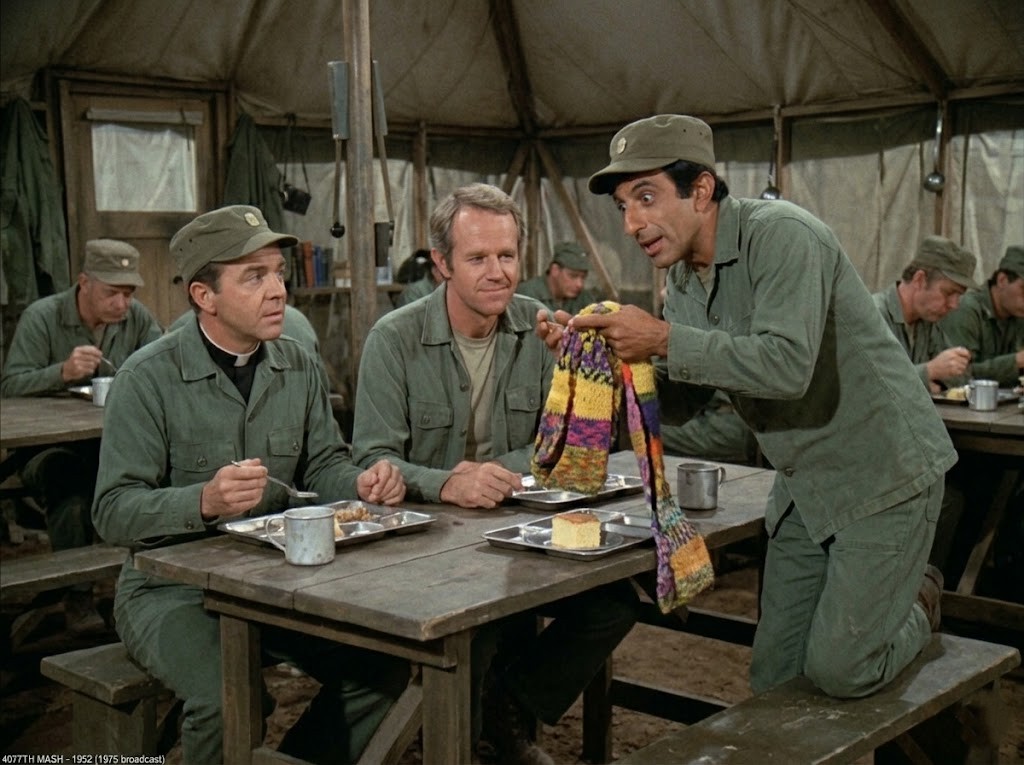
But on this particular afternoon in the mess tent, Corporal Max Klinger brought a completely different kind of warmth to the table, and it arrived in a tangle of mismatched yarn.
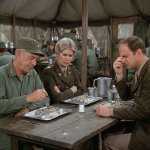
Father Mulcahy and Captain B.J. Hunnicutt were hunched over their metal trays, dealing with another round of indistinguishable army chow, when Klinger practically floated over the bench.
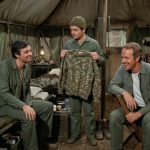
He didn’t have a dress on today, just his standard fatigues and a faded utility cap, but his expression was pure theatrical triumph.
Between his hands, he proudly unfurled a long, wildly vibrant scarf knitted from a chaotic rainbow of leftover wool.
“Gentlemen, feast your eyes,” Klinger whispered, his voice dripping with the reverence of a high-fashion designer unveiling a masterpiece in Paris. “The Toledo Special. Made with love, sweat, and whatever scraps I could bribe out of the supply clerks in Seoul.”
Father Mulcahy paused, his spoon hovering halfway to his mouth, his gentle eyes wide with mild astonishment as he looked at the bright purples, yellows, and oranges.
B.J. leaned back, a trademark, easygoing smirk spreading across his face, his eyes crinkling at the corners as he appraised the loud knitwear.
“It’s… certainly colorful, Klinger,” Mulcahy said softly, trying to find the right pastoral words for something that looked like a technicolor caterpillar. “A very unique penance, perhaps?”
“Penance? Father, this is survival!” Klinger insisted, dropping to one knee on the bench right next to B.J., leaning in close. “I’m sending this home to my Uncle Abdul. He’s got a bad chest, and winters in Ohio can kill a man. I put every ounce of home-cooked comfort I had into these stitches.”
B.J. reached out, running a thumb over the rough wool, his smile softening into something a little more grounded. “It’s thick, Max. He’ll definitely stay warm. But where’d you get the purple? I didn’t think the army issued anything that wasn’t a shade of mud.”
“Don’t ask questions you don’t want the answers to, Captain,” Klinger winked, though his eyes suddenly lost a bit of their theatrical spark, replaced by a quiet, heavy longing. “I just wanted him to have something from me. Something that says I’m okay, and I’m thinking of him.”
Mulcahy smiled warmly, but before he could speak, Klinger’s face fell as he flipped the scarf over, revealing the other end.
The colorful pattern didn’t gently fade out; it abruptly stopped, trailing off into a sad, frayed mess of loose, unraveling threads that threatened to undo the entire thing.
Klinger’s shoulders slumped, the grand illusion shattering in an instant, leaving just a tired kid from Toledo holding a broken piece of string.
“I ran out,” Klinger muttered, his voice dropping an octave, completely stripped of his usual bravado. “I used every last inch of yarn I could scrounge up, and it’s still three feet too short to even wrap around a neck. The whole thing is going to fall apart before it even gets to the mail tent.”
The mess tent suddenly felt a little quieter, the clatter of metal trays in the background fading into the humid air.
B.J. looked at the unraveling edge, his expression shifting from amusement to that deep, steady empathy he usually reserved for patients or letters from Peg.
He knew what it was like to want to send a piece of yourself across the ocean, to try so hard to build a bridge home only to find you’re a few feet short.
“Hey, come on now,” B.J. said gently, putting a hand on Klinger’s arm. “You didn’t come this far to let it unravel, Max.”
Father Mulcahy looked down at his own collar, then toward the corner of the tent where his meager personal belongings were kept.
“You know, Klinger,” the priest said, a thoughtful, quiet resolve in his voice. “I received a care package from my sister, Sister Theresa, last month. She included a pair of heavy, knitted winter socks. They’re a rather drab grey, I’m afraid, but the wool is excellent.”
Klinger looked up, blinking. “Father?”
“I’ve been meaning to learn how to darn,” Mulcahy continued, a small, knowing smile playing on his lips. “But perhaps that wool would serve a higher purpose. If we unravel those socks, we might just have enough grey to finish the border. A nice, steady frame for all your beautiful color.”
B.J. chuckled, nodding in agreement. “And I think Hawkeye still has that old, stretched-out sweater his dad sent him. It’s got a hole the size of a baseball in the elbow, but the rest of it is fair game. We can harvest the sleeves.”
Klinger looked between the priest and the doctor, his eyes shining with a sudden, genuine warmth that had absolutely nothing to do with the weather.
“You guys would do that?” Klinger asked, his voice cracking slightly. “For Uncle Abdul?”
“For Uncle Abdul,” B.J. confirmed softly. “And for you.”
“Besides,” Father Mulcahy added with a dry, gentle humor, “I think a little grey at the end will give it some structure. We can’t have Ohio thinking the 4077th has completely lost its sense of military uniformity.”
Klinger let out a breathless laugh, carefully folding the scarf and holding it against his chest like a treasure.
In a place surrounded by endless olive drab and the constant threat of loss, they spent the rest of the afternoon sitting at that wooden table, planning a rescue mission for a piece of yarn.
It wasn’t a victory that would make the papers, and it wouldn’t change the course of the war, but under the canvas roof of the mess tent, it was enough.
Sometimes, the only way to keep the cold out is to let the people around you help tie up the loose ends.