The Weight of a Thousand Miles
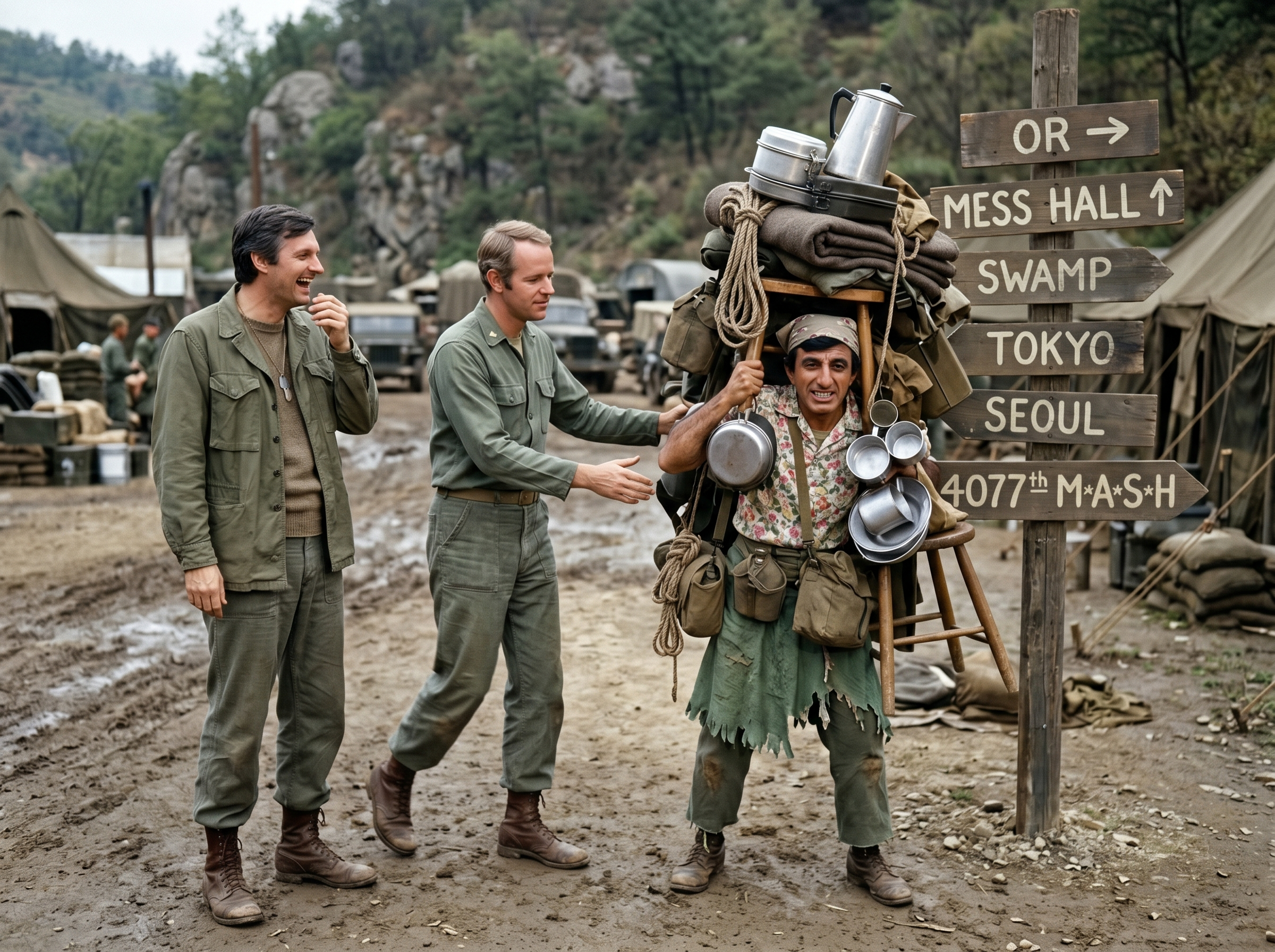
The mud of Korea has a way of clinging to you, not just to your boots, but to your spirit.
It was another one of those interminable Tuesday afternoons at the 4077th, the kind where the air hung heavy with the smell of wet earth and the distant, rhythmic thrum of choppers that never seemed to stop.
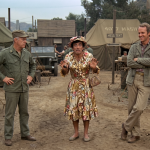
Hawkeye Pierce and B.J. Hunnicutt were walking back from the mess tent, their steps slow and heavy, when they rounded the bend by the signpost—that iconic, crooked wooden finger-pointing toward homes that felt like they were on a different planet.
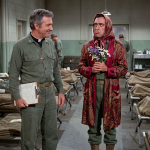
Standing right there, looking like a pack mule designed by an architect with a wicked sense of humor, was Klinger.
He was a sight that could only exist in the surreal theater of our lives.
He was absolutely buried under an impossible mountain of gear: tangled coils of rope, heavy wool blankets, a wooden stool strapped directly to his back, and enough mess kits, canteens, and coffee pots to outfit an entire infantry platoon.
He looked like he was auditioning for the role of a nomadic hermit, or perhaps a one-man refugee camp.
Hawkeye stopped dead in his tracks, a half-formed sarcastic remark dying on his lips as he took in the sheer absurdity of the sight.
B.J., his hand already reaching out in a gesture of instinctive, gentle concern, let out a short, surprised breath.
“Klinger,” Hawkeye said, his voice dropping into that familiar register of mock-amazement that barely masked his genuine worry. “I’ve seen some things, Corporal, but are you planning to open a hardware store, or have you finally decided to pack up and walk all the way to Toledo?”
Klinger didn’t move, his face twisted in a look of profound, comical exertion, his eyes darting toward them as if he were holding up the ceiling of the world.
“I’m not walking, Captain,” Klinger wheezed, his voice straining under the precarious weight of the coffee pot perched precariously atop his makeshift tower. “I’m moving. Permanently. If I can just get past this signpost, the next stop is anywhere that doesn’t have a mud pit for a front yard.”
But as he tried to shift his footing, the entire mountain of gear let out a terrifying, metallic groan.
The stool shifted, the pots clattered dangerously, and the whole contraption began to sway like a ship caught in a gale.
Hawkeye and B.J. lunged forward, hands outstretched, but for a split second, it looked as though the entire, ridiculous, beautiful mess was about to come crashing down on top of him.
B.J. caught the edge of the stool just in time, steadying the load before the coffee pot could take a dive into the mud.
“Easy, easy,” B.J. murmured, his voice as calm as a summer breeze, the kind of steadying influence that always managed to anchor the madness of the camp. “You’ve got enough here to sink a destroyer, Klinger. Let’s get this off you.”
Hawkeye, moving with the practiced grace of a man who had spent his life helping people stand back up, carefully began unhooking the ropes.
“You know,” Hawkeye quipped, though his hands were gentle as he moved a heavy canteen away from Klinger’s neck, “if you’re going to desert, you really should have packed lighter. You’ve got half the base’s inventory on your spine.”
Klinger finally slumped against the wooden post, the pressure released, letting out a long, ragged exhale that sounded like a deflating tire.
He looked at the two of them, his usual theatrical bravado replaced by a flicker of raw, exhausted vulnerability.
“I just wanted to know,” Klinger said, his voice barely audible over the distant hum of the camp, “if I really wanted to go, could I carry the memories, too? Or do they just stay here in the mud?”
The humor that usually defined their days didn’t vanish, but it softened, morphing into something quieter, something more profound.
They weren’t just helping a man unbuckle a load of surplus gear; they were helping a friend acknowledge the heavy, invisible burden of being so far from home for so long.
B.J. put a hand on Klinger’s shoulder, a firm, grounding pressure.
“We’re all carrying a lot, Corporal,” B.J. said softly. “But nobody carries it alone. Not here.”
Hawkeye stood back, looking at the heap of pots, blankets, and rope scattered in the dirt—the debris of a life lived in a tent, waiting for a war to end.
He looked at the signpost, with its directions to Seoul and Tokyo and the Swamp, and for a moment, the distance didn’t seem quite so infinite.
Klinger wiped his brow, a wry, tired smile finally creeping onto his face as he looked at the mess on the ground.
“Well,” Klinger sighed, picking up a single canteen, “I suppose I can live without the coffee pot for another night.”
They stood there for a long moment, the three of them, under the shadow of the signpost that marked their existence.
The mud was still deep, the war was still happening, and home was still a dream, but in that small, shared moment of relief, the world felt a little less heavy.
They turned back toward the tents, walking close together, leaving the scattered gear behind, but keeping the comfort of each other’s presence as they moved through the growing evening shadows.
In the end, it was never the gear that weighed us down, but how lucky we were to have someone there to help us carry it.