The Quiet Rhythm of the 4077th
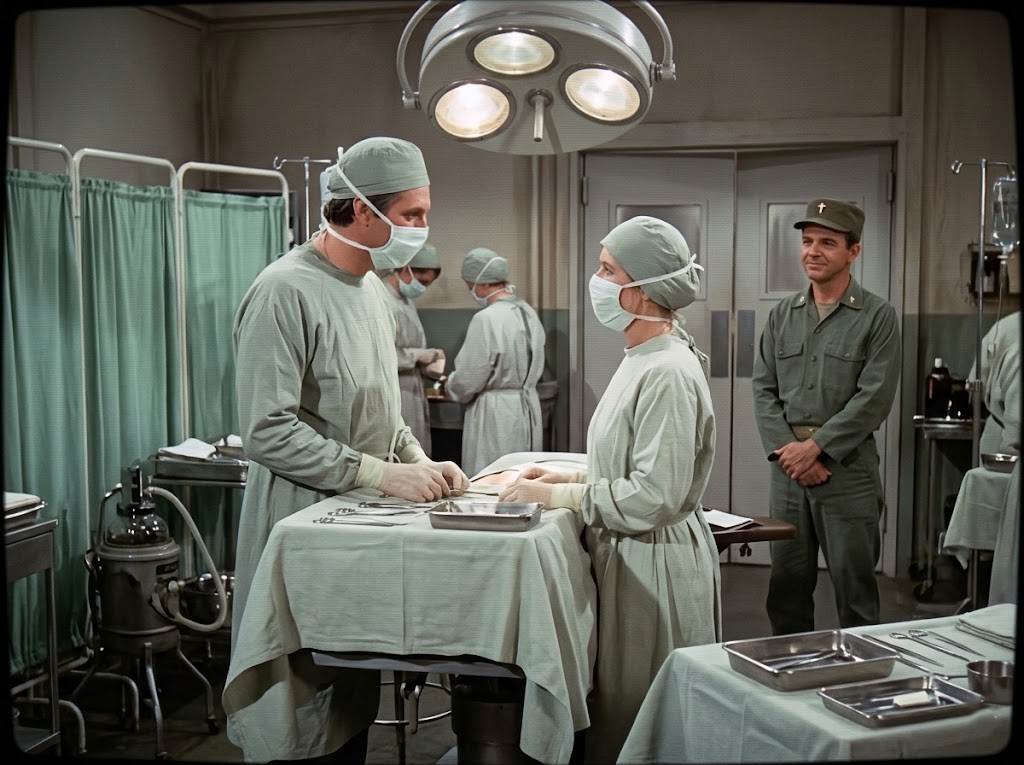
The OR clock didn’t care that it was three in the morning, or that the incoming choppers had finally stopped screaming over the hills.
In the operating room of the 4077th, the air was thick with the smell of alcohol, sweat, and the damp chill of a Korean night. The frantic rush of the last twelve hours had slowed to a steady, exhausting crawl.
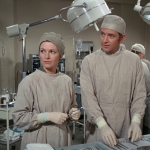
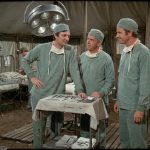
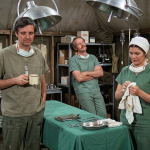
Hawkeye Pierce stood over the table, his shoulders hunched in a posture of pure weariness that no amount of coffee could fix. His scrub gown felt like lead, and his eyes burned behind his mask.
Across from him, Margaret Houlihan was his mirror image—exhausted but perfectly poised, her eyes sharp and locked onto the field of surgery. Behind them, Father Mulcahy stood quietly in his fatigues, a gentle, silent anchor in a room filled with the clinking of metal instruments and the low hum of the suction machine.
“Hemostat, Margaret,” Hawkeye murmured, his voice a dry rasp that lacked its usual rapid-fire theatricality.
She snapped the instrument into his palm with practiced, flawless precision. For a few long minutes, the only sound was the rhythmic snap of metal and the quiet breathing of the staff.
They were working on a young kid from Iowa who had a piece of shrapnel too close to his hepatic artery for anyone’s comfort. The initial panic of the triage had passed, but this was the delicate part—the slow, tedious stitch-work where one slip of a tired hand meant everything.
Hawkeye wiped his brow against his sleeve, his fingers momentarily hovering over the incision. He looked up at Margaret, his eyes softening behind his glasses.
“You know, Houlihan,” he said, trying to find that familiar, comforting banter that kept the dark at bay. “If we keep meeting like this, people are going to talk. The neighbors already think we’re running a midnight tailoring business.”
Margaret didn’t smile, but her eyes crinkled slightly at the corners. “Just focus on the suture, Pierce. The boy needs to get back to his farm, not listen to your nightclub act.”
“A farm,” Hawkeye muttered, his hands moving with meticulous care. “Imagine that. Dirt that doesn’t explode. Corn that grows higher than an elephant’s eye.”
Suddenly, his hand froze.
The low hum of the room seemed to vanish. Hawkeye’s eyes widened slightly above his mask, his fingers perfectly still inside the patient’s abdomen.
Margaret noticed the shift instantly, her posture hardening as she leaned in closer. Even Father Mulcahy stepped forward, his eyes fixed on the sudden rigidity in Hawkeye’s shoulders.
“Hawkeye?” Margaret asked, her voice dropping its sharp edge, replaced by a sudden, tense quiet. “What is it?”
Hawkeye didn’t answer right away. He just stared down, his fingers holding a fragile piece of anatomy that felt entirely too brittle.
“It’s tearing,” Hawkeye whispered, the humor completely gone from his voice. “The tissue is like wet tissue paper. If I let go to clamp it, the artery is going to retract, and we’ll lose him before I can find it again.”
The OR fell completely silent. In the background, the other surgical teams were finishing up their respective tables, but at this particular station, time had ground to a halt.
Margaret didn’t panic. She looked at the tray, then looked at Hawkeye’s hands. “If I place a traction suture just below your thumb, can you hold the tension?”
“Maybe,” Hawkeye said, his voice tight. “But my left hand is cramping, Margaret. I’ve been holding this angle for twenty minutes. If it spasms, it’s over.”
Father Mulcahy closed his eyes for a brief second, his lips moving in a silent, familiar prayer. When he opened them, he walked right up to the edge of the sterile field, looking at the two doctors with an expression of steady, unshakeable faith.
“You won’t slip, Captain,” Mulcahy said softly, his voice cutting through the heavy tension of the room like a cool breeze. “You’ve got the best hands in Korea, and Major Houlihan has the best eyes. You’re not alone in here.”
Hawkeye took a slow, deep breath through his nose. He looked at Margaret. “Alright. On three. You thread the needle, I’ll hold the line. Don’t let me down, Major.”
“I have never let you down, Pierce,” Margaret said fiercely, her voice steady enough to anchor a ship.
With agonizing slowness, Margaret’s gloved hands moved into the field alongside Hawkeye’s. Their fingers brushed—a brief, human contact amidst the cold steel and sterile cotton.
For thirty seconds, nobody breathed. Margaret’s needle moved with the precision of a master watchmaker, looping the fine silk through the delicate tissue right beneath Hawkeye’s fingertips.
“Got it,” she whispered. “Tie it off.”
Hawkeye deftly secured the knot, his fingers moving in a blur before he slowly, carefully withdrew his hands from the incision. The artery held. The bleeding had stopped.
The collective sigh of relief in the room was almost loud enough to wake the patients in the recovery ward.
Hawkeye let his hands drop to his sides, his shoulders slumping as the adrenaline began to drain from his system. He looked across the table at Margaret, whose eyes were shining with a mixture of profound exhaustion and quiet triumph.
“Nice shooting, Tex,” Hawkeye said, his dry wit returning, though his voice was thick with emotion.
“You didn’t do so badly yourself, Pierce,” Margaret replied, her voice remarkably gentle. She turned to the circulating nurse. “Let’s close him up. Carefully.”
Father Mulcahy smiled, a warm, tired expression that seemed to carry the weight of the entire camp. He reached out and offered a brief, reassuring pat on Hawkeye’s shoulder before stepping back into the shadows of the OR.
An hour later, the patient was wheeled out to post-op, stable and breathing on his own.
Hawkeye and Margaret stood by the scrub sink, pulling off their masks and letting the cool night air hit their faces. Their faces were lined with fatigue, gray circles under their eyes, but the bond between them was palpable—a quiet, unspoken understanding forged in the fire of another saved life.
“You know,” Hawkeye said, splashing cold water on his face. “One of these days, we’re going to get a full eight hours of sleep, and we won’t know what to do with ourselves.”
Margaret wiped her hands on a towel, looking out the screen door toward the quiet tents of the 4077th.
“We’ll probably just sit around and complain about the food, Pierce,” she said softly, a genuine smile finally breaking through her tired features. “But until then, we’ll just keep doing this.”
In a place where tomorrow was never promised, they found their strength in the quiet, unbroken rhythms of each other.