The Day Klinger Brought the Sky
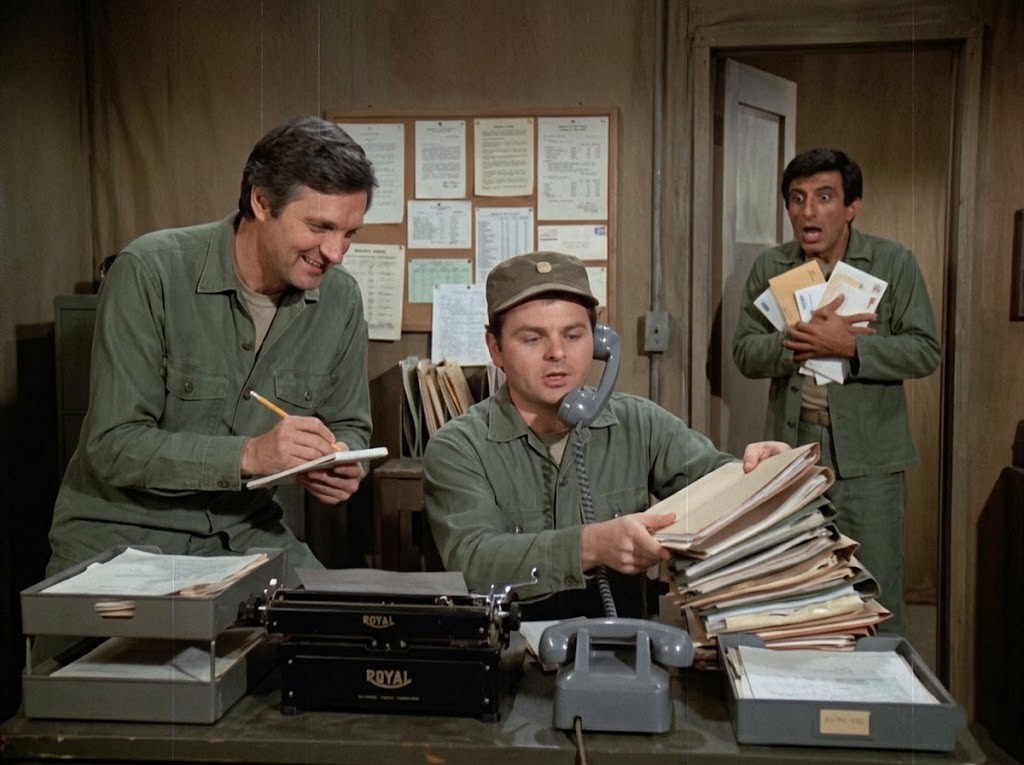
If there was one thing you could count on at the 4077th, besides the endless dust and the smell of antiseptic, it was that any moment of quiet was simply a storm catching its breath.
Inside the cluttered post-op office, Radar sat at his desk, a phone receiver pressed to his ear, his fingers drumming nervously on the wood. His eyes were wide and focused, listening intently to the fuzzy voice on the other end. For Radar, every phone call was important, every message a link to a world that felt impossibly far away. Today, it was just another supply logistics call, but still, he listened as if the entire war effort depended on it.
Behind him, B.J. leaned casually, his notepad and pencil at the ready. He was waiting for Hawkeye to finish some patient notes, but in the meantime, he was observing Radar with a fond, knowing expression. He always found a strange sort of comfort in watching Radar work—there was an earnestness to him that was rare in this place. “Anything interesting, Radar?” B.J. asked, his voice low.
Radar shook his head quickly. “No, sir. Just more… forms. Apparently, we’ve filed the wrong request for socks again.” He sighed, the weight of a thousand administrative hurdles settling on his shoulders. He began to organize a growing stack of papers on his desk, meticulously lining them up as if order could tame the chaos around them.
The office itself was a landscape of papers, clipboards, and file trays, dominated by the heavy, black Royal typewriter. The bulletin board behind them was plastered with memos and notices, a mosaic of military bureaucracy. It was an environment perfectly tailored to the mundane realities of war—realities that often felt more grinding than any shell explosion.
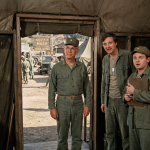
Suddenly, the wooden door to the left, which led out into the compound, began to rattle. It was a familiar sound, the precursor to a hurried entry. The handle turned, and the door was thrown open.
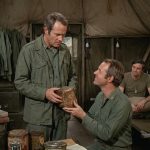
In bounded Klinger, but not in his usual flamboyant attire. Today, he wore standard-issue fatigues, but his arms were overflowing with letters. Bundles of white and beige envelopes were clutched to his chest, creating a rustling mountain that nearly obscured his face.
His expression, usually one of calculated theatricality, was one of pure, unadulterated astonishment. His mouth was open in a perfect ‘O’, his dark eyes wide and wild. He stopped just inside the doorway, the pile of mail shaking with his rapid breathing.
“You… you won’t believe it,” Klinger stammered, his voice choked with urgency.
Radar, sensing the immediate shift in the room’s atmosphere, looked up from his call, his heart rate spiking. B.J. straightened up, the banter forgotten. This was something different. This wasn’t just news about socks.
“What is it, Klinger? What’s going on?” Radar asked, his voice tighter than usual.
Klinger took a step into the room, struggling to keep his precarious bundle intact. He looked from Radar to B.J., his eyes moving back and forth as if searching for the right words, his jaw still hanging loose with disbelief.
“I was at the mail tent,” he finally choked out, “and… and they were sorting the officers’ letters. There’s something…”
He paused, a single tear beginning to pool in the corner of one eye. The expression on his face wasn’t just surprise; it was a profound, shocking moment of recognition that seemed to strip away all his usual layers of performance. It was a moment of complete and raw vulnerability, and it immediately grabbed the attention of everyone in the small room.
Klinger’s next words hung suspended, and the silence that followed was louder than any cannon fire.
“There’s… there’s a letter from Toledo,” Klinger said, his voice almost a whisper. “From the orphanage where I used to bring clothes. The sister… the mother superior… she wrote me.”
The room fell silent. It was a kind of silence they rarely experienced—a silence not of waiting for the wounded, but of waiting for a piece of shared humanity. Radar lowered the phone receiver, letting it rest on its cradle. He hadn’t even realized he’d hung up.
B.J. slowly capped his pen, his face softening with understanding. He’d heard the stories of Klinger’s time in Toledo, of his tireless fundraising for that small community. But those stories had always seemed disconnected from the reality of the 4077th, a distant echo of a kinder world. Hearing it mentioned now, in this cramped, paper-filled office, made it feel real.
“A letter… just for you?” Radar asked gently.
Klinger nodded, the pile of mail shifting slightly. “Yes. She said the children received the latest package I sent. They made me… they made drawings.” He managed to loosen his grip slightly, and from deep within the stack of letters, he pulled out a crumpled piece of paper that had been folded into quarters.
He handed it to B.J., who took it with a tender touch, as if it were ancient parchment. He unfolded it slowly, and his eyes softened. It was a child’s drawing—crude and colorful, with scribbled flowers and a house that leaned precarious but proud under a impossibly blue sky.
“It’s beautiful,” B.J. said, and for a moment, he wasn’t a surgeon; he was a father, picturing the hands that had held that crayon. He showed it to Radar, whose expression mirrored his own—a mixture of wonder and profound nostalgia.
Klinger watched them, a complex tangle of emotions playing across his face. There was the pride of being recognized for something he valued, the sorrow of missing those he loved, and a flicker of the simple joy that came from seeing his world collide with the one he dreamed of. The surprise that had marked his face earlier had softened into a gentle, tearful smile.
“She says they miss me,” Klinger whispered. “They ask when I’m coming home.”
The words floated in the air, a common refrain that echoed in every corner of the camp. But hearing it spoken now, about children an ocean away, gave it a weight that was nearly unbearable. The office, with its stacks of forms and logistical demands, suddenly felt profoundly inadequate, a small box holding people with hearts that yearned for something beyond its walls.
B.J. finally handed the drawing back to Klinger, who tucked it away safely into a inner pocket. “Maybe they have more drawings like that waiting for me, too,” B.J. said, a distant look in his eyes.
Radar began to rearrange the papers on his desk again, but this time, the order felt less important. He patted his stack of file folders—the ‘S’ section, the medical requisitions, the endless requests—and he saw them for what they really were: the tethers that kept them attached to a purpose, however brutal, but also the obstacles that kept them from the skies they longed to see again.
Klinger didn’t go for his usual dramatic exit. He didn’t make a joke or try to use the emotional moment to petition for a section eight. He simply held the stack of mail a little tighter, a gentle reverence having replaced his earlier urgency. He turned to leave, but before he reached the door, he looked back at the two men.
“I’m gonna distribute this mail,” he said softly, “maybe there are some more surprises in here.”
With that, he walked out into the dusty compound, leaving a stillness in the room that was filled with a warm, shared kind of ache. The office returned to its state of organized chaos, but the stack of files on Radar’s desk seemed slightly less imposing, the heavy Royal typewriter a little less cumbersome.
Radar glanced at the phone again, then at the clock. The logistical calls would always be there. But for a moment, the sky had come to them, carried in the arms of a man who just wanted to bring a little color back into their lives.
B.J. opened his notepad, his pen poised over the paper. “We should probably get back to that supply request for the surgical dressings, Radar.”
“Yes, sir,” Radar said, “just one sec.” He reached down and adjusted a pile of forms, his fingers brushing against a folder labeled ‘Personnel.’ He didn’t open it, not right then. He just needed to know it was still there, a reminder of the people who inhabited this world of paper, and the worlds they each carried in their hearts.
And out in the compound, Klinger made his rounds, his arms a little less full, his step a little lighter, carrying a letter from a place that remembered him for a reason other than wearing a skirt, and carrying, too, a piece of the sky that they all so desperately missed.
Some days, the mail was just mail, but other days, it was a lifeline to the people we were before the world forgot to be kind.