A Cupful of Human Kindness: The 4:00 AM Coffee Break
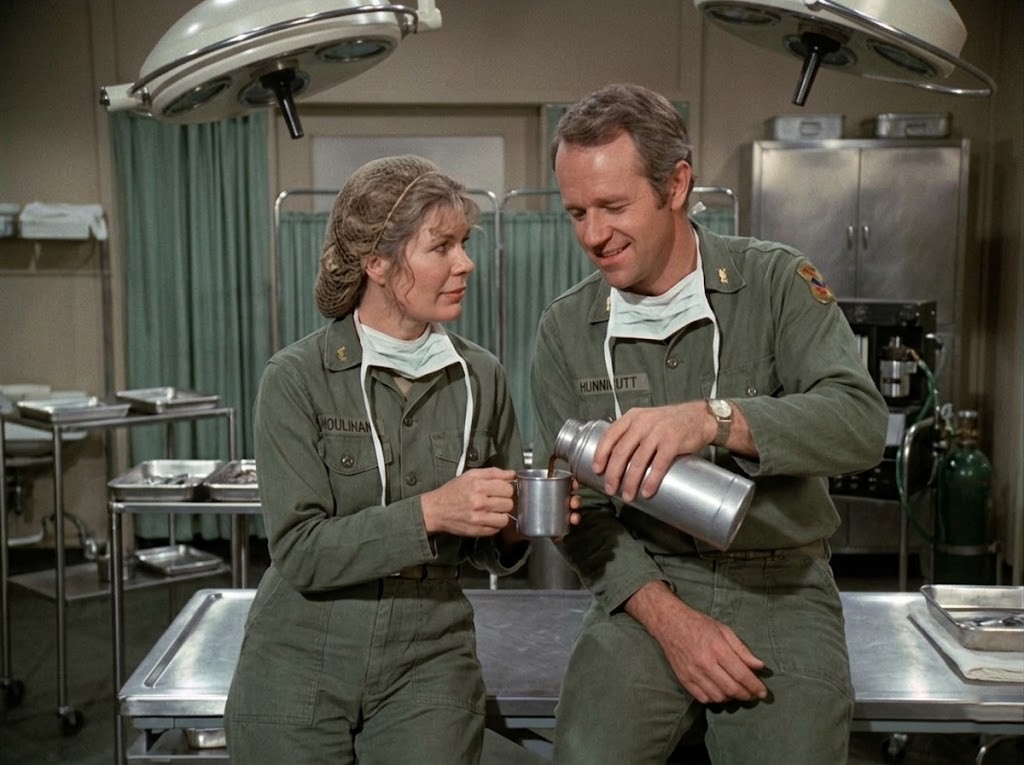
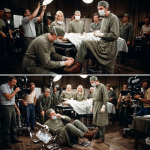
It was just after 4:00 AM in Korea, which meant it was also just past exhaustion in the Operating Room of the 4077th.
The last casualty had just been wheeled out, the surgical table wiped down, and the smell of antiseptic hung heavy and low, almost as thick as the silence. For three straight days, the O.R. had been a whirlwind of sound—screams, prayers, the endless metallic clatter of surgical tools, and the frantic, determined voices of surgeons and nurses.
And then, the quiet. Which was sometimes worse.
Surgical instruments lay on stainless steel trays, clean now, but still carrying the ghost-weight of everything they had touched. High above, the massive O.R. lights still blazed, their unforgiving glare highlighting every tired crease and worry line.
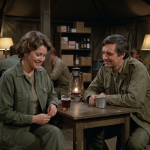
Major Margaret Houlihan and Captain B.J. Hunnicutt weren’t just tired; they were vibrating with the kind of fatigue that gets down into your bone marrow. Margaret had leaned herself against the edge of a scrub sink, her eyes momentarily closed. The O.R. was technically ‘down’, but for her, it was never really off.
B.J. was propped against a sterile tray table, which wasn’t technically against regulations but was close enough to get them in trouble if an inspector were ever to visit. Not that an inspector would ever come to the 4077th, especially not at 4:00 AM, but Margaret always held herself to a certain standard, even when her knees were buckling.
They were both still in their green surgical coveralls, their green hair coverings still on, and their face masks were pulled down, resting loosely around their necks. Those masks, meant to protect, were currently serving as reminders of how difficult the last 72 hours had been.
It was during one of these silent, liminal moments that the shift happened. The collective weariness was a thick blanket, a heavy presence you could almost touch.
Margaret opened her eyes, finding B.J. looking at her with a worn-out smile. He looked older than he did three days ago. More tired. Maybe even a little sad.
Without saying a word, B.J. reached behind him and produced a battered, army-issue metal thermos. He didn’t explain where he’d gotten it. He didn’t make a show of it. He just brought it out.
He unfastened the lid and then, carefully, poured a cup of coffee into a small, dented steel mug. The mug itself looked like it had survived several wars, not just this one.
The steam that curled from the mug was a small miracle. It smelled like salvation, but it also smelled like home. Specifically, it smelled like a small-town diner somewhere in Iowa, and for a split second, B.J. looked like he could almost see it.
Margaret watched him, her fatigue warring with a quiet sense of curiosity. She held out her hand, and B.J., still smiling, carefully held the cup and poured the dark, rich liquid. His focus was singular; he wasn’t pouring coffee, he was delivering hope.
And then, just as the last drop was about to leave the thermos, the distinct, low thud-thud-thud of a helicopter rotor blade filled the air. They both froze, their tired bodies reacting before their minds could register the implication. The O.R. was going to be busy again.
The cup of coffee, the last small mercy they had, sat, half-full, in the stainless steel tray. It felt like the entire universe was contained within that small, steaming metal vessel. And then, as the sounds of the chopper grew louder, they heard it—the cry of a single voice. A voice crying out for help, not a soldier’s, but a child’s.
The silence of the O.R. shattered, and in its place was a flurry of purposeful movement. The chopper’s sound was a signal that the moment of peace had ended, but that small, high-pitched cry changed the nature of the urgency. It wasn’t just another incoming casualty; it was the most fragile kind.
They didn’t look at each other, but they knew the other’s next move. Margaret had the green hair covering ripped off and her face mask was back in place before B.J. had even started moving toward the doors. The transformation was instant—from two exhausted, broken-down humans to the professional medical unit they were known to be.
B.J. didn’t even pick up the coffee. He just started to run. He had two young daughters back home in Peg, and that sound, that tiny, panicked sound, was a dagger to his heart. It didn’t matter that it was a Korean child. To him, in that moment, it was *his* child, crying for him, for anybody, across an ocean.
They found the young girl—she couldn’t have been more than ten—lying on a stretcher just outside the triage tent, her face pale, her breathing shallow. She was dressed in traditional Korean clothes, dusty and torn. A local man, his face a mask of worry and dust, clutched her hand, tears leaving tracks in the grime on his face.
“She was caught in some crossfire,” Radar said, appearing out of nowhere with a clipboard and a hand on the local man’s shoulder. “I already put her in the queue for Klinger to get her sorted, but…” his voice trailed off as he looked at the little girl, his large, round eyes filled with a concern that was far too old for him.
“Let me look at her,” B.J. said, already on his knees, his hands moving with gentle precision. He looked at the child, ignoring the language barrier, ignoring the war, ignoring everything but the patient in front of him. He needed to be her anchor.
They all watched, a collective holding of breath, as B.J. worked, his face a study in tender concentration. Margaret was right there beside him, anticipating every need before it was spoken. There was no rank in that moment. There were just two people, united in a single, sacred goal.
When B.J. finally looked up, his expression was a mix of fatigue and a single, hard-won victory. “It’s serious, but we got it early. She’s going to be okay.”
The relief that swept through the room was palpable, a shared exhale that almost felt louder than the original chopper sound. The local man started to cry openly, his hands shaking as he touched the girl’s forehead.
It was in moments like this that the true character of the 4077th was forged. It wasn’t about the grand victories or the dramatic gestures. It was about the small acts of kindness, the shared burdens, and the found family that had taken the place of the ones they had all left behind.
Later that same morning, as the first rays of the sun started to peak over the surrounding hills, B.J. and Margaret found themselves back in the O.R., the same O.R. that had been the scene of so much pain and so much triumph. The stainless steel tables were empty, the O.R. lights finally off, replaced by the soft, warm glow of the dawn.
They didn’t speak, and they didn’t need to. The coffee, now long cold, was still sitting in the metal mug on the tray. B.J. picked it up, took a slow, methodical sip, and then, with a quiet smile, held it out to Margaret.
She hesitated, her professional demeanor clashing with her human fatigue. But then, looking at the man in front of her, she saw not just a doctor, not just a colleague, but a friend. A family. And she took the cup.
That simple, shared cup of cold coffee was a testament to their resilience, their camaraderie, and their shared commitment to finding a small bit of grace in a truly broken world. It wasn’t just a drink; it was a promise. A promise that no matter how long the shift, no matter how heavy the burden, they would always be there to pick up the pieces, one small cup at a time.
And in that one small, steaming cup, the 4077th found its humanity, and we found our heart.