The Quietest Hour in Post-Op
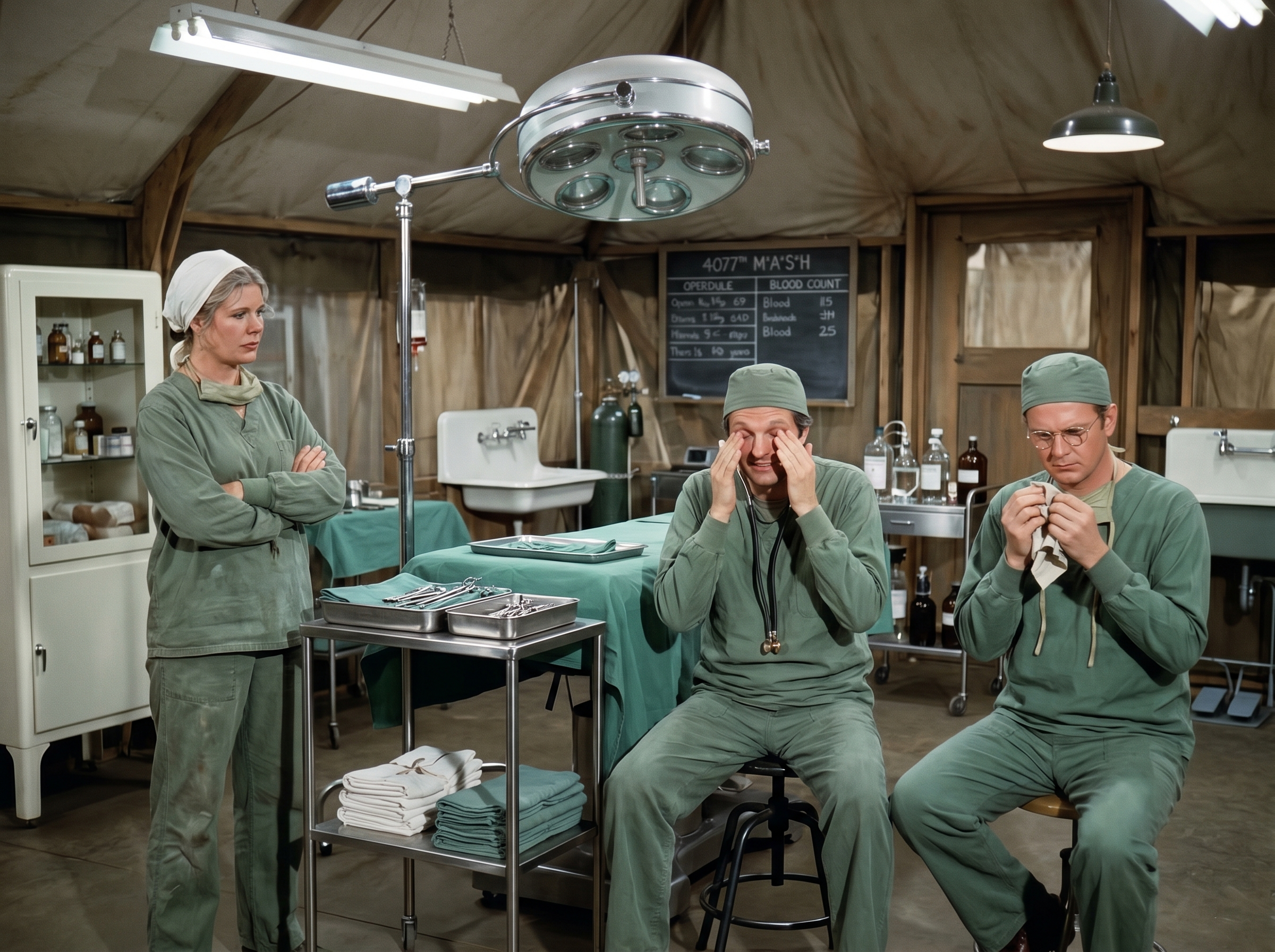
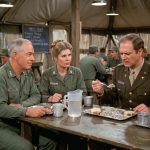
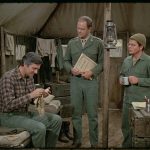
The surgical tent was finally silent, a rare, ringing stillness that felt heavier than the chaos of the last twelve hours. The overhead lamps hummed with a low, dying buzz, casting long shadows against the canvas walls as depicted in a10_clean.jpg.
Hawkeye sat on the metal stool, his posture collapsed, his fingers pressed firmly against his eyes as if he could physically push away the day’s toll. Next to him, B.J. hunched over, his own face a mask of exhaustion as he methodically cleaned a small piece of gauze, his eyes focused on the fabric with a desperate, singular intensity.
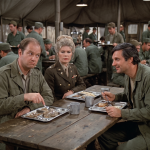
Margaret stood to the side, her arms tightly crossed over her scrubs, her gaze fixed on the two men. She wasn’t barking orders or checking charts; she was simply watching, her jaw set, guarding the silence they had all earned.
The chalkboard behind them listed the blood counts, cold numbers that told the story of a long afternoon. Outside, the Korean wind rattled the tent flaps, but in here, the air was thick with the smell of antiseptic and the collective, bone-deep fatigue of people who had given everything they had.
Suddenly, Hawkeye let out a ragged, humorless chuckle, his hands still covering his face.
“You know, B.J.,” he murmured, his voice sounding like gravel, “they say time heals all wounds. I’d settle for it just healing the stiffness in my lower back.”
B.J. didn’t look up, but the corner of his mouth twitched, though his eyes remained dim.
“I’d settle for a drink that didn’t taste like radiator fluid and a bed that didn’t double as a drainage ditch,” B.J. replied, his voice barely a whisper.
Hawkeye finally dropped his hands, revealing eyes rimmed with a profound, aching weariness that seemed to age him a decade in an instant. He looked over at Margaret, his expression shifting from defensive wit to something raw and unguarded.
“Major,” he said softly, “if you’re going to stand there and judge us, I suggest you do it with a glass of something strong in your hand.”
Margaret’s expression softened, the rigidity in her shoulders dipping just a fraction. She looked at them—two brilliant surgeons reduced to two tired boys sitting in the dust—and realized with a pang that for once, she didn’t have the strength to play the disciplinarian.
“I’m not judging you, Captain,” she said, her voice unusually gentle, betraying a flicker of genuine concern. “I’m just waiting to make sure you’re both actually still breathing.”
Hawkeye stared at her, the silence stretching until it felt like it might snap under the weight of everything they couldn’t say aloud.
The tension reached a breaking point, not with a shout, but with the sudden, sharp clatter of a metal instrument tray being bumped by someone’s elbow. The sound echoed in the quiet tent, startling them all.
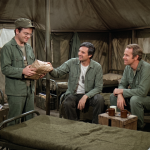
Margaret exhaled, a long, slow breath, and stepped forward, the professional distance finally dissolving. She walked to the small supply cabinet, retrieving a bottle of precious, hoarded scotch—the kind they kept for “emergencies”—and three chipped metal cups.
“It’s not exactly the officers’ club,” she remarked, her voice regaining a bit of its trademark steel, though it lacked any real heat. “But it’s a long walk to the mess tent, and I don’t think either of you is going anywhere.”
B.J. finally set down his gauze, looking up at her with a look of genuine, humble gratitude.
“Major, you are a saint in combat boots,” he said, offering a tired, lopsided grin.
Hawkeye just watched as she poured. The simple, domestic act of pouring a drink in the middle of a war zone was an absurd ritual, yet it was the only thing that made sense in the world they occupied.
As she handed them the cups, the harsh, clinical light from the overhead lamps seemed to dim, replaced by a strange, fragile warmth. They didn’t toast to anything—not to the war, not to the victory of a successful surgery, not even to the morning. They just sat in the quiet, sipping the burn of the scotch and letting the adrenaline finally leave their limbs.
“You know,” Hawkeye said after a long moment, staring up at the tent ceiling, “if I had a nickel for every time I thought about quitting, I’d be a very rich man. But I’d be a very lonely one.”
B.J. nodded slowly, his gaze drifting to the empty operating table behind them.
“We’re a long way from home, Hawk,” he said softly. “But I suppose the view isn’t half bad, considering who’s sitting in the front row.”
Margaret stood leaning against the supply table, her arms finally uncrossed, her hands resting at her sides. For a moment, the Major and the two surgeons weren’t defined by rank or duty, but by the shared, heavy burden of being human in a place that tried its hardest to strip that away.
They sat there for a long time, the only movement the slow drip of an IV bag somewhere in the dark and the occasional shifting of the tent canvas. There was no need for grand speeches or heroic declarations. The friendship was in the exhaustion, the quiet companionship, and the unspoken pact that tomorrow they would wake up, scrub in, and do it all again, together.
The war would continue outside, the trucks would rumble, and the helicopters would return, but in this small, dusty square of the 4077th, there was a fleeting, perfect peace.
In the heart of the storm, the quietest moments are the ones that hold us together.