Maps, Men, and the Long Road Home
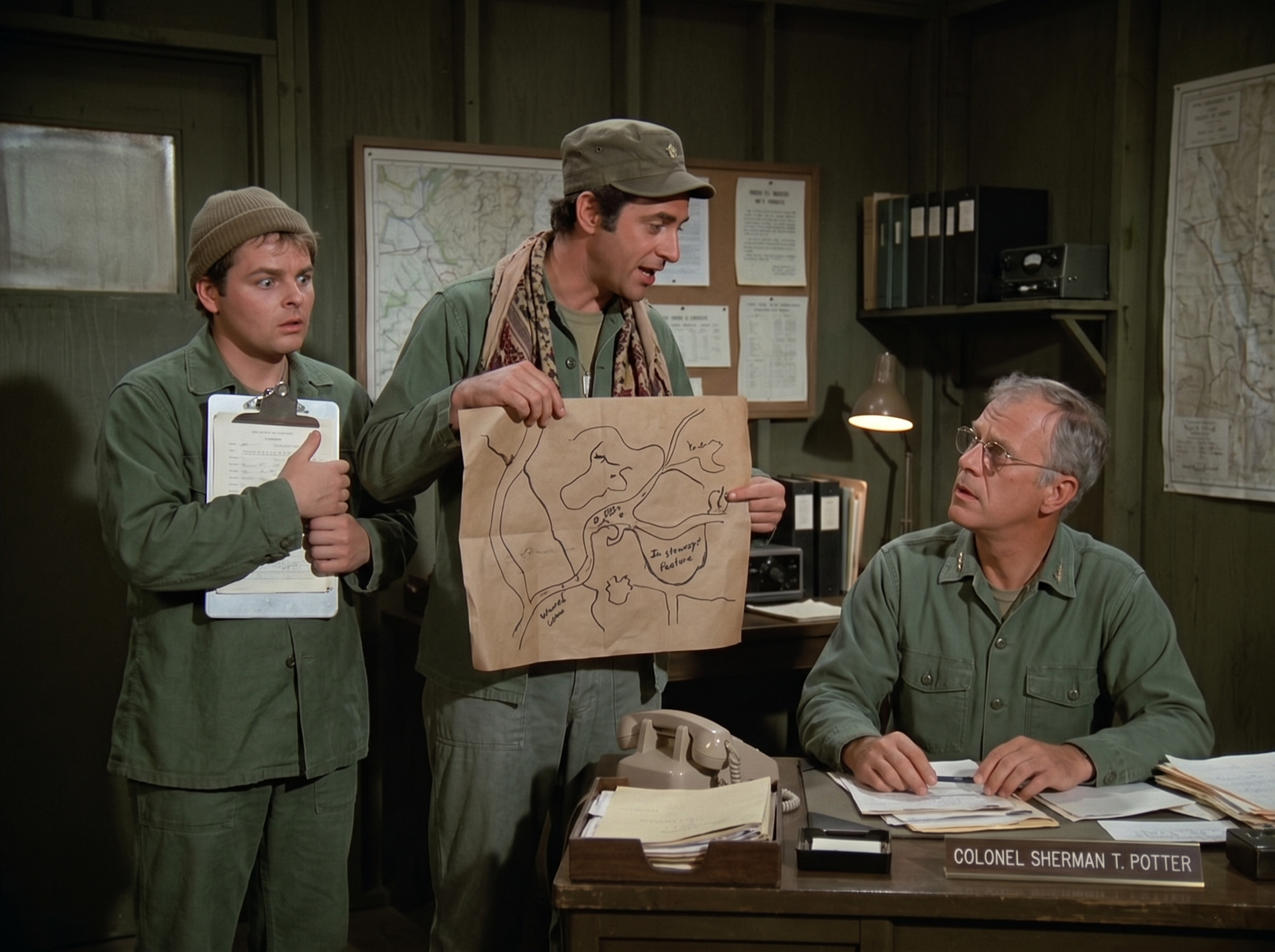
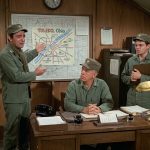
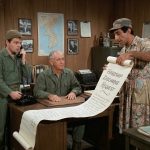
If fatigue had a visual representation, it was the inside of Colonel Potter’s office that night. The air was thick with the faint smell of old coffee, stale tobacco, and the crushing weight of another endless day. It felt less like a headquarters and more like a quiet waiting room for a world that refused to stop spinning. The simple, painted wooden walls seemed to press closer, absorbing the tension that always hung silently above the single, small desk. The light from a single, green-shaded lamp was a sharp, yellow reminder of everything that wasn’t peaceful. Behind that desk sat Colonel Potter himself. His posture, stiff but not rigid, spoke of a tiredness that had seeped into his bones long before this war began. He stared down at the daily paperwork—a mountain of administrative futility that never seemed to shrink, no matter how many forms were signed.
On the desk, the nameplate was clear: “COLONEL SHERMAN T. POTTER.” It was a tiny island of stability in an ocean of uncertainty. To his right, the desk phone sat, silent for now, but its presence was a constant threat of a midnight call, a new crisis, or more casualties. He hadn’t had a decent cup of cocoa or a quiet thought all evening. The paperwork, normally just a chore, now felt like a personal insult from the bureaucrats in Seoul who didn’t understand the 4077th’s special kind of chaos. His expression was a carefully held mask of stoicism, but the quiet weariness was etched deeply into the lines around his eyes. He didn’t just look like a commanding officer; he looked like a grandfather who wished the whole world would just go to sleep. He knew that any peaceful moment was a borrowed comfort, soon to be paid back with interest.
Then the door opened, ending the quiet. Captain Hawkeye Pierce walked in, followed closely by Corporal Radar O’Reilly. Neither had a patient or a rifle, which was, theoretically, a good sign. Hawkeye, still in his fatigues and the same patterned scarf, was holding up a large piece of brown, crinkled paper. Radar, clutching his omnipresent clipboard, looked like he had just witnessed an incredibly polite car accident. He was the picture of wide-eyed innocence, a small bird caught between a hawk and a grumpy old bear. His face was a map of nerves, his eyes flickering from Hawkeye to the Colonel with the practiced anxiety of a man who spent his life expecting to be yelled at for things he didn’t do. Hawkeye’s expression, however, was one of intense, earnest concentration, which was always far more dangerous than his sarcasm.
Potter looked up, his gaze settling on the pair. He didn’t say a word. He just lowered his spectacles and gave them the “Potter stare”—a unique look that could wither a young doctor’s ego while simultaneously demanding immediate explanation. The silence stretched. It was a familiar ritual: Hawkeye’s energy meets Potter’s resistance. The Captain, oblivious (or just pretending to be), thrust the piece of brown paper toward the Colonel’s desk. It wasn’t an official map, that much was clear. It was a chaotic network of hand-drawn lines, symbols, and scribbles made with a thick, dark pen. Radar, seemingly trying to physically compress himself behind his clipboard, gave a small, nervous gulp that was louder than he intended. Whatever this was, it wasn’t the delivery of the mail.
Hawkeye began his pitch, his voice urgent but strangely soft. He was pointing at the crude lines with an intensity that made the scribbles feel incredibly important. “Colonel, you have to look at this. It’s revolutionary. A complete rethink of logistics in this sector.” Radar shifted uncomfortably. He knew what “revolutionary” usually meant when it came from Hawkeye Pierce, and it rarely ended with everyone getting an extra ration of peaches. Potter’s gaze moved from Hawkeye to the crinkled map and back again. The quiet, exhausted humor in the room was hanging by a thread. The Colonel sighed, a sound that felt like he was exhaling the entire afternoon’s bad decisions. “Logistics, Pierce? I hope this isn’t another elaborate plan to swap medical supplies for a still or the back half of a jeep.”
Hawkeye’s voice dropped to a level of conspiratorial importance. “No, Colonel, better. *A lot* better. This is…” He hesitated, letting the moment swell. Potter’s patience was visibly thinning, his hands resting on his desk as if to hold it down against whatever storm Pierce was creating. Radar, now looking like he might vibrate out of his uniform, was staring at the paper with what looked like pure panic. Then Hawkeye spoke the words that stopped everything. “This is a map… to the *perfect* cup of coffee.” He paused, his expression unchanged. “The ‘Logistics of a Good Brew,’ Colonel. It’s a complete survey. Temperature gradients. Distance from the water source. Optimal roasting times. And…” he gestured with a flourish, “the hidden path to the *real* sugar ration.” The silence that followed was different. It wasn’t the tension of trouble; it was the quiet, strange pause of a room where sanity had just gone on furlough. Potter’s expression slowly changed, and the story had crossed a line it couldn’t return from.
Colonel Potter stared. It was a stare that could make a second lieutenant forget his own name. He wasn’t angry, not exactly. He was bewildered, fatigued, and holding a cup that was currently full of what B.J. called “the engine sludge of despair.” He looked at the frantic, scribbled map, then back at Hawkeye’s serious, focused face, and finally at Radar, who looked like a small animal caught in a headlight beam, desperately trying to merge with the wall. The green desk lamp cast long shadows that seemed to mock the entire, quiet encounter. “A map…” Potter repeated, his voice dangerously low, “… to a cup of coffee?” He said it slowly, as if the words themselves didn’t make any sense.
Radar couldn’t hold back anymore. He gave a sharp, frantic squeak that sounded like a distressed trumpet. “I told him, Colonel! I told him you were busy with the important reports! The real paperwork! But he wouldn’t listen! He just kept… mapping!” He gestured wildly with his clipboard, his innocent face contorted in an agony of responsibility and nervous energy. He looked as though he personally carried the blame for every cup of bad coffee in Korea. His eyes were wide with a plea for understanding, a small, scared beacon of obedience in Hawkeye’s sea of manic energy. Radar knew the chain of command, and he knew that “map of coffee” was not listed on any official diagram of responsibilities.
Hawkeye, however, stood his ground, unfazed. He brought the paper even closer to Potter, pointing to a particularly frantic tangle of lines. “Look here, Colonel. This ‘In Storage Feature.’ Radar said you keep the good stuff locked away. But this survey proves…” he looked from the map to Potter and back, “that this ‘feature’ is just the corner cupboard. And the ‘hidden path’ is simply avoiding the orderly room when Klinger is wearing a dress that makes a noise.” He tapped the paper, his conviction unshaken. “The Logistics of Happiness, Sherman. It’s all about the morale-to-caffeine ratio. And currently, the entire camp is running on empty.” His hand gestured with a flourish, as if to say, *Behold! The solution!*
Potter took a long, slow breath. The sound was like old wood sighing against a cold wind. He didn’t look at the map anymore; he just looked at his two men—the manic energy and the frantic innocence, side-by-side, united in their absurdity and their concern. He picked up his own, half-full mug of cold, dark coffee. He looked at it. He swirled it. He looked up at them, his eyes softened by a weary compassion. A faint, real smile tugged at the corner of his mouth, the kind that was only earned by being the father of a thousand problems that you didn’t have answers for. He held his mug out toward the strange, hand-drawn map. “Logistics, huh?” he muttered, his voice quiet.
The humor in the room changed then. It was no longer about the joke or the trouble. It was just three tired men sharing a quiet moment of connection, a found family finding a way to survive the crushing sameness. Potter’s smile deepened, a small crack in his professional wall. “Well,” he said, taking the map from Hawkeye’s hands, “if this map is as good as you say it is, I may need your assistance with the ‘In Storage Feature.’” He put his cup down and picked up the paper, examining the crinkled scribbles as if they were a blueprint for peace. Radar stared, his wide eyes processing the fact that he wasn’t going to the stockade. A look of profound, quiet relief washed over his young, anxious face. He let out a breath he felt he had been holding for days, his shoulders relaxing for the first time.
Hawkeye didn’t celebrate. He just gave a small, contented nod, a quick, almost tender smirk playing on his lips. His wit had softened the room, as it always did, hiding the exhaustion that he felt to his very core. He stood a little straighter, satisfied, but his posture was still heavy with the day. Radar, though relieved, was still staring at the map with a kind of terrified curiosity. Potter held it with care, and for a fleeting moment, the green lamp wasn’t illuminating problems; it was casting a light on the human bonds that held the 4077th together, tighter than any regulation. The quiet settled again, but this time, it was a warm, gentle quiet.
Hawkeye Pierce had just turned a logistical problem into a moment of found-family tenderness. He gave Potter a final, respectful look, and then turned, leaving the Colonel still studying the ‘perfect coffee’ map. Radar, still processing his survival, scurried after him, clutching his clipboard like a security blanket. The door clicked shut, leaving Colonel Potter alone in his office once more. He didn’t look back at his mountain of paperwork. Instead, he looked at his cold cup of coffee, then at the crinkled map, and finally, he gave a soft, thoughtful chuckle. In that small, painted room, filled with maps of war and documents of despair, the Hand-Drawn Map of the Perfect Brew was the most important thing Sherman Potter possessed. It was a blueprint for survival, drawn in the ink of friendship, the crinkles of exhaustion, and the enduring, bittersweet hope of a better cup.
It’s often the smallest maps that show us the truest way home.