The Ink of Ordinary Days
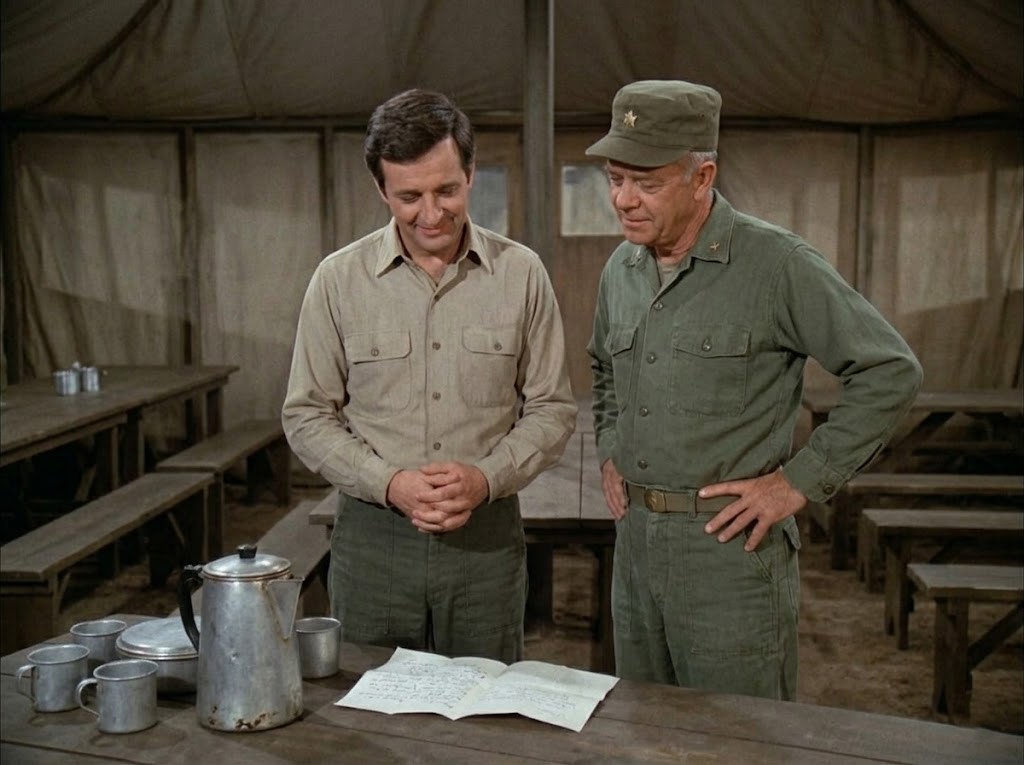
The Swamp was freezing, the O.R. was a conveyor belt of human suffering, and the mud outside had finally reached that special, treacherous depth that could swallow a combat boot whole.
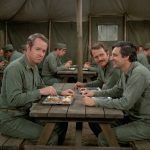
But inside the mess tent, under the low canvas ceiling and the faint, familiar scent of scorched coffee, a different kind of silence had fallen.
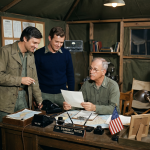
On the long wooden table, right next to a battered aluminum percolator and a few dented tin cups, lay a single piece of paper, creased and worn at the edges from a long journey across the Pacific.
Father Mulcahy stood with his hands loosely clasped in front of him, a soft, rare smile creasing the corners of his eyes as he stared down at the handwriting.
Beside him, Colonel Potter leaned in, his thumbs hooked loosely into his web belt, his star-adorned cap tilted just enough to catch the dim light of the afternoon.
Neither man spoke for a long moment; they just watched the ink on the page as if it were a fragile artifact retrieved from another world.
It wasn’t an official dispatch from Seoul, nor was it a stern reprimand from the top brass at I Corps.
It was a letter that had mistakenly slipped into the bottom of a supply crate of penicillin—a stray piece of mail addressed to a soldier who had been transferred out of the 4077th months ago.
“It’s from his daughter, Colonel,” Father Mulcahy said softly, his voice carrying the gentle, rhythmic cadence of a man who spent his days anchoring the souls of tired men. “She’s seven now. She writes about a stray cat that took up residence under their front porch in Ohio.”
Potter grunted, a sound that was half-gruff commander and half-sentimental grandfather. He looked at the crooked, oversized letters, the sprawling pencil marks that struggled to stay within the lines, and the tiny smudge of what looked like strawberry jam in the corner.
“A stray cat,” Potter muttered, his voice softening around the edges. “Mildred used to take those in. By the time I left for the Big War, we had a regular feline infantry division in the barn.”
He looked closer at the page, his eyes tracking a specific line where the child had drawn a rudimentary picture of a house with smoke curling out of the chimney.
The simplicity of it was striking, a sharp, beautiful contrast to the olive drab canvas and the distant, dull thud of artillery that served as their permanent background music.
For a few seconds, the war seemed to recede, leaving just the two men and a little girl’s description of a Tuesday afternoon in America.
But as Father Mulcahy turned the page to read the final paragraph, his smile faltered, and a sudden, heavy stillness settled over his shoulders.
Potter noticed the shift instantly, his brow furrowing as he glanced from the paper up to the priest’s face. “What is it, Father? Bad news from home?”
Mulcahy swallowed hard, his fingers tightening against each other as he looked at the date at the top of the letter, a date that changed everything about the innocent words on the page.
“The letter was written four months ago, Colonel,” Mulcahy said, his voice dropping an octave, carrying the weight of a truth he had seen too many times in this valley. “It’s addressed to Corporal Higgins. He was the young man from Toledo. The one who transferred to the 8063rd back in April.”
Potter’s face hardened, the lines around his mouth deepening. Everyone in the camp knew what had happened to the 8063rd’s forward detachment three weeks ago. It was the kind of news that didn’t need an official announcement; it just drifted through the tents like the winter chill.
Higgins wasn’t coming home to Ohio. He wasn’t going to see the stray cat under the porch.
The mess tent suddenly felt incredibly empty, the tin cups looking cold and institutional against the rough wood.
The door flap rustled, and Hawkeye Pierce walked in, his hands shoved deep into the pockets of his faded purple robe, his shoulders hunched against the wind.
He took one look at the solemn tableau—the priest, the Colonel, and the single piece of paper—and his usual sarcastic greeting died on his lips.
“Alright, who died?” Hawkeye asked, his tone stripping away the armor of his wit, leaving only the raw, protective instinct of a surgeon who fought death every single day. “Or did Radar finally find out what’s actually in the meatloaf?”
“An old letter, Pierce,” Potter said quietly, not looking up. “A ghost ship of a mail delivery.”
Hawkeye walked over, leaning over Potter’s shoulder to look at the paper. He read the crooked handwriting, his eyes moving quickly, his jaw tightening as he realized whose name was at the top.
He didn’t make a joke. He didn’t offer a cynical commentary on the army’s postal system. Instead, he reached out and gently touched the corner of the page, right over the little drawing of the smoky chimney.
“My dad used to write me letters like this when I was at camp,” Hawkeye murmured, his voice uncharacteristically steady, stripped of all theatricality. “He’d tell me about the harbor, about how the clams were running, or how the neighbor’s dog barked at the moon. Just… ordinary, beautiful, boring things.”
BJ Hunnicutt entered a moment later, wiping mud off his boots, a tired smile on his face that faded the moment he felt the room’s atmosphere. He stood by the door, quietly observing his friends.
He didn’t need to ask what was wrong; he saw the faraway look in Potter’s eyes and the profound, aching homesickness that mirrored his own whenever he thought of his daughter, Erin, growing up without him half a world away.
“What do we do with it, Father?” BJ asked softly from the doorway. “We can’t send it back. And we can’t forward it.”
Father Mulcahy picked up the letter, folding it with a reverence usually reserved for the sacramental elements. He slipped it into his breast pocket, right next to his silver cross.
“I’ll keep it,” the priest said firmly. “I’ll write to his widow. I won’t mention the delay, and I won’t mention the mud. I will just tell her that her husband was remembered here, and that his daughter’s words found their way to friendly hands.”
Colonel Potter nodded, a look of deep pride passing over his weathered features as he looked at his chaplain. He reached out, patting Mulcahy on the arm—a brief, solid gesture of military solidarity and human affection.
“Good man, Father,” Potter said, his voice thick but resolute. He turned toward the coffee pot, pouring a steaming stream of the dark, bitter brew into a tin cup, offering it to the priest. “Now, let’s drink this battery acid before the next chopper report comes in. We’ve still got a camp to run.”
Hawkeye sighed, the familiar, defensive spark returning to his eyes as he pulled a cup toward himself. “You know, Colonel, if we use enough sugar, we might be able to convince ourselves this is actually chocolate. Or at least, a highly toxic form of tea.”
The room broke into a quiet, collective chuckle—the fragile, necessary laughter that kept the 4077th from breaking under the weight of the world.
They stood together in the drafty mess tent, wrapped in the warmth of their shared exhaustion, holding onto the memory of an ordinary life that kept them all moving forward.
Amidst the noise of a forgotten war, it was the quiet reminders of home that kept their hearts human.