A Tapestry of Toledo
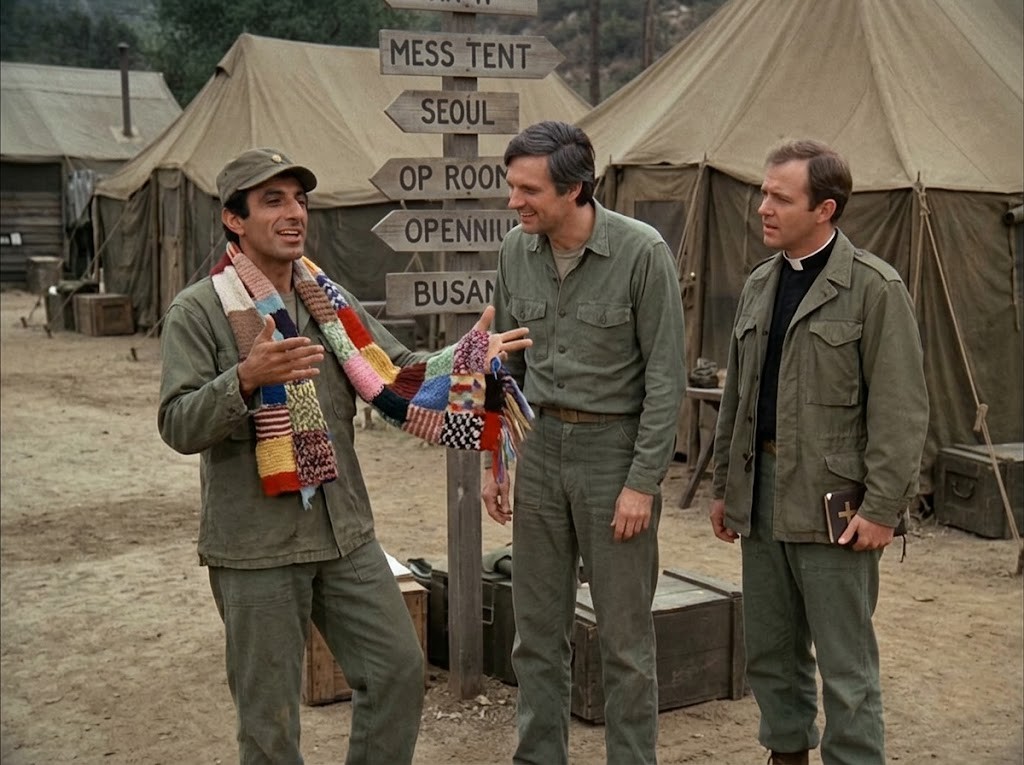
The 4077th Mobile Army Surgical Hospital was a world painted entirely in the colors of exhaustion. It was a masterpiece of monotony, rendered in endless shades of dust brown, sun-bleached canvas, and military-issue olive drab.
When you lived in that world long enough, your eyes started to starve for anything else. You forgot what a bright cherry red looked like, or the deep, comforting navy blue of a twilight sky back home.
Captain Benjamin Franklin Pierce was currently standing in the center of the compound, feeling precisely that kind of starvation. He had just walked out of a grueling fourteen-hour shift in the OR. His shoulders ached, his eyes were heavy with grit, and his mind was still buzzing with the chaotic rhythm of surgery.
Hawkeye stopped by the wooden signpost that stood at the heart of the camp. He let his hands rest loosely near his belt, taking a deep breath of the dry, dusty air. It wasn’t clean air, but it wasn’t the sweet, heavy smell of ether, and that was good enough for him.
Father John Mulcahy was standing just a few feet away. The chaplain was clutching his worn black Bible against his green jacket, looking up at the wooden arrows pointing to places like Seoul, Busan, and Coney Island. The Father had a habit of looking at those signs when the camp was quiet, perhaps offering a silent prayer for the miles that separated the men from the lives they had left behind.
For a moment, it was just the two of them, standing in the tired, quiet aftermath of another long day.
Then, the quiet was broken by the crunch of heavy boots on the dry earth, and a sudden, violent explosion of color entered the compound.
It was Corporal Maxwell Klinger.
However, for once, the pride of Toledo was not wearing a chiffon evening gown, a feathered boa, or a smart matching skirt and jacket. He was wearing his standard, regulation green fatigues and his military cap.
But draped around his neck, cascading down his chest and hanging almost to his knees, was the most magnificent, absurd, and vibrant piece of knitwear the Korean peninsula had ever seen.
It was a scarf, but calling it a scarf felt like a profound understatement. It was a chunky, heavy, chaotic patchwork of clashing colors. There were squares of mustard yellow stitched next to crimson red, interwoven with blocks of cobalt blue, bright orange, and a particularly loud shade of purple. It looked less like an article of winter clothing and more like a melted box of crayons.
Hawkeye tilted his head, a genuine, amused smile breaking through his deep fatigue. He looked Klinger up and down.
“Well, Max,” Hawkeye said, his voice laced with affectionate dry wit. “I have to admit, it’s a bold fashion choice. But aren’t you worried that wearing a rainbow in a combat zone might make you a rather festive target?”
Father Mulcahy furrowed his brow, looking at the scarf with a mixture of gentle bewilderment and deep pastoral concern. He tilted his head, trying to find some sort of pattern in the chaotic knitting.
“My goodness, Corporal,” Mulcahy murmured softly. “That is certainly… an enthusiastic garment. Did you find that in the local village, or is this a new tactic for a psychiatric discharge?”
Klinger stopped in front of them. He didn’t offer his usual theatrical wink or a rehearsed speech about section eights. Instead, his dark eyes were wide, and his hands were moving quickly, gesturing dramatically toward the woolen blocks resting against his chest.
“Gentlemen, feast your eyes on a genuine masterpiece,” Klinger said, his voice rising with that familiar, frantic Toledo hustle. “This isn’t just a scarf. This is a shield. This is a work of art. This is a direct import from the greatest city on God’s green earth.”
“It looks like an afghan had a nervous breakdown,” Hawkeye chuckled softly, still smiling.
But Klinger didn’t laugh. He reached into his deep fatigue pocket and pulled out a piece of paper. It was a letter, crumpled and smoothed out several times, the edges soft from being handled.
Klinger looked down at the paper. His expressive hands stopped moving. The frantic, salesman-like energy drained out of him in an instant. He swallowed hard, his throat bobbing, and when he spoke again, his voice was tight, thin, and dangerously close to breaking.
“It came in mail call this morning,” Klinger whispered, staring at the paper. “From my neighborhood. From the women on my street.”
He looked up at Hawkeye, his eyes shining with a sudden, overwhelming moisture, the vibrant colors of the scarf framing a face that suddenly looked incredibly young and unbearably far from home.
Hawkeye’s smile faded, though the warmth in his eyes remained. The tired amusement vanished from his face, instantly replaced by the sharp, quiet empathy he usually reserved for boys waking up in the post-op ward. He let his hands fall to his sides and took a half-step closer.
“From the neighborhood, Max?” Hawkeye asked quietly, his voice gentle and completely free of sarcasm.
Klinger nodded, his fingers gripping the crumpled letter tightly. He looked down at the heavy yarn draped over his shoulders, reaching up to touch a bright blue square with a dirt-stained thumb.
“Yeah,” Klinger said, his voice thick. “My Ma organized it. She got all the ladies on the block together. They heard it gets cold over here in the winter. Real cold. So, they wanted to make me something to keep me warm. But… yarn is expensive right now. Hard to come by.”
Father Mulcahy stepped closer, his initial confusion melting away into a profound, tender understanding. He looked at the mismatched squares not as an eyesore, but as a deeply human labor of love.
“So, they used what they had,” Mulcahy observed softly, his fingers tightening around his Bible.
“More than that, Father,” Klinger said, a tear finally escaping and tracing a clean line through the dust on his cheek. He didn’t bother wiping it away. “They used what I left behind.”
Klinger pointed to the bright blue square he was holding. “My Ma wrote it all down in the letter. This blue part? She unraveled my old baseball socks. The ones I wore when we won the city championship.”
He moved his hand to a deeply saturated, crimson red square. “And this red one here. That’s from the sweater my Uncle Mustafa used to wear when he worked the night shifts at the packing plant. He wore it every day until it fell apart.”
Hawkeye stood perfectly still, listening. The wind blew a fine layer of dust across the compound, but all he could see were the vibrant colors of a life happening thousands of miles away.
“This yellow piece,” Klinger continued, his voice trembling as he traced a soft, chunky square near his collarbone. “That’s from the blanket my little sister had on her bed when she was a baby. She’s grown up now. But Ma saved it.”
Klinger took a shaky breath and looked up at the two officers. The weight of the war, the endless days of blood, the crushing boredom, and the terrifying noise seemed to press heavily on the young corporal’s shoulders. But the scarf was holding him upright.
“Ma said she wanted me to be wrapped up in the neighborhood,” Klinger whispered, his voice barely carrying over the distant, low hum of the camp’s generators. “She wrote that as long as I wear this, I ain’t really in Korea. I’m sitting on the front stoop in Toledo on a Sunday afternoon, with everyone looking out for me.”
Silence fell over the small group by the signpost. It was a heavy, sacred kind of silence.
Hawkeye reached out and lightly brushed his fingers against a dark green patch near the end of the long scarf. He felt a sudden, sharp ache in his own chest, a wave of homesickness so strong it almost knocked the wind out of him. Crabapple Cove, Maine, felt just as agonizingly out of reach as Toledo, Ohio.
For once in his life, Benjamin Franklin Pierce didn’t look for a punchline. He didn’t try to deflect the emotion with a rapid-fire joke.
“It’s a beautiful piece of work, Klinger,” Hawkeye said, his voice slightly gravelly with his own unspoken longing. “It really is. It’s the finest piece of haberdashery in all of South Korea.”
Father Mulcahy smiled warmly, his eyes crinkling at the corners. He reached out and gently patted Klinger’s shoulder, right over a bright orange square of yarn.
“I believe the good Lord appreciates a splash of vibrant color in an otherwise dreary landscape,” Mulcahy said gently. “It is a beautiful testament to love, Corporal. And the love of a family is never out of uniform.”
Klinger sniffled, finally reaching up to wipe his cheek with the back of his hand. A tiny, fragile piece of his usual, resilient spirit began to return to his eyes. He stood a little taller, adjusting the heavy wool around his neck.
“You think it’ll pass inspection, Captain?” Klinger asked, a hint of his old hustle creeping back into his tone. “Major Burns might have a stroke if he sees me wearing civilian colors with my fatigues.”
Hawkeye grinned, a real, deeply fond smile that reached all the way to his tired eyes.
“If Frank or Margaret say one single word about this scarf,” Hawkeye said, patting Klinger on the arm, “I will personally write a medical profile declaring you tragically allergic to standard-issue neckwear, and I’ll have B.J. co-sign it.”
“Thank you, Captain,” Klinger said softly. “Thank you, Father.”
“Come on, Max,” Hawkeye said, gesturing toward the mess tent. “Let’s go get some coffee. You can tell us if your baseball team was actually any good, or if that’s just another Toledo tall tale.”
Klinger smiled, wrapping the long, absurd, beautiful scarf once more around his neck. The bright, clashing colors stood in fierce, glorious defiance against the dull mud and the fading canvas behind them.
The three men walked away from the signpost together, stepping back into the endless gray of the war, anchored and warmed by a messy, mismatched pile of love from home.
In a place where everything was designed to blend in, sometimes survival meant wearing your heart in the brightest colors possible.