The Masterpiece that Made the Colonel Pause
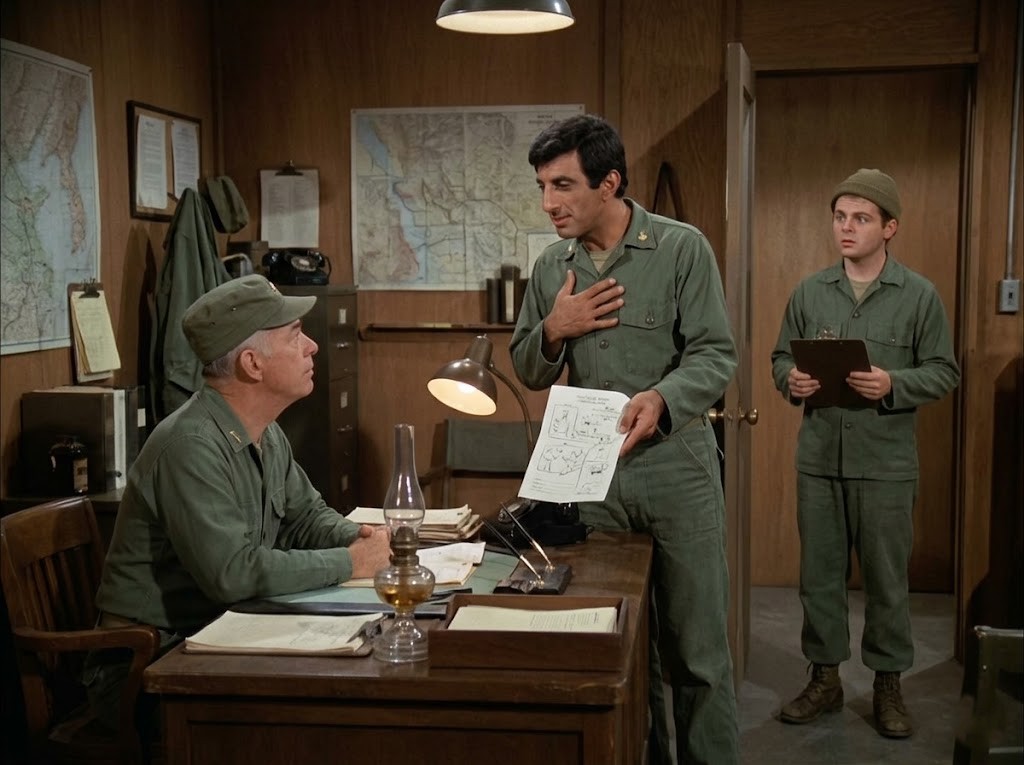
The stillness in Colonel Potter’s office was thicker than the dust on a Jeep’s windshield.
It was a quiet Tuesday afternoon, or what passed for quiet. The sound of the chopper pads was muffled, and for ten glorious minutes, the OR was dark.
Potter sat behind his heavy desk, his brow furrowed as he stared at another stack of supply requisitions. His signature cap, slightly faded by sun and sweat, was pulled low. He was a man holding the world on his shoulders, one form at a time.
Behind him, maps of the jagged Korean peninsula were pinned haphazardly to the wood-paneled walls. They showed troop movements that were constantly shifting, a visual representation of the chaos that was only miles away.
Corporal Radar O’Reilly stood by the doorway, clipboard hugged tightly to his chest. His knit cap was pulled over his ears, and he looked from the Colonel to the Captain, his eyes wide, nervously observing the interaction.
Captain Pierce had entered dramatically. He didn’t just walk; he arrived.
One hand was pressed over his heart, a look of profound, almost exaggerated pain and conviction etched onto his face. His posture was that of a classical actor delivering the performance of a lifetime, or perhaps a man suffering from severe indigestion.
In his other hand, he held a single, crumpled piece of paper. He had been chasing the Colonel for days with it, and this was finally his moment.
Potter looked up, sighing. He was accustomed to Pierce’s flair, but today he looked exceptionally weary.
“Pierce, unless that is a signed transfer for my favorite supply sergeant from Tokyo, I’m not in the mood,” Potter said, his voice a tired rasp.
“This, Colonel… this is art,” Hawkeye proclaimed, his voice low and vibrating with dramatic weight. “This is the human spirit, captured on the back of a confiscated requisition form!”
Potter eyed the paper. The drawing on it, from this distance, was nothing more than simple, pencil-drawn shapes. Two stick figures and a round blob.
“Is that a patient, Pierce? Another one of your psychological projects?” Potter asked, already sensing the impending request for an unauthorized item or an extreme medical intervention.
“It is a patient, yes. Private Miller. Or, as he is now known, ‘The Boy with the Charcoal Heart.’ He couldn’t speak, Colonel. He didn’t say a single word for four days. Not to the doctors, not to the nurses.”
Potter looked up, his expression softening slightly. Silence in a young soldier was often a sign of trauma too deep for words.
“And?”
“He sat there with a charred piece of wood and paper we found, and he worked. Hours. He drew… us,” Hawkeye said, his hand still on his chest, but his theatrics dropping to something closer to genuine sincerity. “The three of us. You, me, and the Corporal.”
Potter took off his glasses and rubbed the bridge of his nose. He took the paper from Hawkeye’s outstretched hand, his calloused fingers carefully handling the delicate sheet.
As he focused on the simple, pencil-drawn lines, the tired resignation in his face gave way to a new expression. He wasn’t seeing stick figures. He was seeing the human souls behind the camouflage. He looked up at Pierce, and the performance from the Captain was gone, replaced by an open, expectant vulnerability.
Potter looked back at the drawing, and for the first time all day, his shoulders dropped.
He stared at the paper in his hands, not speaking, and the quiet in the room suddenly felt heavy enough to break.
Potter stared at the simple graphite lines that covered the back of a form requesting new fuel drums.
It wasn’t a good drawing, by artistic standards. The proportions were wrong. The hands looked like forks. But the intent was crystal clear.
The stick figure on the left was undeniably the Colonel. It had a round, flat cap on its head and was drawn with solid, decisive strokes. Its hands were locked together on the table, exactly the posture of a man ready to listen.
The figure in the middle was Hawkeye. He was drawn with wildly waving limbs, one hand on his chest in a recognizable echo of his own dramatic stance. The face was just two dots and a line, but somehow it captured the Captain’s constant, frantic energy.
And the small, round blob on the far right, drawn in the corner near the door… that was Radar. It was smaller, clutching a small square (the clipboard), and the boy had even drawn two small lines around the head to represent the ears under the cap.
The simple, silent boy hadn’t drawn the tents, or the operating table, or the mud. He hadn’t drawn his own wound. He had drawn the only three men who had looked him in the eye and tried to connect when the rest of the world was just a screaming blur.
“He called it… ‘The Big Doctors,'” Hawkeye murmured, his dramatic voice replaced by a quiet, raw tone. “He finally spoke. Just that. And then he gave it to me.”
Radar shifted on his feet by the doorway, clear-eyed and earnest. He sniffed once, and the sound echoed like a gunshot in the silent room. “He drew me with big ears, sir. He noticed.”
Potter looked up from the paper, his eyes glassy, and let out a long, shuddering breath that wasn’t a sigh. It was a release of pressure he didn’t realize he’d been holding.
“It isn’t much,” Hawkeye said, trying to soften the emotional blow he’d delivered. “It’s just… it reminds you. That sometimes, when we’re not fixing bodies, we’re maybe fixing something else.”
Potter carefully set the paper down on his desk, not allowing it to crumple again. He looked at Hawkeye, really *looked* at him, beyond the theatrics and the sarcasm, and saw the man who needed to share this moment of grace as much as the boy had needed to draw it.
“He has to go back to his unit tomorrow,” Potter said, his voice steady now, but different than before.
“I know,” Hawkeye replied.
“He needs… well, he needs more than just some bandages,” the Colonel continued. “And we are going to run out of charcoal if we keep giving it to patients.”
Potter reached into his desk drawer and pulled out a small, metal tin. He opened it, revealing a small cache of colored pencils, slightly worn. They were a gift from his wife, Mildred, intended for him to sketch and relax in his minimal downtime.
“Radar,” Potter barked, and the Corporal snapped to attention. “Go down to Supply. Tell Zale… no, tell Klinger. I don’t want to explain myself to Zale. Tell Klinger I need a padded envelope and to get this paper to my home address in Missouri. Tell him… tell him it’s medical intelligence of a highly sensitive nature.”
Radar’s eyes lit up. “Yes, sir! Sensitive nature. Padded envelope. Right away, sir.”
Potter looked at Hawkeye. “And take these pencils to the boy. He’s earned some color.”
Potter then picked up the oil lamp that had been sitting unused in the center of his desk, next to the pen set. He looked at it for a moment, then positioned it on the paper, letting its base hold down the corners, protecting the silent masterpiece.
“Alright, Captain,” Potter said, putting his glasses back on. “Point made. Now get back to the pre-op. I think I hear the choppers, and they’re not bringing gifts.”
Hawkeye nodded, but he didn’t move. He stood there for a few seconds, looking at the drawing pinned under the lamp, and then at the old man who ran the whole messy, heart-breaking circus. He dropped his hand from his chest.
“Thanks, Colonel.”
“Go on,” Potter replied, not looking up as he finally picked up the supply forms he had ignored.
As Hawkeye turned to leave, and Radar scurried out ahead of him to find a suitable padded envelope, a moment of profound, wordless connection was left behind.
The maps on the wall showed a war, but the drawing on the desk showed a family that had found each other, stick figures and all, in the middle of it. The choppers were landing, and the darkness of the OR would soon be pierced by intense, bright lights, but for one simple moment, the lights of their own shared humanity were all that mattered.
It wasn’t a medal, but it was the best thing they ever won.