The Quiet in the Canvass: Remembering the Swamp
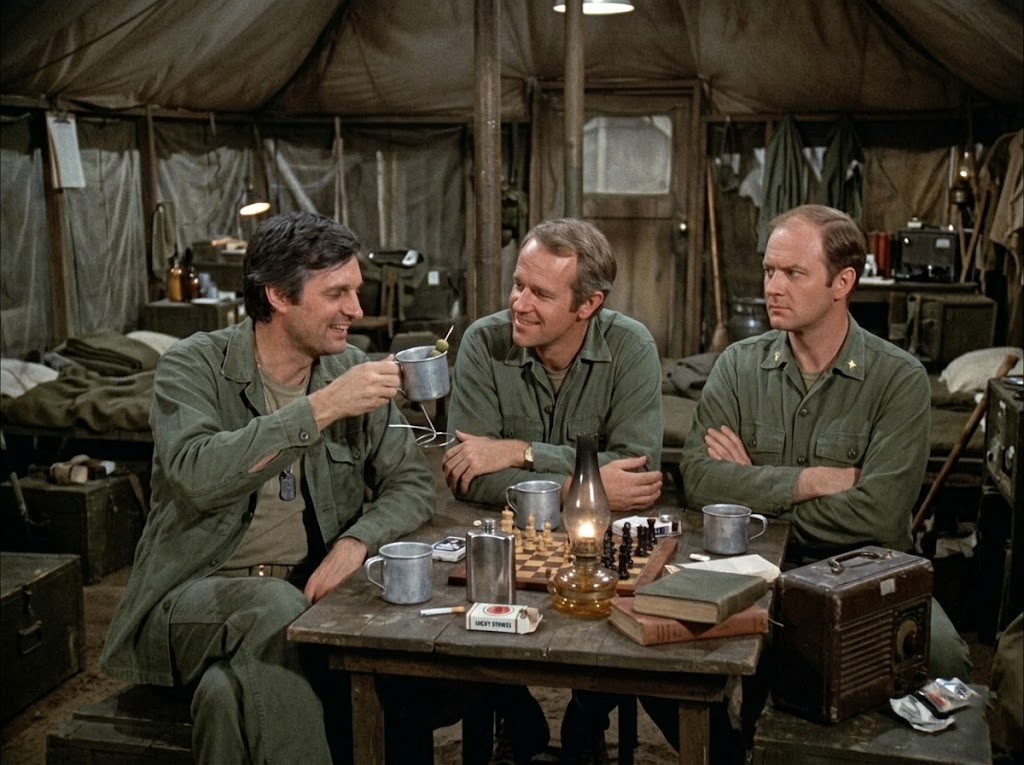
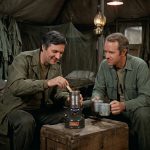
The dim lantern light in the officers’ tent barely cut the gloom. Outside, a light drizzle was falling. Inside, the three men were as far apart as they could be while sitting at the same rickety table. A vintage radio sat near one corner, its speaker muffled, playing something from another era. This was the Swamp, and on nights like this, it felt less like a medical compound and more like an emotional safe house.
Every movement in the small space seemed to ripple with a weary familiarity. They knew each other’s sighs, their specific brand of fatigue, and their favorite hiding spots within the silence. The surgical shifts had bled into each other, and now they were left with the aftermath—the simple, stark need to just exist.
On the table sat three metal mess mugs. They were scratched and dented, filled with the usual gin and grape juice concoction. Near them, a forgotten hip flask and a scattered chess game spoke of earlier, failed attempts at distraction. This specific configuration of drinks and props had become the standard operating procedure for the after-hours debrief.
Hawkeye Pierce, sitting relaxed and at ease, had been quietly holding court for ten minutes, recounting a story that was seventy percent fiction and thirty percent actual human logic. He was leaning back on his simple stool, one leg crossed over the other, wearing his signature olive-drab fatigue jacket. His grin was sharp, knowing, a weapon forged over months of coping with the impossible.
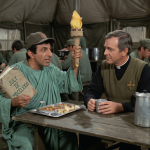
But tonight, Hawkeye wasn’t just talking; he was raising his mug. He had found, amidst the medical clutter, a single, perfect olive, which he had speared with a toothpick and placed carefully inside the gin. “Here’s to us, gentlemen. To the great and terrible art of holding it all together,” Hawkeye announced, his voice low, filled with a dry, tired warmth.
Beside him, B.J. Hunnicutt watched the olive Bob in the murky green liquid, a small, knowing smile on his face. He sat with his arms crossed over his chest, relaxed yet steady. B.J. understood the performative nature of Hawkeye’s wit, the way it covered the wounds that didn’t bleed. His own heart was thousands of miles away, and this quiet moment, with these men, was his anchor in the chaos.
But then there was Charles Emerson Winchester III. The Bostonian sat stiffly to B.J.’s right, his posture immaculate even in the simple canvas tent. He had been listening with his eyes fixed on the radio, his jaw set in a hard line. His expression was a carefully curated shield of indifference and superior breeding. Charles had always insisted that a gentleman never toasts with anything less than fine crystal and champagne, and certainly not with an olive in gin.
Charles crossed his arms even more tightly over his chest, as seen in the photograph. His silent resistance was a loud, judgmental thud in the small room. “Is that thing meant to be appetizing, Captain Pierce?” he asked, his aristocratic accent clipping the words like ice on a windowpane.
Hawkeye didn’t lower his mug. He didn’t lose his smile. “Charles, this olive isn’t food. This olive is a philosophical statement. It’s a bit of civilization floating in a sea of army issued sludge. It’s refined. Symmetrical. It’s practically you.”
Hawkeye’s eyes were locked on Charles, and for a long, fragile moment, nothing happened. The quiet hum of the radio and the steady drizzle on the canvas was all that filled the air. The small event, the simple toast, felt suddenly significant, a tiny battle of will and human connection. And Charles, with all his refined sarcasm and carefully guarded isolation, was looking Hawkeye straight in the eyes, refusing to budge, leaving the warm, hopeful moment hanging precariously on the edge of a stony, stubborn refusal.
The silence that followed was different. It wasn’t the usual comfortable, tired companion they shared. This silence felt like a physical weight, pressing down on the rickety table, straining the bonds of their found family. Hawkeye’s arm remained raised, the olive perfectly balanced. The playful glint in his eye was hardening, a flicker of something close to genuine frustration and pain slipping through the cracks of his performance. He *needed* this. They *all* did.
B.J. watched them both, the tension crackling between his two friends. He saw the look on Charles’s face—not just superiority, but a deep, hidden fear. He saw the way Charles tightened his grip on his own arms, as if holding his world together required maximum physical effort. Charles wasn’t just being stubborn; he was holding a wall that kept the real world, and the overwhelming pain he felt every day, at bay.
“He’s got you there, Charles,” B.J. said, breaking the silence with a gentle, grounding voice. “A symmetrical, refined statement. The man speaks your language.” He uncrossed his arms and took his own mug, ready to participate.
Charles let out a soft, sharp exhale that was half-sigh, half-snort. He didn’t uncross his arms. He didn’t speak. But the rigidity in his jaw softened, just slightly. The armor was heavy, and tonight, with Hawkeye looking at him with that quiet, human vulnerability behind the wit, the armor felt particularly suffocating.
“Fine,” Charles muttered, the word almost inaudible.
Slowly, deliberately, Charles began to move. He uncrossed one arm, then the other, the simple action feeling monumental in the cramped tent. He reached out and wrapped his hand around his own mess mug, which was sitting near the scattered chess pieces and the oil lantern. He didn’t smile, and he didn’t lower his guard, but he had engaged.
Hawkeye’s grin returned, this time authentic. “I knew it. You have a soul. B.J., quick, write this down: ‘Boston concedes defeat to an olive on a toothpick. The war is officially over.’ Wait, that’s not quite right. ‘Civilization triumphs over cynicism.'”
“Don’t push it, Pierce,” Charles warned, his voice dry but no longer hostile.
Hawkeye raised his mug slightly higher. “To us. For simply being here. And to this magnificent olive, named Herbert, who bravely gave his life for the cause of morale.”
B.J. raised his mug. “To US.”
And Charles, with a subtle shift in his expression that hinted at a secret compassion, touched his mug to the table, and then, slowly, toward Hawkeye’s. The metallic *clink* of the mugs coming together was the quiet resolution the night desperately needed. It was a humble moment, a found moment, a connection born of shared exhaustion and a deep, unspoken need to know they weren’t alone. They sat and drank in a different kind of silence now—one that felt safe, warm, and true to the human heart of the 4077th.
This was the Swamp, where the only thing that could truly warm the canvas was a simple, found moment of friendship.