The Wrench that Holds it All Together
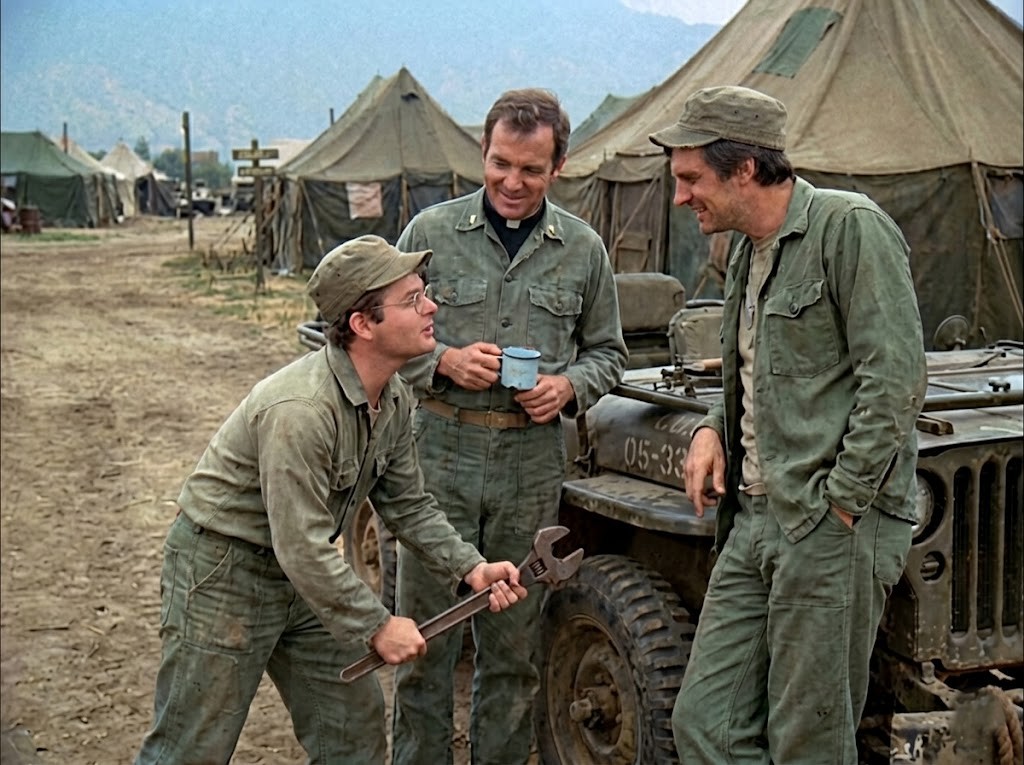
The dawn was still painting the mountains with a bruise-colored light when the compound first began to stir. It was that liminal hour in Korea where you couldn’t tell if the cold mist was dew or just exhaustion clinging to the canvas tents. The 4077th was finally quiet, a rare peace bought after a grueling seventy-two hour shift. But near the main cluster of dust-caked vehicles, there was movement.
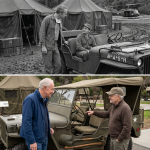
Captain Benjamin Franklin “Hawkeye” Pierce stood leaning casually against the front fender of a particularly battered jeep. His cap was askew, and he looked like a man who hadn’t slept since 1951. He watched the world with a weary, dry amusement, the only thing that kept him sane. Father John Mulcahy, ever the gentle soul, had stopped beside him, clutchin his blue enamel coffee mug like a holy relic. He looked tired too, but his expression held a quiet compassion as he looked down.
Their focus was on Radar O’Reilly.
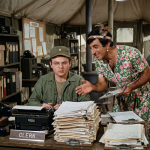
Radar wasn’t looking like the efficient company clerk. He was crouched down low, straining with an effort that made his face screw up. He was wearing his fatigues, already dirty with grease on one shoulder and a mud stain on his knee. Both of his small hands were wrapped around the wooden handle of a massive, old plumbing wrench. It was far too large for the job, whatever the job was. He was positioned near the jeep’s engine block, pulling with a desperation that was almost painful to watch.
Hawkeye watched him with a twitch of a smile. “Radar, are you trying to adjust that screw, or are you just performing an experimental, non-consensual engine massage?” he asked, his voice low and raspy.
Mulcahy chuckled softly. “He does seem very… dedicated, Pierce.”
Radar didn’t answer right away. He was too busy grunting. He took a breath, looked up, his glasses slightly crooked, and locked eyes with Hawkeye.
“Captain, the Colonel’s jeep,” Radar said, his voice earnest and full of dread. “It won’t start. And I’ve tried everything. The engine oil is fine. The battery is fine. I even checked the fuel line for dead mice. And you know, a while back, I sort of… well, I let the engine get a little hot, and I’m just sure this nut is the key to it all.” He looked back at the engine, biting his lip. “I have to get it right. He needs this jeep for that inspection over at Division at 0800. I can’t let him down.”
The wrench was slipping. It was just a millimeter at first. But as Radar put his entire weight behind it, the heavy metal teeth failed to bite. The wrench groaned. His foot slipped in the loose dirt. With a sudden, sickening *crack*, the wrench came loose. Radar tumbled backward, completely losing his balance. But that wasn’t the worst of it. The sound from the engine wasn’t a loose nut; it was the final, devastating mechanical crunch that signaled catastrophic engine failure. A cloud of oil-smoke hissed out from somewhere deep within the block. Radar froze, sitting on the ground, still holding that absurd, useless wrench with both hands, his eyes wide with horror as he looked at Hawkeye and Mulcahy.
Silence settled over the compound like heavy dust. No one moved. The image of Radar, small and defeated, framed by the smoky jeep and the endless rows of military-green tents, felt frozen. The wrench was no longer a tool; it was a symbol of an impossible burden. For a long, painful minute, the only sound was the faint hiss of oil against hot metal.
Hawkeye didn’t say anything witty. The joke died in his throat. He looked at Radar, and then he looked down at his own tired feet. This wasn’t a medical case, but it was a human one, and in some ways, it was just as complex. He saw the genuine distress in the young man’s eyes, the crushing weight of perceived failure. He pushed himself off the jeep, his casual pose forgotten, and walked over to where Radar was sitting in the dirt.
Mulcahy, too, moved. He stepped forward with a quiet, practiced tenderness. He didn’t try to console Radar with words at first. Instead, he simply knelt down beside him. With one hand, he gently reached out and took the large wrench from Radar’s hands. He didn’t use it or set it aside; he just held it for a moment, absorbing the weight and frustration that came with it.
“Radar,” Mulcahy said, his voice soft, “good intentions are not measured by a machine’s capacity to function.”
Radar looked at the Padre, then at Hawkeye. He was trembling. “But I broke it,” he whispered. “The Colonel’s jeep.”
Potter’s voice came from behind them, dry and unmistakable. “It appears you didn’t just break it, son. You practically committed engine-cide.”
The three men jumped. Colonel Potter was standing there, his hands clasped behind his back, looking at the smoky ruin with a face like worn leather. He had been there for most of the silent minute, watching. Radar tried to stand, almost knocking over Mulcahy in his haste, but his knees were weak. He just sat back down, head hung low.
Hawkeye prepared to deflect. He could see Potter’s jaw set, and he knew how much this unit relied on that jeep. “Colonel, if you’ll excuse us, Radar was just… practicing his hydraulic extraction skills. Very advanced stuff.”
Potter gave Hawkeye a look that withered the sarcasm before it could fully bloom. Then, he looked down at Radar. He didn’t lecture him about property or duty. He just let out a long, slow sigh. He walked over, the dirt crunching under his boots, and stood directly in front of the young clerk.
“Radar, look at me,” Potter said, his voice surprisingly gentle. Radar slowly raised his head, expecting the explosion. Potter just pointed at the smoky engine block. “What you see there is a pile of junk that was probably on its last legs when we got it. You didn’t break it, you just… was present at its retirement. But what I see,” he continued, and his voice got a little thicker, “is a boy who got up before dawn to try and fix something because he cared more about helping his commanding officer than his own comfort.”
Potter looked at Hawkeye, then Mulcahy, and back at Radar. “This war,” he said, “is a lot like that jeep. It’s a broken, smoky mess that we’re all just trying to keep running with the wrong tools. But the thing that makes it possible to keep going, the *only* thing, is not the wrench itself. It’s the hand that holds it.”
Potter reached into his pocket and pulled out his own handkerchief, offering it to Radar to wipe his glasses and the dirt from his face. “This jeep is gone. It’s done for. But you,” he patted Radar on the shoulder, “you’re still the best company clerk I ever had. Now, the three of you look like death warmed over and then served on a tray. How about we all go to the mess tent and get some of that burnt sludge they call coffee?”
Radar finally stood up, his face breaking into a wobbly smile. He used Potter’s handkerchief to wipe the grease from his hands. He didn’t know what to say, so he just nodded. Mulcahy gently placed the wrench on the fender of the doomed vehicle. Hawkeye put an arm around Radar’s shoulder. They all started to walk, the four of them, leaving the smoking, broken jeep behind, moving together across the dusty compound toward the main compound.
The jeep would be replaced. But the memory of that morning—of a young man with a wrench too big, an old colonel with a heart even bigger, and the quiet family they had built out of the chaos—wouldn’t be so easily forgotten. They were a found family, broken and tired, but holding together against a world that was trying to pull them apart. And as they walked, the rising sun was finally breaking through, casting long shadows across the camp, a promise of another day.
Sometimes, the best you could do was simply stand by a friend while everything fell apart.