The Best Medicine in Uijeongbu
The silence that followed a marathon session in the OR was a heavy, physical thing. It wasn’t a peaceful quiet, but rather the deafening absence of chopper blades, hissing ventilators, and the frantic barking of orders.
It was the kind of quiet that settled into your bones and made your hands shake once there was finally nothing left to hold onto.
After thirty-two straight hours of patching up a battered infantry company, the swamp rats of the 4077th didn’t walk across the compound; they merely aimed their bodies toward Rosie’s Bar and let gravity do the rest.
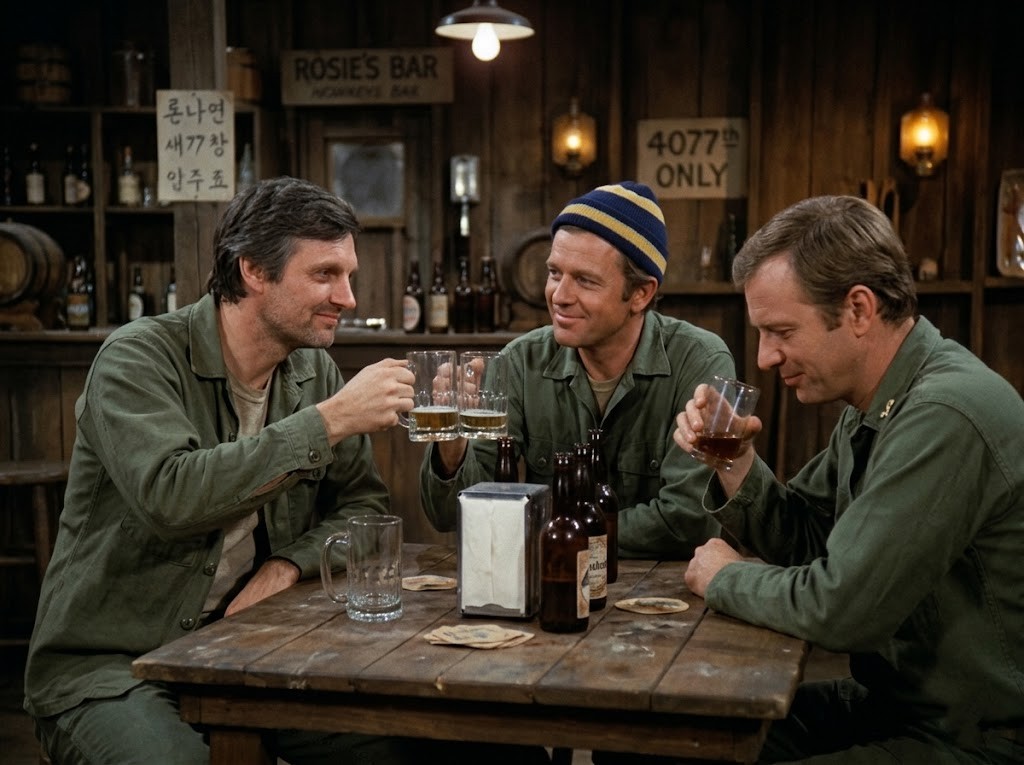
Inside, the air was thick with the familiar, comforting smells of stale sawdust, cheap cigar smoke, and whatever fermented concoction Rosie was passing off as beer that week. The dim amber light from the kerosene lanterns painted the rough wood walls in warm, forgiving strokes.
Hawkeye collapsed into a chair at their usual corner table, his green fatigue shirt unbuttoned to reveal his sweat-stained olive undershirt. He looked like a man who had just gone twelve rounds with a freight train and lost on a technicality.
Beside him, B.J. slumped against the table, pulling a ridiculous, brightly colored blue and yellow striped knit cap low over his ears. It was a care package item from Peg, meant for a harsh Illinois winter, but B.J. wore it like a crown of domestic armor against the Korean cold.
Surprisingly, Charles Emerson Winchester III had followed them. Usually, the Boston Brahmin would rather perform his own appendectomy than drink in an establishment decorated with ration boxes and a hand-painted wooden sign proudly declaring “4077th ONLY.”
Yet, there he sat. He was meticulously dressed in his standard issue greens, his collar insignia catching the low light. He didn’t complain about the draft. He didn’t complain about the smell of kimchee.
Instead, Charles quietly produced a silver flask from his coat, poured a modest measure of private reserve scotch into a small glass, and signaled Rosie to bring two heavy glass mugs of local beer for his tentmates.
Hawkeye eyed the sudden generosity with deep suspicion. He wrapped his hand around the thick handle of his mug, feeling the cool condensation. “Alright, Charles. What’s the catch? Is this a bribe to get me to stop whistling in the shower, or did someone finally make you a general?”
Charles didn’t take the bait. He didn’t puff up his chest or deliver a withering, multi-syllabic insult.
He just sat there, staring down at the amber liquid in his glass. His face was entirely devoid of its usual arrogant armor. He looked older, smaller, and incredibly tired.
“The boy on table three,” Charles said, his voice barely rising above the low hum of the generator outside. “The young corporal with the shrapnel in his descending aorta.”
Hawkeye and B.J. exchanged a swift, guarded look. They both knew the kid. It was the worst case of the day. Charles had spent four agonizing hours doing microscopic vascular work with hands that were shaking from exhaustion, refusing to let the boy slip away.
Charles finally looked up, his eyes meeting Hawkeye’s, filled with a raw, desperate vulnerability that he rarely let the world see.
“Tell me the truth, Pierce,” Charles whispered, his voice cracking. “Is he going to see morning?”
The banter died instantly in Hawkeye’s throat. The sarcastic deflection he always kept chambered and ready for moments just like this suddenly felt entirely useless.
He looked at Charles. He didn’t see the pompous aristocrat who played his opera too loud. He just saw another terrified, exhausted doctor trying to hold back the tide with a teaspoon.
Hawkeye let out a long, slow breath. The tension in his shoulders finally dropped an inch.
“I checked his charts in post-op before we walked over here,” Hawkeye said quietly, his voice gentle and completely stripped of its usual bravado. “His pressure is stable. His color is coming back. He’s breathing on his own, Charles.”
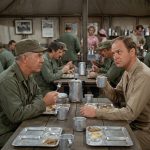
B.J. nodded in agreement, leaning forward slightly against the scuffed wooden table, right beside the metal napkin dispenser and the dark, unlabeled sauce bottles. “You did it, Charles. It was an impossible stitch, but you did it. You gave that kid another fifty years.”
For a long moment, the only sound at the table was the distant, tinny music drifting from the jukebox on the other side of the room.
Then, very slowly, the crushing weight of the war seemed to lift from Charles’s shoulders. The tight, anxious lines around his mouth softened. He didn’t say a word, but he didn’t have to. The profound, overwhelming relief was written across every inch of his face.
Hawkeye felt a sudden, fierce rush of affection for the two men sitting with him. They drove him crazy. They lived in a dirt-floored tent that smelled like a swamp. But in this godforsaken corner of the world, they were the only sanity he had left.
A small, genuine smile broke across Hawkeye’s tired, scruffy face. He lifted his heavy glass mug of beer, holding it out over the center of the table.
B.J. caught the look. A warm, easy grin spread across his face, lighting up the dim corner. He raised his own mug, the ridiculous blue and yellow beanie bobbing slightly as he leaned in.
With a satisfying, solid *clink*, the two thick glasses met in the air. It wasn’t a toast to victory, or to the generals, or to the end of the war. It was just a quiet acknowledgment that they had survived another day, and they had kept someone else alive to see it, too.
“To table three,” Hawkeye said softly.
“To table three,” B.J. echoed, taking a long, grateful drink.
Beside them, Charles didn’t raise his glass to join the physical clink. But as Hawkeye and B.J. drank, Charles looked down into his own small glass of scotch.
A small, quiet, profoundly tender smile touched Charles’s lips. He didn’t look at them, but he sat back in his chair, completely at peace, soaking in the rare, comforting warmth of belonging to a family he never asked for, but secretly desperately needed.
They sat there for a long time in the amber glow of Rosie’s Bar, letting the cheap beer and the good scotch do their work. Tomorrow, the choppers would come again. The war would demand more of them than they had to give.
But tonight, in this drafty, wood-paneled room halfway across the world from home, they had bought one boy a lifetime, and they had each other.
And for now, that was enough.
In a place designed entirely for breaking, they had somehow figured out how to keep each other whole.