The Language of the Quiet Hours”
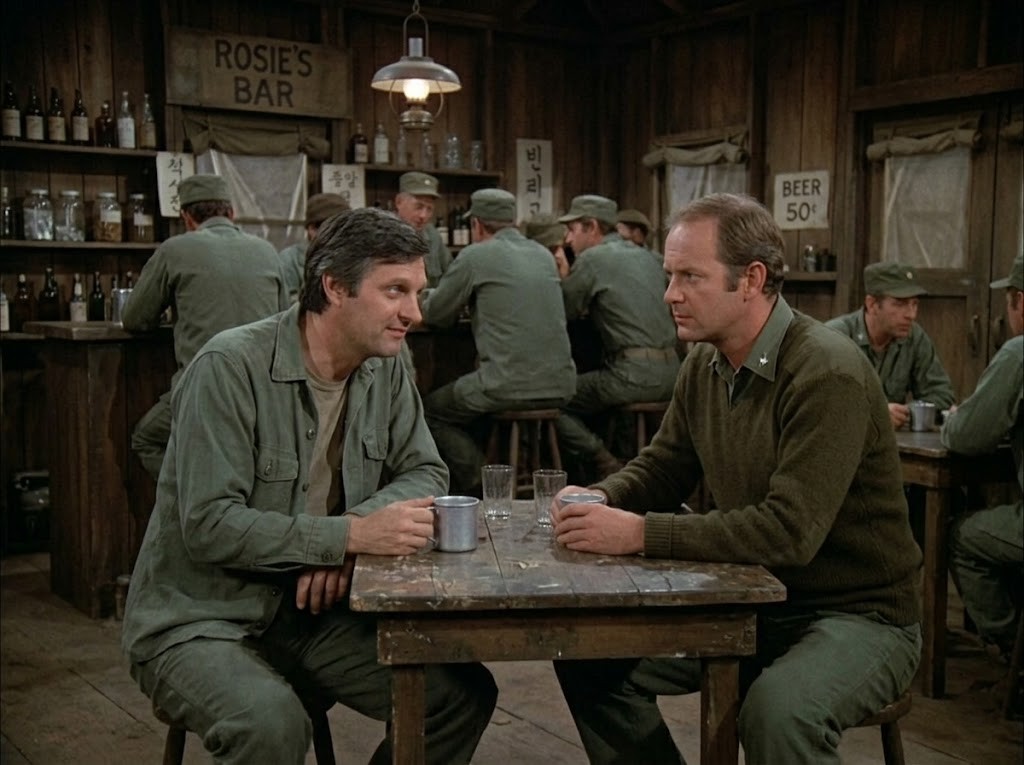
The overhead lantern at Rosie’s Bar always hummed a low, erratic tune, a fragile barrier against the vast Korean night. Inside, the air smelled faintly of damp wood, spilled beer, and the heavy, unmistakable exhaustion of the 4077th.
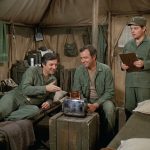
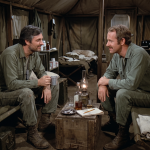
Hawkeye Pierce leaned forward, his green fatigue shirt unbuttoned at the collar, fingers curled around a tarnished tin cup. Across the scarred wooden table sat Major Charles Emerson Winchester III, looking distinctly out of place in his pristine woolen sweater, yet wearing a look of profound weariness that no Boston pedigree could shield him from.
It had been a thirty-hour session in the Operating Room, a relentless parade of broken young bodies that left everyone drained to the marrow. Usually, by this hour, Hawkeye would be masking his fatigue with a barrage of rapid-fire quips, while Charles would be retreating behind a wall of classical music and aristocratic disdain.
Tonight, however, the silence between them was different. It wasn’t the frosty truce of two mismatched doctors, but a shared, heavy anchor.
Around them, the low murmur of enlisted men and the clinking of glasses provided a dull background hum. Rosie’s was a sanctuary where rank blurred under the dim lights, and the war felt, if only for an hour, a few miles further away.
Hawkeye took a slow sip of the harsh local brew, his eyes studying the man across from him. Charles was staring intently into his own cup, his jaw tightly set, his thoughts clearly thousands of miles away in Beacon Hill.
“You know, Charles,” Hawkeye said softly, his voice devoid of its usual theatrical edge, “if you stare any harder into that tin, you’re going to burn a hole right through to the table.”
Charles didn’t look up immediately. He merely shifted his grip on the handle, his knuckles whitening slightly against the metal.
“I am merely reflecting, Pierce,” Charles replied, his deep voice carrying a rare, quiet vulnerability. “Reflecting on the sheer, unadulterated absurdity of our current geographic coordinates.”
“Rosie’s isn’t so bad,” Hawkeye offered with a faint, tired smile. “The ambiance leaves something to be desired, but the vintage is unpretentious. Somewhere between paint thinner and a bad decision.”
Charles let out a breath that was half-sigh, half-scoff. He looked up then, meeting Hawkeye’s gaze with an intensity that made the surrounding noise of the bar seem to instantly fade away.
“I received a letter from my sister, Honoria, today,” Charles said, his voice dropping to a near whisper.
Hawkeye paused, sensing the sudden shift in the air. The casual banter evaporated, replaced by the raw, exposed nerves that always accompanied news from home in a place like this.
“Is she alright?” Hawkeye asked, his demeanor shifting instantly to that of a genuine friend, his eyes narrowing with quiet concern.
Charles looked directly into Hawkeye’s eyes, his expression a fragile mix of pride and absolute heartbreak. “She writes of the autumn leaves in Boston, Pierce. Of the concerts at Symphony Hall. And for a terrifying moment… I couldn’t remember what the oboe sounded like.”
The admission hung in the air, heavy and sharp, catching Hawkeye completely off guard as Charles stared at him, waiting for a punchline that would never come.”””
For a second, the hum of Rosie’s Bar seemed to vanish completely. Hawkeye looked at Charles, seeing past the pompous exterior, past the grand speeches and the high-society armor, straight into the heart of a homesick man who was terrified of losing pieces of himself to the mud of Uijeongbu.
Hawkeye didn’t laugh. He didn’t offer a sarcastic remark or a witty evasion. He simply sat there, his gaze steady and filled with a deep, understanding empathy.
“An oboe,” Hawkeye said softly, nodding his head slowly. “It’s a tricky instrument to hold onto out here. The dust gets into everything, Charles. Even the memories.”
Charles seemed to relax a fraction, his shoulders dropping slightly as he realized his vulnerability wouldn’t be turned into a weapon. He took a small sip from his cup, his eyes never leaving Hawkeye’s face.
“It is the anchor, you see,” Charles murmured, his voice thick with a refined sort of grief. “The music, the culture, the civilization. If I allow the sounds of the OR—the snapping of hemostats, the suction, the artillery—to drown out the music, then what is left of Charles Emerson Winchester?”
Hawkeye shifted his weight on the wooden stool, leaning closer across the table. He knew that fear intimately. Every doctor in the 4077th lived with the terrifying thought that the war was slowly replacing their souls with a cold, mechanical efficiency.
“You’re still in there, Charles,” Hawkeye said, his voice firm but incredibly gentle. “Trust me. A guy who can complain as beautifully as you do about the lack of decent tea isn’t going to disappear that easily.”
A ghost of a smile flickered across Charles’s face, gone as quickly as it arrived, but it broke the tension in the room. He looked down at the table, tracing a line in the weathered wood with his thumb.
“Your optimism is staggering, Pierce,” Charles muttered, though the bite was entirely gone from his tone. “And highly uncharacteristic.”
“Hey, I have my moments,” Hawkeye grinned faintly, raising his cup. “Usually after midnight, and usually when the swamp juice runs low. But seriously, Charles. You haven’t lost the music. You’re just playing a very long, very loud intermission.”
Charles looked up, his eyes softening as he absorbed the words. He raised his own tin cup, letting it tap against Hawkeye’s with a dull, unglamorous clink. It wasn’t crystal, and it wasn’t champagne, but in that moment, it was a profound communion.
“To long intermissions,” Charles said quietly.
They drank in silence for a few minutes, the warmth of the moment settling over them like a heavy blanket. Around them, the other soldiers continued their low chatter, oblivious to the quiet bridge that had just been built between Boston and Crabapple Cove.
“You want to know what I miss?” Hawkeye asked after a while, his eyes turning reflective.
“I dread to ask,” Charles replied, though his expression remained open and warm. “Some dreadful seafood shack, no doubt?”
“The smell of the Atlantic Ocean on a Tuesday morning,” Hawkeye said, looking past Charles, out into the dark. “Not the fancy docks. Just the docks where the fishermen bring in the catch. It smells like salt, old ropes, and absolute freedom. Sometimes, when the wind blows from the south here, I try to convince myself I can smell it. But it’s usually just Klinger cooking something illegal behind the laundry tent.”
Charles let out a genuine, hearty chuckle, the sound rich and warm in the cramped bar. “A terrible substitute, Pierce. Truly dreadful.”
“Yeah, well, we take what we can get,” Hawkeye smiled, his eyes twinkling with that familiar, resilient spark.
They sat together for another hour, talking less about the war and more about the small, beautiful things waiting for them on the other side of the ocean. They argued gently about the merits of clam chowder versus lobster bisque, a meaningless debate that felt like the most important conversation in the world.
By the time they stood up to leave, the lantern above them was flickering, signaling the approaching dawn. They walked out of Rosie’s into the cool, crisp Korean air, the mountains looming like dark giants in the distance.
As they walked back toward the compound, Charles paused for a moment, looking up at the starlit sky. He closed his eyes, took a deep breath, and let out a soft hum. It was a single, pure, clear note.
“What’s that?” Hawkeye asked, stopping beside him.
Charles opened his eyes, a serene, unmistakable dignity returning to his posture. “That, Pierce, was the opening note of Mozart’s Oboe Concerto in C Major. I believe I have found it again.”
Hawkeye smiled, clapping a hand gently on the Major’s shoulder as they walked toward the tents. “Sounds beautiful, Charles. Don’t lose the sheet music.”
In the mud of Korea, the finest medicine they ever shared didn’t come from a bottle, but from the quiet grace of a friend who understood the silence.”””