The Weight of an Unsigned Letter
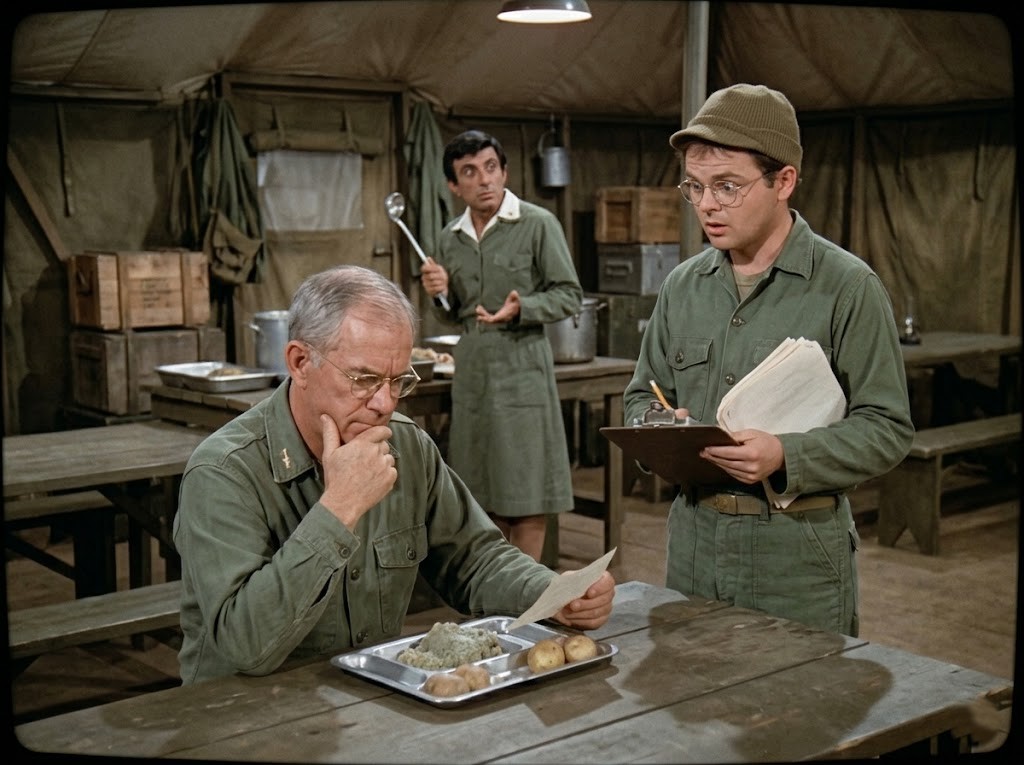
Some days at the 4077th, the war didn’t look like incoming choppers or rivers of red on an OR table. Sometimes, it looked like a cold tin tray of gray mashed potatoes and three hard-boiled eggs that had seen better decades.
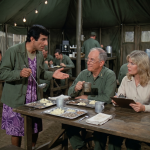
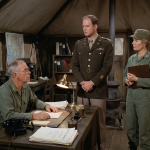
Colonel Potter stared down at his lunch as if it were an enemy outpost that refused to surrender. The mess tent was uncharacteristically quiet, save for the low, rhythmic scrape of Corporal Klinger’s soup ladle against the bottom of a massive metal pot in the background.
Radar O’Reilly stood just a step away, his boots shifted slightly in the dirt, clutching a clipboard to his chest like a shield. In his other hand, a thick sheaf of daily requisitions hung limply, but his eyes weren’t on the paperwork. They were fixed anxiously on the old man.
Potter didn’t pick up his fork. Instead, his weathered fingers tightly held a single, crumpled piece of paper that had arrived in the morning mail pouch—a letter without a return address, postmarked from a small town in Missouri.
“It’s from the Miller family, sir,” Radar murmured, his voice cracking slightly in the humid air of the tent. “The boy from the push near the Han River last month. The one who… well, the one who didn’t make the bus ride to Seoul.”
Potter’s jaw tightened, the deep lines around his mouth deepening into canyons of exhaustion. His reading glasses sat low on his nose, framing eyes that had looked at too many casualty reports over three different wars, yet still felt the sting of every single name.
Behind them, Klinger paused his stirring, the heavy metal ladle frozen mid-air, his dark eyes wide with a rare, quiet concern. He was wearing his usual utility olive drabs today, but his theatrical posture remained, his frame leaning forward to catch the heavy silence hanging over the commanding officer’s table.
The Colonel raised his left hand, resting his chin heavily against his knuckles, his index finger tracing the side of his face as he read the words for the third time. The letter didn’t contain anger or blame; it was filled with simple, heartbreaking gratitude from a mother who just wanted to know if her son had been warm at the end.
“They think we have all the answers, Radar,” Potter said, his voice a low, gravelly whisper that barely carried past the edge of the wooden picnic table. “They think because I have silver eagles on my shoulders, I can tell them why a twenty-year-old boy from Missouri stops breathing while the sun is coming up over a ridge he never heard of a year ago.”
Radar shifted his weight, his knuckles turning white against the wooden edge of his clipboard, wanting desperately to offer the kind of comfort only a kid from Iowa could give, but finding his throat completely locked.
Potter looked up, his eyes suddenly bright with an unspoken pain, looking straight through Radar as if searching for something the army had never taught him how to fix. “What do I tell a mother, Radar, when the truth is just that we ran out of time?”
The silence stretched out, heavy and suffocating, filling the spaces between the empty benches of the mess tent. Klinger slowly lowered the ladle back into the pot, the usual dramatic flair entirely gone from his face, replaced by the somber understanding of a soldier who knew exactly what that kind of grief felt like.
Radar took a small step closer, lowering his clipboard just an inch. “You tell her about the blanket, sir,” he said softly, his voice steadying. “You tell her how BJ held his hand, and how Hawkeye made that terrible joke about the Iowa state fair just to make him smile. And… and you tell her that Father Mulcahy said the words he needed to hear.”
Potter looked at the young corporal, the harsh lines on his face softening just a fraction at the boy’s earnest words. He looked down at the cold, uninviting food on his tray, then back at the letter, his thumb tracing the unevenly typed ink.
“A commander isn’t supposed to get caught up in the ledger, Radar,” Potter said, his voice gentler now, carrying the weight of a father who had buried too many sons. “You’re supposed to look at the numbers, make the report, and move to the next set of coordinates. But damn it, every time I look at these kids, I just see my own boy’s face looking back at me.”
Klinger walked over quietly, setting down a fresh mug of steaming black coffee near the edge of the table, avoiding the usual banter about his hardship discharge or his latest scheme. “Company clerk’s right, Colonel,” Klinger said quietly, his voice devoid of its usual theatrics. “We don’t forget ’em. None of us do. That’s gotta count for something back home.”
Potter looked up at Klinger, then at Radar, seeing the tired, dirty faces of the camp’s heartbeat. They were exhausted, homesick, and fed up with the mud and the gray potatoes, yet here they stood, holding each other up in the middle of a forgotten tent.
A faint, tired smile finally broken through the Colonel’s stern expression, a brief flash of the steady warmth that kept the 4077th from spinning off its axis. He reached out and tapped the clipboard in Radar’s hands.
“Alright, Corporal,” Potter said, straightening his back as the familiar, comforting mantle of authority settled over him once more. “Bring me the good stationery from my desk. The stuff without the grease stains. We’re going to write Mrs. Miller a letter, and we’re going to tell her exactly how brave her boy was.”
Radar nodded quickly, a look of immense relief washing over his round face as he adjusted his glasses. “Yes, sir. Right away, sir. I’ll even find a pen that doesn’t leak.”
As Radar turned to head back to the office, and Klinger went back to his pots, Potter picked up his fork, finally taking a small bite of the cold potatoes. It still tasted terrible, but the air in the tent felt just a little bit lighter, warmed by the quiet, unbreakable bond of a family found in the most unlikely of places.
In the mud of Korea, the finest medicine they ever offered wasn’t found in a bottle, but in the quiet moments when they refused to let each other carry the weight alone.