THE SPRINGTIME OFFENSIVE OF CORPORAL KLINGER
In the heart of that dusty, olive-green corner of Korea, some days the only thing louder than the incoming choppers was the silence.
It was a fatigue you felt in your bones, a grayness that seeped into everything, from the canvas of the tents to the water in the Lister bags.
Some guys wrote letters home to stay sane. Some drank grape knee-hi.
And then there was Corporal Maxwell Q. Klinger, fighting his own private war against the drab monotony with a weapon uniquely his own.
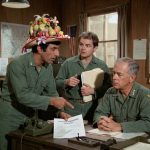
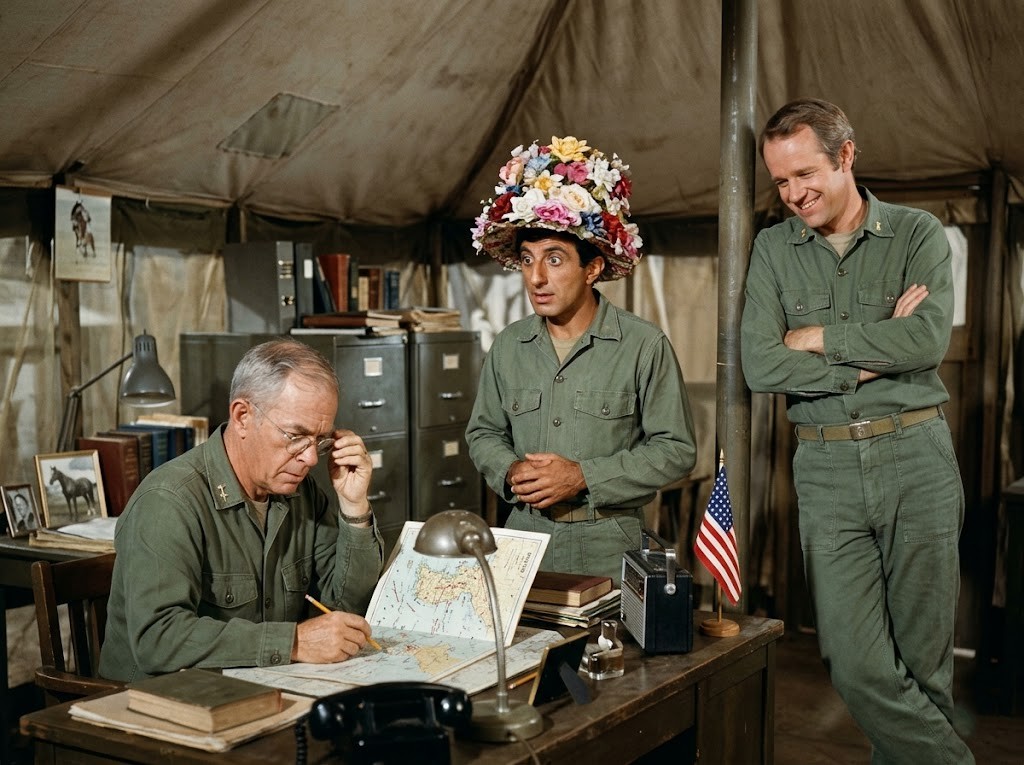
Colonel Potter sat behind his desk, eyes narrowing through his reading glasses.
A fresh map of the 38th parallel was spread out before him, marked with lines and circles that meant decisions no man should have to make.
He was deep in thought, pencil poised, when the screen door to the office slapped open.
B.J. Hunnicutt, leaning casually against the center pole of the tent, looked up and his face split into a slow, lazy grin.
Klinger stood on the threshold, a sudden, blinding blast of color against the sea of O.D. green.
He wasn’t wearing one of his usual outfits today. He was in his standard-issue uniform, pressed for once.
But perched upon his head, resting directly on his GI-issue cap, was the single most elaborate, ridiculous, and utterly breathtaking construction of flowers anyone in that tent had ever seen.
The hat was a riot of faux silk blooms.
There were pink roses, bright yellow daisies, white lilies, and clusters of deep red buds, all bundled together into a massive, overflowing bouquet.
It looked like an English garden had exploded in a PX.
“Klinger,” Potter said, slowly lowering his glasses and looking over them.
His pencil was now hovering precariously over the map. “May I ask, what in the name of General Grant’s beard is that on your head?”
Klinger adjusted his stance, trying to look dignified beneath three pounds of artificial foliage.
“It’s not just a hat, Colonel,” he said, his earnest brown eyes fixed on Potter. “It’s hope.”
B.J. didn’t even try to hide his laughter, his grin growing wider.
“Klinger, hope usually looks more like a 24-hour pass than a floating florist shop,” B.J. said.
“It was a gift, Captain! In my last package from Toledo,” Klinger argued, his voice rising in dramatic justification.
“A gesture. A springtime offensive against the grayness! All these colors… they remind us that the world is more than dust and olive green!”
He turned his head slightly, and the sheer volume of the flowers was astonishing. They bobbed with every movement.
“Klinger,” Potter said, his voice dropping to that dangerous, quiet level.
“We have a major push coming up. The wounded are due in less than an hour. And you chose now… right now… to wear a garden?”
Klinger froze, sensing the weight of Potter’s fatigue.
His arms, previously gestured wildly, were now clutched nervously at his side.
B.J.’s smile faded slightly, recognizing the underlying strain.
Potter looked from the ridiculous hat to the tired lines on the map, his pencil holding the fate of the moment.
The screen door banged open again, and both Radar’s glasses and Hawkeye’s sharp voice entered.
“Colonel! We’ve got incoming, ten ambulances!” Radar shouted, his breath catching.
Hawkeye came in right behind him, skidding to a stop.
He took one look at Klinger and the massive floral creation and threw his hands up in mock despair.
“Good God, Klinger,” Hawkeye said, “I knew you were trying to get out of the Army, but I didn’t think you’d sprout leaves to do it!”
Everyone in the office stopped, holding their breath. Potter was looking at the map. Radar was staring at Klinger. Hawkeye was waiting for the perfect follow-up joke. Klinger was standing in rigid suspense, his garden hat defying the war around it.
The silence was heavier than the artillery.
Potter didn’t move. He just stared at the pencil, holding the whole 4077th in the balance of one exhausted breath.
—
“Ten ambulances,” Potter finally repeated, the words dropping like lead.
His eyes never left the map, but the pencil remained poised. He was looking *through* the pencil, holding onto some small thread of control.
“Yes, sir. Captain Hunnicutt, Major Pierce,” Radar confirmed, shifting nervously.
Hawkeye looked from the map to Klinger. He saw the genuine anxiety in Klinger’s eyes, the sincere belief that he was doing something *good*, even if it was preposterously colorful.
The tension was palpable. It wasn’t about the hat anymore; it was about the break in the collective spirit. It was about whether an absurd act of joy had a place in a war.
Klinger’s flowery hat seemed to grow heavier by the second.
Finally, Potter looked up.
He pushed his reading glasses back up his nose, the old cavalry officer reappearing.
“Alright,” he said, his voice surprising them with its steady tone. “Listen up. The real offensive is in sixty minutes.”
He looked directly at Klinger, making eye contact through the glasses.
“You’ve got fifteen minutes. One five.”
Klinger’s eyes went wide. “Sir?”
“For that… that floral display,” Potter continued. “Fifteen minutes. You wear it around the camp. You show every single tired soul you can find. Let them see a little bit of spring.”
Klinger’s face was a pure portrait of shocked delight.
“And then,” Potter added, “you take it off, put that uniform back on, and get your tail down to pre-op. Are we clear?”
A slow, brilliant grin spread across Klinger’s face.
He executed the most crisp, meaningful salute he had ever given, flowers bobbing wildly. “Crystal, Colonel! Clear as the Toledo bell!”
He practically floated out the screen door, his massive hat disappearing into the sunlight, a trail of colors leaving the tent.
“Potter,” B.J. said, still smiling, but now softly. “That was… a masterful maneuver.”
Potter finally returned his attention to the map, but the fatigue seemed slightly less heavy.
“It was a tactical decision, Captain,” he grunted, the ghost of a smile pulling at his dry lips. “A commanding officer must manage his troops’ morale. Even if that morale wears an outfit made entirely of silk petunias.”
Hawkeye, who had been leaning against the frame, let out a soft chuckle and raised a casual hand. “A bold strategic decision, Colonel. You might even call it a blossoming success.”
He gave a small nod of genuine respect towards Potter and pushed past Radar to leave the office. “Well, let’s go, Radar. Before we all get drafted into the flower show.”
Radar, still holding his clipboard, watched Hawkeye leave, then looked back at Potter. “Colonel… about the garden club…”
“Radar,” Potter said, not looking up. “Not now.”
“Right, sir.” Radar beat a hasty retreat.
The tent settled into a new, lighter kind of quiet.
B.J. was still by the pole, but now he was looking not at the map, but after Klinger.
“He does try, doesn’t he?” B.J. murmured.
“He does,” Potter agreed softly, returning his pencil to a circle on the map.
A few minutes later, the faint sound of laughter bubbled through the camp, growing louder. They could almost imagine Klinger parading through the lines of tired GIs, bringing a momentary smile to every weary face.
For a brief, impossible quarter of an hour, the grayness was pushed back.
It was just fifteen minutes, but it felt longer. It felt like something real.
Potter finished his note on the map and looked up at B.J.
“Alright, Captain. Let’s go fight a war.”
—
Sometimes, hope wears a flower hat, and a good commanding officer knows enough not to ask why.