The Weight of the World on a Rotary Phone
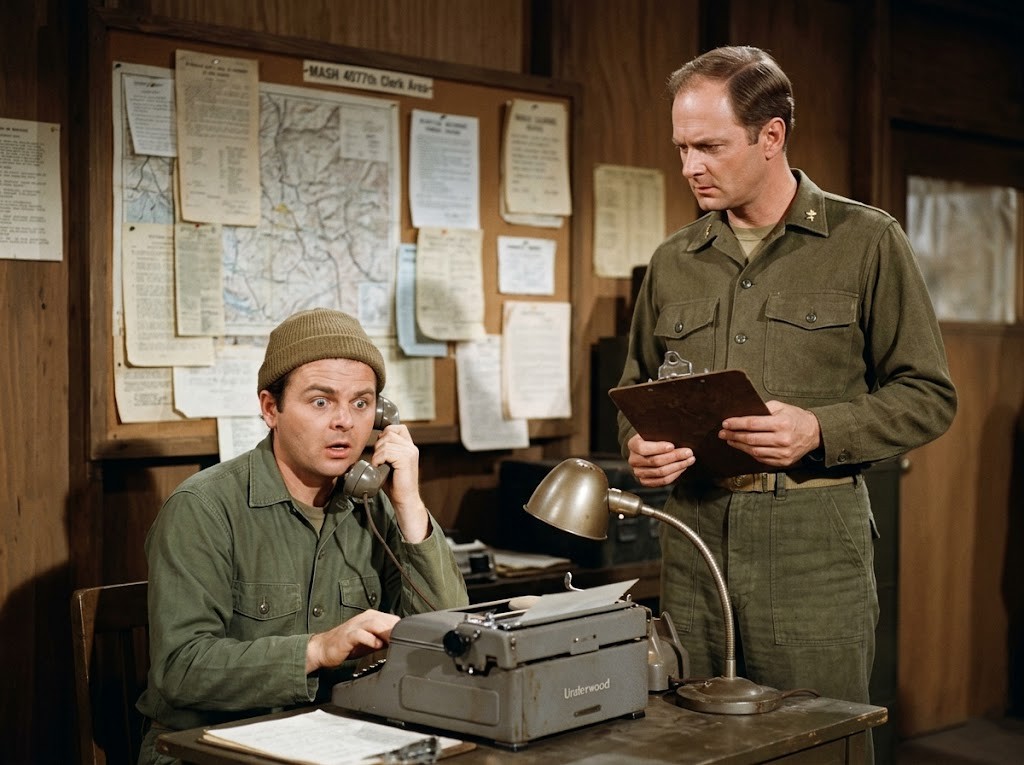
The clerk’s office of the 4077th was rarely a place of peace, but it had its own kind of rhythm.
It was a rhythm built on the heavy, metallic clack-clack-ding of an olive-drab Underwood typewriter. That machine was the true heartbeat of the camp. Every casualty report, every transfer order, every desperate letter home passed through its ink-stained ribbon.
On this particular Tuesday, the air in the office was thick with the scent of stale coffee, mimeograph fluid, and the damp chill of a lingering Korean autumn.
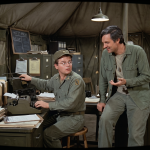
Corporal Walter “Radar” O’Reilly sat hunched at the desk. His signature green knit cap was pulled down low over his ears, a small barrier against the constant noise of the war outside. His fingers flew across the keys with surprising grace for a farm boy from Iowa.
Standing beside him, casting a long, impeccably tailored shadow over the cluttered desk, was Major Charles Emerson Winchester III.
Charles gripped a wooden clipboard as if it were a shield against the sheer indignity of his surroundings. His posture was rigid, his uniform unnervingly neat, and his brow furrowed in deep, aristocratic concentration. He was in the middle of dictating a highly complex, aggressively polysyllabic requisition form.
“Furthermore, Corporal,” Charles intoned, his Boston accent cutting through the dusty air, “inform the quartermaster at I Corps that if he sends me one more spool of inferior, fraying surgical silk, I shall personally see to it that he spends the remainder of this conflict counting tongue depressors in a tent entirely devoid of a heater. Do you have that?”
“‘Tent entirely devoid of a heater,’” Radar muttered, his eyes glued to the paper feeding through the carriage. “Got it, Major.”
“Excellent. Now, begin paragraph four. ‘Regarding the deplorable state of the recent penicillin shipment—’”
Before Charles could finish his thought, the black rotary phone on the desk rang. It was a sharp, jarring sound that cut through the low hum of the camp.
Without missing a beat, Radar’s left hand shot out and grabbed the heavy receiver, bringing it to his ear. His right hand remained perfectly poised over the typewriter keys, ready to resume the Major’s tirade the second the call was finished.
“M*A*S*H 4077th, Colonel Potter’s office, Corporal O’Reilly speaking,” Radar chirped, his voice slipping into its usual, automatic cadence.
Charles sighed heavily. He tapped a perfectly manicured finger against his clipboard, his eyes locked on the typewriter carriage, silently urging the boy to finish his trivial interruption.
But Radar didn’t go into his usual routine. He didn’t ask for Sparky. He didn’t grab a pencil to take a message.
Instead, the color rapidly drained from Radar’s round face.
His eyes went incredibly wide, fixing on a spot somewhere on the wooden wall just past the Major’s shoulder. His mouth dropped open into a small, frozen oval of pure, unadulterated shock. His right hand slowly sank, the fingers resting lifelessly on the keys of the Underwood.
“Sparky… are you sure?” Radar whispered into the receiver, his voice trembling. “Are you absolutely sure?”
Charles stopped tapping his clipboard. The deep annoyance on his face shifted instantly into the sharp, clinical focus of a trained surgeon. He knew what shock looked like. He saw it every day in O.R.
“What is it, Corporal?” Charles asked, his voice losing a fraction of its haughtiness.
Radar didn’t seem to hear him. He was listening to the voice crackling through the phone line, and with every second, he looked smaller, younger, and more defeated.
“But Sparky, they can’t do that,” Radar pleaded, his voice cracking. “I promised Sister Theresa. The temperature is dropping to near freezing tonight. Those kids don’t have anything.”
Charles stood perfectly still. The map on the corkboard behind them, proudly labeled ‘MASH 4077th Clerk Area’, seemed to loom over the heavy silence in the room.
Radar slowly lowered the receiver, missing the cradle entirely on his first try. He looked up at Charles, his wide eyes swimming with unshed tears.
“Major,” Radar said, his voice barely above a whisper. “It’s the supply convoy. The one bringing the winter blankets and the fuel oil for the orphanage.”
“What about it, Max—Corporal?” Charles asked softly.
“They rerouted it,” Radar said, swallowing hard against the lump in his throat. “A two-star general in Seoul decided his officers’ club needed the fuel for a visiting congressional delegation. The blankets were sent to a supply depot in Tokyo. The orphans aren’t getting anything.”
The heavy silence of the war settled over the small wooden office. Charles stared at the young clerk, the weight of the moment pressing down on them both, as the distant, rhythmic thumping of chopper blades began to echo over the hills.
For a long, agonizing moment, Major Winchester said absolutely nothing.
He looked down at his wooden clipboard. He looked at the half-typed requisition form for surgical silk. Suddenly, his complaints about fraying thread and quartermaster incompetence felt profoundly, embarrassingly hollow.
He looked back at Radar. The young corporal was staring blankly at the typewriter keys, his shoulders slumped. He looked like a boy who had just realized that the world was not a fair or kind place, and that realization was crushing him. Radar had spent three weeks trading favors, calling in debts, and negotiating with supply sergeants across the entire peninsula to secure those blankets for the local children.
And with one casual order from a general in a warm office miles away, it was all gone.
Charles felt a familiar, cold anger rising in his chest. It was the same anger he felt when he saw a beautiful young life ruined on his operating table. He possessed an aristocratic disdain for many things, but he held a special, burning hatred for the abuse of power at the expense of the innocent.
“Corporal,” Charles said, his voice terrifyingly calm. “Who precisely is the supply officer in charge of this… reallocation?”
Radar blinked, looking up in confusion. “Uh, it’s a Colonel ‘Bulldog’ MacIntyre, sir. Down at I Corps Supply Command.”
Charles carefully placed his wooden clipboard on the edge of the desk. He smoothed the front of his green wool shirt with immense precision. Then, he extended an open hand toward the young clerk.
“The instrument, Corporal,” Charles said softly. “Hand it to me.”
Radar hesitated for a second, then quickly handed over the heavy black receiver.
Charles brought the phone to his ear. He stood up a little straighter, his chest expanding, his entire posture radiating the undeniable, centuries-old authority of the Boston upper crust.
“Sparky, is it?” Charles began, his tone dripping with an icy, dangerous politeness. “This is Major Charles Emerson Winchester III. Yes, the third. Do not interrupt me. You will patch me through to Colonel MacIntyre at I Corps immediately. If he is at lunch, you will pull him from his table. If he is sleeping, you will wake him. Am I understood?”
Radar watched, his jaw slightly slack, as Charles waited for the connection. The Major’s face was a mask of utter composure.
“Colonel MacIntyre,” Charles said smoothly a moment later. “What a profound displeasure. I am calling from the 4077th M*A*S*H regarding a recent and, quite frankly, baffling supply diversion. A convoy of blankets and fuel meant for a local orphanage.”
Charles paused, listening to the voice on the other end. His eyes narrowed.
“Yes, Colonel, I am fully aware of the General’s congressional visitors,” Charles continued, his voice dropping an octave, becoming a lethal weapon of articulate fury. “What you are perhaps entirely unaware of is that my father, Charles Emerson Winchester II, plays golf every Sunday with Senator Henry Cabot Lodge. The very same senator who chairs the Armed Services Committee. The very committee that approves the General’s budget.”
Radar’s eyes went as wide as saucers. He sat perfectly still, holding his breath.
“Now, Colonel,” Charles purred into the phone, “I would hate to mention in my weekly letter home that the United States Army is allowing Korean orphans to freeze to death so that a few visiting politicians can enjoy a warmer scotch. I imagine the Boston Globe would find that story positively riveting. It might even prompt a formal inquiry. Do you understand the sheer, unmitigated nightmare I can bring down upon your miserable, paper-pushing existence?”
There was a long pause. Charles simply stood there, an immovable mountain of righteousness dressed in olive drab.
“I thought you might see reason,” Charles finally said, a thin, triumphant smile playing at the corners of his mouth. “I expect that convoy to arrive at the 4077th by 1800 hours this evening. Not tomorrow. Tonight. Do not disappoint me, Colonel. The consequences would be… devastatingly permanent.”
Charles pulled the receiver from his ear and placed it back on the cradle with a soft, final *click*.
The silence in the clerk’s office returned, but the heavy, oppressive weight of it was gone. The air felt lighter.
Charles calmly picked up his wooden clipboard. He cleared his throat, adjusting his collar, his face instantly smoothing back into its familiar, haughty mask. He refused to look directly at the awe-struck corporal sitting beside him.
“Now then, Corporal,” Charles said briskly, tapping the paper on the clipboard. “Where were we? Ah, yes. Paragraph four. I believe I was expressing my profound distaste for the penicillin shipments. Are your fingers entirely paralyzed, or can we proceed?”
Radar just stared at him. The young clerk’s eyes were shining, but the tears of defeat had been replaced by something entirely different. He saw right through the Major’s bluster. He saw the quiet, fiercely guarded heart of a man who would move mountains for a stranger, so long as no one ever accused him of being nice.
“Major…” Radar started, his voice thick with emotion. “I… thank you. The kids… they—”
“Corporal O’Reilly,” Charles interrupted sharply, holding up a single, manicured finger. “If you utter one word of this entirely mundane administrative correction to Captain Pierce or Captain Hunnicutt, I will personally see to it that your beloved teddy bear is demoted to a private and transferred to a combat unit. Am I clear?”
Radar couldn’t help it. A massive, radiant smile broke across his face.
“Crystal clear, Major,” Radar said softly.
He turned back to the Underwood typewriter. He placed his hands over the keys, his fingers finding their familiar places. The rhythmic clack-clack-ding began again, echoing off the thin wooden walls.
Charles stood beside him, dictating his pompous letters, standing guard over a small, quiet victory in a war that offered far too few of them.
In the heart of the 4077th, the loudest heroics never happened in the operating room; they happened quietly, over a field phone, between people who had forgotten how to be anything but family.