The Floral Diplomat of the 4077th
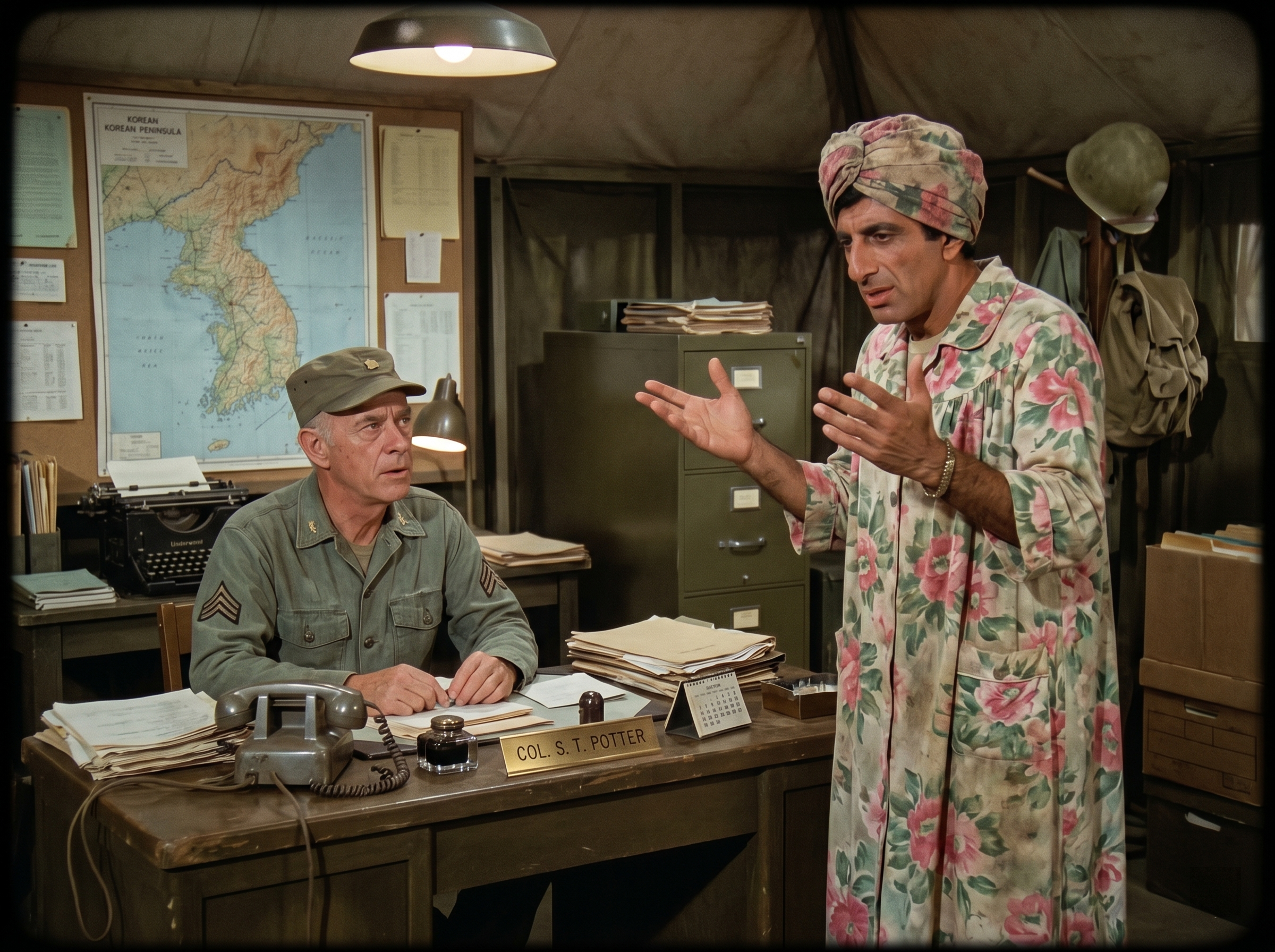
The Korean air outside was crisp and biting, the kind of cold that seemed to seep right through the canvas walls of Colonel Potter’s office. Inside, however, the air was thick with a very different kind of tension.
Colonel Sherman T. Potter sat behind his desk, his posture stiff, eyes fixed on the man standing before him. It was a look Potter usually reserved for an unexpected inspection by a general who had lost his map, but today, the target was far more familiar.
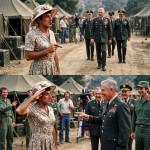
Max Klinger was standing in the center of the office, draped in a floor-length, vintage floral dressing gown that looked as though it had been salvaged from a grandmother’s attic in Toledo. A matching fabric head wrap was coiled precariously around his head.
Klinger held his hands out, palms upward in a gesture of pure, unadulterated exasperation. His face was a mask of dramatic indignation, as if the very fabric of the Geneva Convention was being violated by the laundry service.
“Colonel, I am not asking for the moon,” Klinger declared, his voice rising with that signature mix of theatrical despair and genuine annoyance. “I am simply asking for a little bit of dignity. Do you know what a sergeant in the mess hall said when he saw me in this? He asked if I was the new camp decorator.”
Potter didn’t blink. He simply adjusted his cap, his jaw set, staring at Klinger as if he were trying to solve a complex math problem using only his left eyebrow. The silence in the tent was heavy, broken only by the rhythmic clacking of the typewriter in the outer office and the distant hum of a generator.
“Klinger,” Potter finally grunted, his voice a low, gravelly rumble. “You’ve worn dresses, you’ve worn bridal gowns, and I’m fairly certain I once saw you try to claim you were a statue. Why, in the name of all that is holy, are you wearing a bathrobe to a staff meeting?”
Klinger gasped, clutching the lapels of his floral robe as if he’d been personally insulted. “This is not just a bathrobe, sir. This is ‘morning elegance.’ And it is all I have left! The laundry rotation has betrayed me, Colonel. If I have to face the day in this, then I intend to make it everyone else’s problem!”
Potter leaned forward, his hands clasped firmly on the desk, the ‘COL. S.T. POTTER’ nameplate catching the soft light. He looked tired—not just the bone-deep weariness of a man running a mobile hospital, but the specific, quiet exhaustion of a father trying to keep his children from tearing the house down.
“Klinger,” Potter said, his voice dropping, “if you don’t drop the act and get back to your duties, I’m going to make sure your next outfit is a set of fatigues two sizes too small and a shovel for the latrines.”
Klinger didn’t back down. Instead, he took a step closer, his eyes suddenly wide and burning with a desperate, frantic intensity. “I can’t go back out there like this, Colonel. Not today. You don’t understand—the whole mood of the camp is shifting, and I’m the only one who can see it!”
The air in the office went still. Klinger’s theatrics suddenly felt less like a scheme and more like a plea. He dropped his hands, the floral fabric of his robe shifting as his shoulders slumped. The humor vanished, replaced by that raw, frantic honesty that often lurked beneath the layers of his costumes.
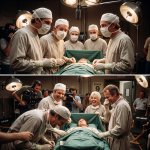
“The boys are coming back from surgery, sir,” Klinger whispered, his voice losing its shrill, comedic edge. “They’re quiet. Too quiet. Even Hawkeye isn’t cracking jokes, and B.J. is just staring at the wall. I thought… I thought if I looked ridiculous enough, maybe someone would laugh. Just once. Just for a second.”
Potter watched him, his own shoulders slowly softening. The gruff, commanding officer persona flickered and dimmed, revealing the man underneath—the man who had seen too many wars and knew the price of a smile better than anyone.
He looked down at his desk, then back at the man in the floral gown. He didn’t see a prankster or a goldbricker. He saw a soldier who was, in his own strange, desperate way, trying to hold the world together with a bit of color and a lot of nerves.
Potter let out a long, slow breath, a faint, tired smile finally ghosting across his face. He reached into his desk drawer and pulled out a small, crinkled pack of cigars. He didn’t light one, just turned it over in his calloused hands.
“You’re a pain in my neck, Klinger,” Potter said, though the sting was gone from his words. “A genuine, one-of-a-kind, Grade-A headache.”
“I try my best, sir,” Klinger mumbled, tugging at the edge of his head wrap.
Potter stood up, his joints creaking in the silence of the tent. He walked around the desk, his movements slow and deliberate. He stopped right in front of Klinger, looking him up and down with a shake of his head.
“It’s a hideous robe,” Potter noted, his eyes crinkling at the corners. “Colors are all wrong for your complexion. Makes you look like a wilted hibiscus.”
Klinger managed a weak, lopsided grin. “It was the only thing in the bin, Colonel.”
“Go find Father Mulcahy,” Potter said, gesturing toward the tent flap. “Tell him I said to check the supply crates in the back. There might be some spare uniforms that aren’t quite as… decorative. And Klinger?”
Klinger paused at the entrance, turning back.
“Good work,” Potter said, his voice quiet, almost a whisper.
Klinger nodded, a silent acknowledgment of the shared weight they both carried. He stepped out into the mud of the compound, the floral robe bright against the drab, grey backdrop of the camp.
Potter stood alone in his office for a long moment, listening to the sounds of the 4077th—the distant shouts, the roar of a jeep, the low murmur of men trying to remember how to be human again. He sat back down at his desk, picked up a pen, and stared at the map of Korea on the wall, feeling the familiar, bittersweet comfort of a home that was never meant to be a home, filled with people he would carry in his heart long after the war was finally done.
Sometimes, the only way to survive the darkness is to wear a few flowers and refuse to let the sadness win.