The Geometry of Memory
The dust of Korea doesn’t settle; it just temporarily reassigns itself to a new surface.
It caked on boots that were already tired and clung to tents that had seen too much.
This afternoon, though, it was a relatively quiet problem, hanging softly in the late heat.
The compound, that familiar, worn geography, was temporarily calm.
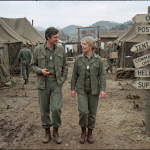
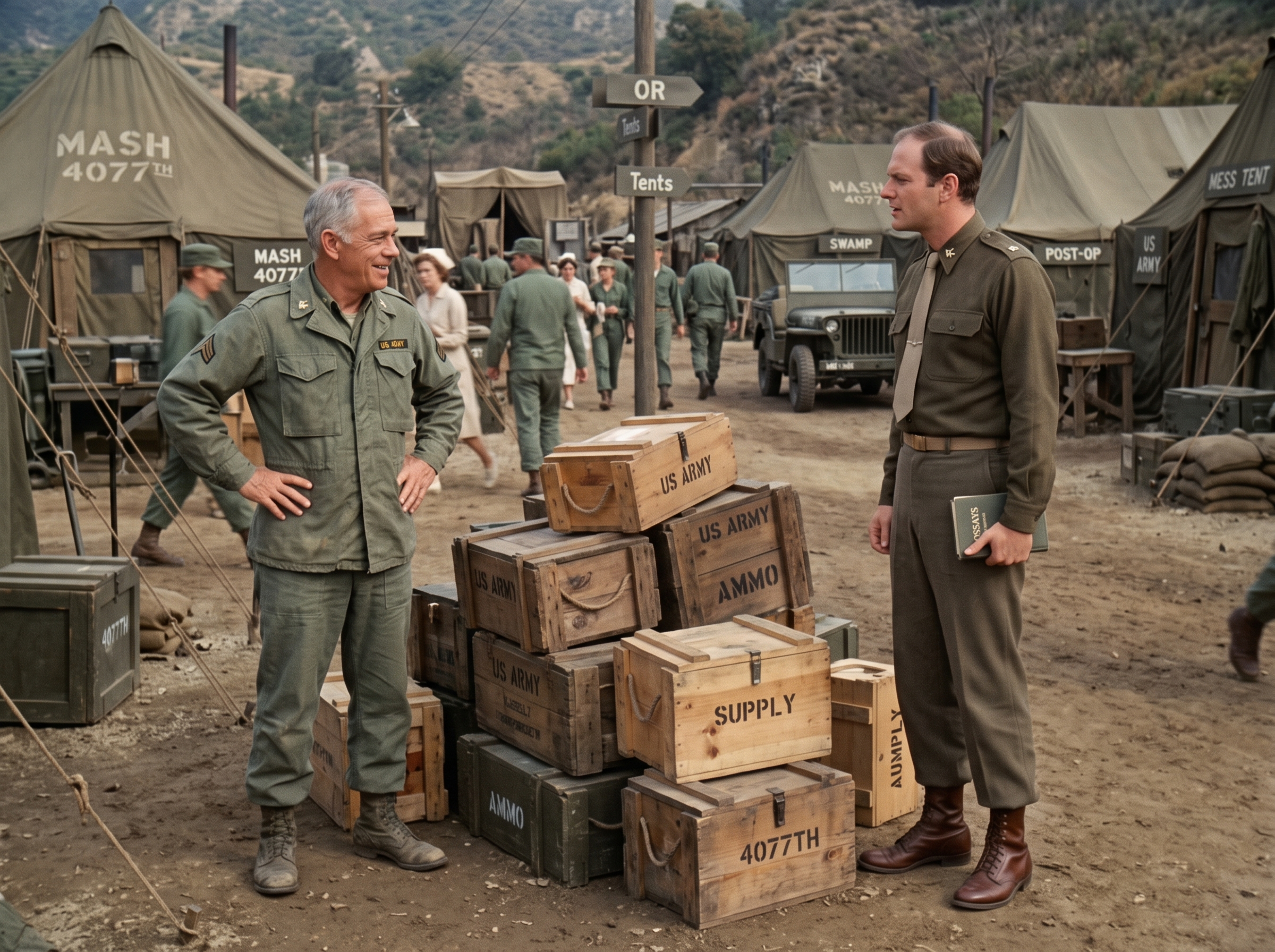
The signposts—pointing to ‘OR,’ ‘Swap,’ ‘Post-Op,’ and the infamous ‘Mess Tent’—stood like confused sentinels.
A few personnel moved lethargically, but the main tension was centered on a small pile of cargo.
Colonel Sherman Potter had found a few spare moments to breathe.
Or so he thought.
His breath, however, was immediately hijacked by the sight before him.
A small mountain of supply crates was not merely stacked; it was… assembled.
It defied pedestrian definitions of logistics.
It looked more like a precariously balanced modernist sculpture than a military delivery.
Potter, a man who preferred his world organized with equine simplicity, came to a halt.
He planted his worn boots in the dirt.
His hands, the same weathered hands that had stitched together a thousand soldiers, snapped onto his hips.
He was wearing his fatigue jacket, already faded by time and scrubbings.
A dry smile, part amusement, part disbelief, tugged at the corner of his mouth.
This wasn’t anger; it was an intersection of surprise and weariness.
Standing slightly apart, Major Charles Emerson Winchester III held his ground.
Charles was, as always, an island of pressed fabric in a sea of olive drab.
Even now, wearing his dress shirt and tie under the Korean sun, he maintained his rigidity.
He stood with a guarded, perfect posture, looking more like he was defending a thesis at Harvard than supply boxes in a ditch.
In his left hand, he held a small, leather-bound volume.
It was titled, inevitably, Logistics, Order, and the Cartesian Soul.
Winchester didn’t immediately speak, preferring to let his disdain for the Colonel’s impending evaluation hang in the air.
Potter finally broke the silence, his voice a calm rasp.
“Charles,” he began, gesturing with one hand toward the chaotic formation.
“I believe ‘AUMPLY’ is misspelled on that side box.”
“And I am fairly certain gravity is about to submit a formal complaint.”
Winchester didn’t blink. He only raised his small book a fraction of an inch.
“AUMPLY, Colonel, is likely shorthand for ‘Augmented Supply,’ which, given our persistent lack of standard equipment, seems rather appropriate.”
Potter’s eyes narrowed. “And the… geometry?”
Charles adjusted his posture, finding his sarcastic footing.
“It is not, as you might think, chaos, Colonel.”
“It is a non-linear allocation system, designed to maximize immediate access while minimizing the overall footprint.”
Potter looked at him, then back at the crates, which appeared ready to drop “Ammo” onto “4077TH.”
“I see,” Potter said quietly. “You mean it’s a mess.”
Charles’s defense was just beginning, but at that precise moment, a sound pierced the heat.
It wasn’t a shell. It wasn’t an alarm.
It was the distant, chopping breath of helicopters.
The compound, which had been static, suddenly trembled into motion.
People in the background, including a couple of nurses and another soldier, froze, listening.
The temporary stillness, the warm light, the humorous debate… all vanished.
The tension wasn’t about the boxes anymore; it was the arrival of the inevitable.
Potter dropped his hands from his hips, the amusement leaving his face.
“Crates later, Major,” he said, turning toward the noise. “Surgeries now.”
He left Charles standing there, the little leather book still clutched in his hand.
The complex stack of boxes suddenly seemed very small against the incoming tide.
They were in OR for fourteen hours.
The heat was worse in there, the lighting harsh, the sound a symphony of controlled desperation.
The easy camaraderie and dry wit of the 4077th faded into the brutal efficiency of muscle memory.
When Potter and Winchester finally emerged, the sun was gone.
The compound was painted in soft twilight and the cool shadows of early evening.
Their energy was fully depleted, their shirts stained with fatigue and other fluids they didn’t want to think about.
They walked in silence, a worn-out Colonel and a tired Boston aristocrat.
They passed the silent signposts, which now seemed to point only to exhaustion.
By an unconscious decision, both men drifted back toward the supply pile.
It was still there, a silhouette against the fading orange sky.
The boxes looked exactly the same—confused, unbalanced, and still waiting.
The ‘AUMPLY’ typo was now barely legible in the dusk.
Potter stopped, looking at the pile with new, older eyes.
“Fourteen hours,” he muttered, his voice barely above a whisper.
“And all we saved, Charles… is this.”
He wasn’t talking about the crates. He was talking about the idea of order.
The world out there was chaos and metal. This little stack, as failed as it was, was a attempt to build something.
Charles stood beside him, the book long gone, replaced by a deep tremor in his fingers.
He stared at his chaotic creation.
“It was meant to be logical,” Charles said softly.
The arrogance, the sarcasm, the need to impress—all of that had been scrubbed away in OR.
“The triage out there… it is non-linear, Colonel. I thought… maybe here…”
Potter nodded, a slow, fatherly movement.
“I know,” he said gently. “We try to control the small things because the big things… they just don’t listen to us.”
He looked at the boxes. The specific box labeled ‘4077TH’ was at the bottom.
Potter stepped forward, his boots dusty.
“Let’s try logic again, Major. But this time, let’s try the horse-sense version.”
He bent down and took a corner of the top Ammo crate.
Winchester watched him for a second, then, with a quiet sigh that was also a surrender, he bent down and took the other corner.
They didn’t speak. They didn’t argue.
Together, they carefully, almost delicately, began to disassemble the stack.
No complex Cartesian theory. Just muscle and gravity and cooperation.
They stacked Ammo with Ammo. Supply with Supply.
They worked for twenty minutes, the rhythmic sound of sliding wood filling the quiet air.
When they were finished, the boxes were in two clean, sturdy, and boring rows.
The ‘4077TH’ was visible, upright.
Potter dusted his hands, looking at the order they had made.
“Better,” he said. The simple word held a quiet dignity.
Charles nodded, his posture slightly slumped, but his gaze steady.
“Better,” he agreed, the smallest ghost of a tired smile returning.
They looked at each other for a long moment in the twilight, acknowledging a connection they couldn’t name.
It wasn’t affection, exactly. It was a shared survival, a mutual exhaustion, and a respect for the other’s humanity.
The compound was dark now, lit only by a few faint tent lanterns.
The other people who had been visible were gone. Only the shadows and the two men remained.
Potter finally patted the top box. “Goodnight, Charles.”
“Goodnight, Colonel,” Winchester replied, a tired Boston lilt still present.
He watched Potter walk away toward his quarters.
Then Charles turned and walked toward the Swamp, leaving the neat boxes behind.
The order didn’t change the war, but for tonight, at least, it meant they could sleep knowing they had conquered one thing.
The geometry of the 4077th was restored.
It was just wood and dirt, but some memories don’t need a monument.