The Taste of Beacon Hill in the Mud of Uijeongbu
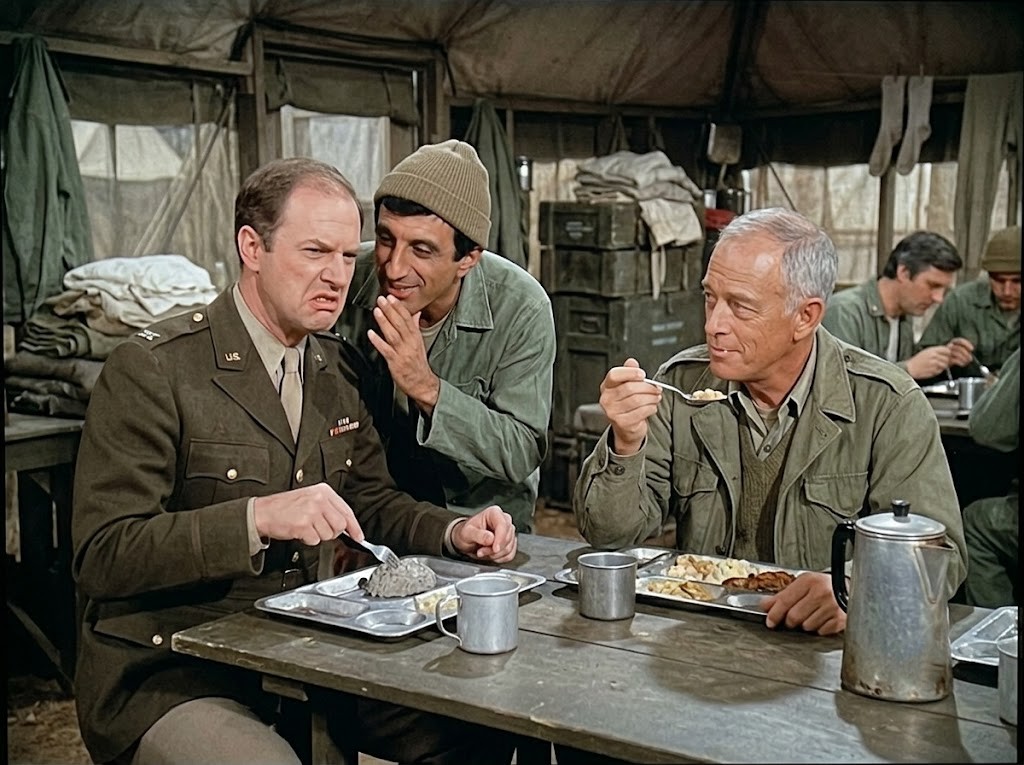
The mud outside the mess tent was ankle-deep, but inside, Major Charles Emerson Winchester III sat as though he were dining at the Parker House in Boston.
He was dressed in his immaculate Class A uniform, every button polished to a mirror shine, a stark contrast to the olive drab fatigue jackets and damp canvas that defined the 4077th.
Yet, looking down at his metal tray, Charles’s face contorted into an expression of profound, unmatched disgust, his fork hovering above a gray, gelatinous mass that defied both nature and culinary science.
“It is a crime,” Charles muttered, his voice dripping with aristocratic disdain. “An absolute, unadulterated assault on the gastrointestinal tract.”
Colonel Potter, sitting across from him, calmly raised a spoonful of the exact same mystery food to his mouth, his face a mask of seasoned, midwestern stoicism.
Potter chewed slowly, evaluating the gray lump with the patient eye of a man who had survived two world wars and a diet consisting primarily of Army rations.
“Calm down, Charles,” Potter said dryly, a faint, grandfatherly smirk playing on his lips. “It builds character. Besides, Igor swears it’s Salisbury steak, though I think the horse might have a grievance.”
“It has the consistency of wet mortar and the aroma of a damp basement, Colonel,” Charles snapped, poking the mass with his fork as if expecting it to fight back.
Just then, Max Klinger materialized from the shadows of the tent, leaning down until his lips were inches from Charles’s ear.
Klinger wasn’t wearing one of his famous dresses today; he was in a standard issue beanie and fatigue shirt, but his expression was pure, unadulterated mischief.
“Major,” Klinger whispered loudly, shielding his mouth with a hand, “I wouldn’t eat that if I were you. But if you’re looking for a little taste of the good life… I might know a guy who just intercepted a very specific, very fragile package from Massachusetts.”
Charles froze, his fork stopping mid-air as he turned his head slowly toward Klinger, his eyes narrowing with a mixture of intense suspicion and desperate hope.
The entire mess tent seemed to grow quiet, the ambient clatter of metal trays fading as Charles realized Klinger was holding the one thing he had been praying for all month: a genuine, unbroken record of the Boston Symphony Orchestra, sent straight from home.
But Klinger’s grin grew wider, and he leaned in closer, dropping the real bombshell. “The catch is, Major… the mail jeep took a dive into a ditch, and if you want it before the humidity warps the vinyl into a salad bowl, we have to move right now, before the MP patrol locks up the supply shack.”
Charles’s chest tightened under his pressed uniform jacket, the conflict raging behind his eyes as clear as day.
To a man like Winchester, a piece of home—the soaring strings of Beethoven played by the finest musicians in New England—wasn’t just entertainment; it was oxygen in a place that constantly threatened to suffocate him.
Colonel Potter watched the silent battle play out over the rim of his tin coffee cup, his expression softening from amusement to a quiet, paternal understanding.
“Go on, Winchester,” Potter said softly, setting his spoon down. “Heaven knows if I could get a fresh ear of Iowa corn out of a ditch right now, I’d leave a trail of dust behind me. Just make sure you don’t scuff those fancy shoes.”
Charles didn’t need to be told twice; he stood up so fast his chair scraped loudly against the dirt floor, ignoring the amused chuckles from Hawkeye and B.J. at the neighboring table.
He followed Klinger out into the damp, gray afternoon, his pristine trousers instantly splattered with cold Korean mud as they hurried toward the edge of the compound.
The supply shack was dark, smelling of canvas, motor oil, and old paper, but there, sitting on a wooden crate, was a battered cardboard box addressed in elegant cursive to *Major C.E. Winchester III*.
Klinger pulled a pocket knife from his fatigue pants and neatly sliced the heavy twine, stepping back to let Charles inspect the cargo.
With trembling, surgeon’s hands, Charles pulled back the damp cardboard layers, his breath catching in his throat as he lifted the heavy, pristine black vinyl disc from its sleeve.
It was immaculate, completely untouched by the dampness of the ditch or the harshness of the war zone, its red and gold label gleaming under the single hanging lightbulb.
“The Boston Symphony,” Charles whispered, his voice losing every ounce of its usual pompous edge, replaced by a raw, fragile vulnerability that he rarely let anyone see. “The 1948 recording of Brahms’ Academic Festival Overture… conducted by Koussevitzky himself.”
Klinger stood by the door, watching the big man cradle the piece of plastic like it was a newborn child, a soft, genuine smile replacing his usual conniving grin.
“I figured a guy who dresses like he’s going to the opera just to eat Igor’s cooking deserved a little music to go with it,” Klinger said quietly, leaning against the wooden doorframe.
Charles looked up, his eyes slightly misted over, looking at Klinger not as an annoying supply clerk or a theater act, but as a man who had just handed him a lifeline.
“Thank you, Klinger,” Charles said, his voice thick but remarkably formal. “I am… deeply in your debt. Though, I must ask, what is the price for this extraordinary act of administrative larceny?”
Klinger waved a hand dismissively, turning to look out at the grey, drizzling camp. “No charge today, Major. Just… play it loud enough so the rest of us can hear it over the generators tonight, okay?”
An hour later, the rain began to fall in earnest, drumming a steady, rhythmic beat against the canvas roofs of the 4077th.
But inside the Swamp, the scratching sound of a needle finding its groove cut through the damp chill, followed immediately by the rich, warm, triumphant swell of a brass section from thousands of miles away.
Colonel Potter sat in his office, a rare smile gracing his weathered face as the music drifted across the compound, blending seamlessly with the sound of the rain.
In the mess tent, the food was still cold, the war was still happening, and the fatigue was still etched deep into everyone’s bones.
But for one beautiful, fleeting hour, the mud of Uijeongbu felt just a little bit closer to home.
Sometimes, the sweetest melodies are the ones that remind us we’re still human, even in the middle of nowhere.