The Impossible Geometry of Kindness in Korea
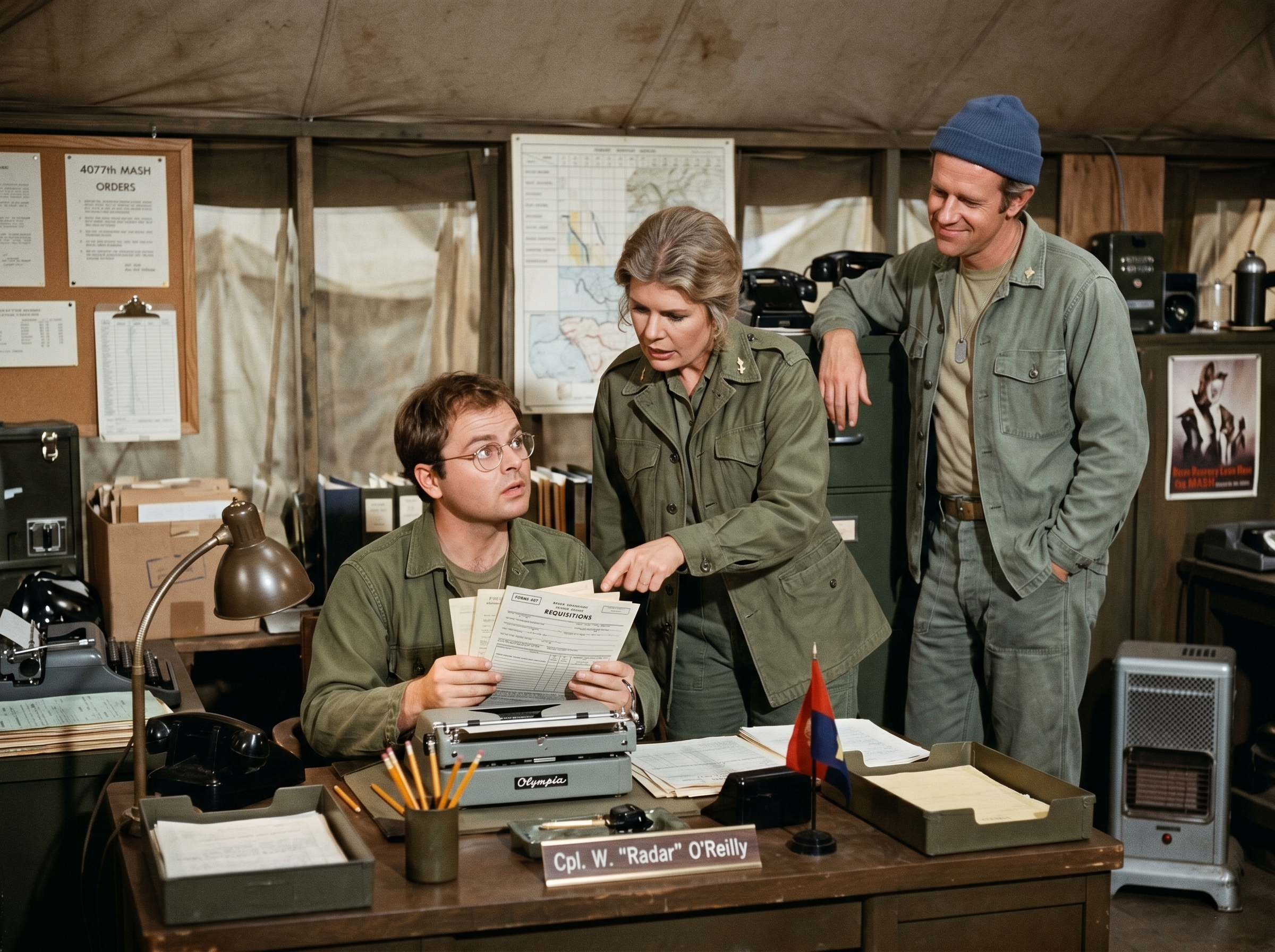
Sometimes, the loudest sounds in the 4077th aren’t the choppers. They aren’t the mortars or the artillery rumble from the line. They are the quiet sighs, the frantic rustle of impossible paperwork, and the heavy thuds of hearts breaking. Usually, all three happen right at Radar O’Reilly’s desk.
It was one of those rare afternoons where the O.R. was finally empty. The fatigue was the heavy, gray kind that settles in your bones. But in Radar’s tent, the battle was just heating up.
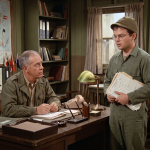
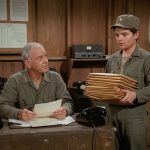
The central source of conflict was a specific piece of paper. Radar held it like it was a live grenade. He was leaning into the dim light of his brass lamp, looking more like a concerned sparrow than an Army clerk. He was trying to make sense of the nonsense of war.
Major Margaret Houlihan was looming over his desk like a magnificent, olive-drab storm cloud. She was pointing, with perfect, piercing precision, at a single line of bureaucratic gibberish. Her expression was a masterclass in frustration and absolute professional demand. The tent walls seemed to vibrate slightly when she spoke.
“I don’t care about the guidelines from Tokyo, Radar!” she snapped. “It’s a requisition form, not a treaty for a world peace conference! Where is the order number?” Her finger was a fixed bayonet on the page.
Radar flinched, his glasses slipping slightly. “Major, I know the form is messy. But if I don’t follow the code on the memo, they’ll send us 500 left boots instead of the winter coats.” He looked genuinely distressed, a rare moment where his administrative superpowers were failing him.
Captain B.J. Hunnicutt was standing right behind them, by the filing cabinets. He looked like a calm lighthouse in the middle of this tempest. B.J. was just… there. Leaning. Smiling, actually.
He was wearing that faded blue watch cap, the one that probably smelled like laundry and home. He had his hands casually tucked into his fatigue pockets. His calm, easy grin was the complete opposite of the chaos happening a foot away. B.J. watched Margaret’s focused intensity and Radar’s innocent desperation.
He offered no solutions. He didn’t intervene. He simply offered the quiet comfort of his dry amusement. It was the unspoken message: Look how ridiculous this is. Look how human we are. It was exactly the kind of warmth that kept everyone from just walking into the mountains.
The tension in the room was delicate. Margaret demanded order. Radar wanted to please her. B.J. just wanted everyone to survive. Just then, a faint buzzer sounded on the field phone behind them.
It was a soft sound. But the moment it rang, the frantic energy froze. B.J.’s smile faded. Margaret looked up. Radar swallowed. The game was paused.
Radar reached over the phone to grab the receiver. His eyes never left the paper that was causing all the trouble. His other hand stayed fixed on the “Cpl. W. ‘Radar’ O’Reilly” nameplate, his safe harbor.
He picked it up, expecting the usual demand. But the voice on the other end was too quiet. Too tired. Radar’s expression changed from paperwork-anxiety to a deep, profound sadness.
“Yes, sir,” Radar whispered. “I… I understand. No choppers. Just a convoy of three.” He put the phone down, the click louder than the buzzer had been.
For a long moment, the three of them just stood in that specific configuration shown in the picture. The desk, the typewriter, the maps, the “4077th MASH ORDERS” board. It was all still there. But it felt distant now.
The tension of the supply requisition didn’t just break; it completely dissolved. It was impossible to worry about Left Boots versus Winter Coats. Not when they all knew that three trucks were arriving, carrying soldiers who had no use for either.
Margaret Houlihan did something then that only happened when the walls truly fell away. She straightened up from her military lean. Her commanding posture melted. The sharp Major who was just berating a clerk was gone.
She left her hand on the edge of the desk, but she didn’t look at the paper anymore. She looked at B.J. Her professional, capability-driven eyes were suddenly wide with a quiet, devastating vulnerability. It was the look of a healer who knew they were about to fail before they even began.
B.J. moved first. He didn’t make a big show of it. He didn’t offer a dramatic comforting speech. He just stepped forward, his body language still relaxed but now purposeful. He gently clapped Radar on the shoulder. It was a simple ‘Good job, kid’ that meant everything.
Then he looked at Margaret. “The trucks are still 20 minutes out,” B.J. said softly. “Radar, I think the Major could use a coffee. The kind you can stand a spoon up in.“
Radar looked up, the sadness still in his eyes, but a quiet competence returned. He nodded, already reaching for the hot plate. “Yes, sir. Captain, would you want one, too?“
“Always,” B.J. smiled, a ghost of his previous easygoing grin returning. “But first, I need to find Hawkeye. He’s probably trying to fix something in the pre-op again.“
The scene in the photo, the frozen moment of shared confusion and friction, was gone. It had been replaced by the weary reality of the 4077th. The family was about to go back to work.
The warmth that remained in the tent wasn’t from the brass lamp. It was the warmth of three people who found common ground in the face of inevitable pain. It was the tender geometry of their friendship: Margaret’s command, B.J.’s humor, and Radar’s heart. They all knew that after the convoy came and the O.R. was full again, this tiny moment of shared humanity at a messy desk would be what kept them sane.
They went back to saving lives, knowing the paper work would wait, because friendship always came first.