A Chapter of Dust and Dignity at the 4077th
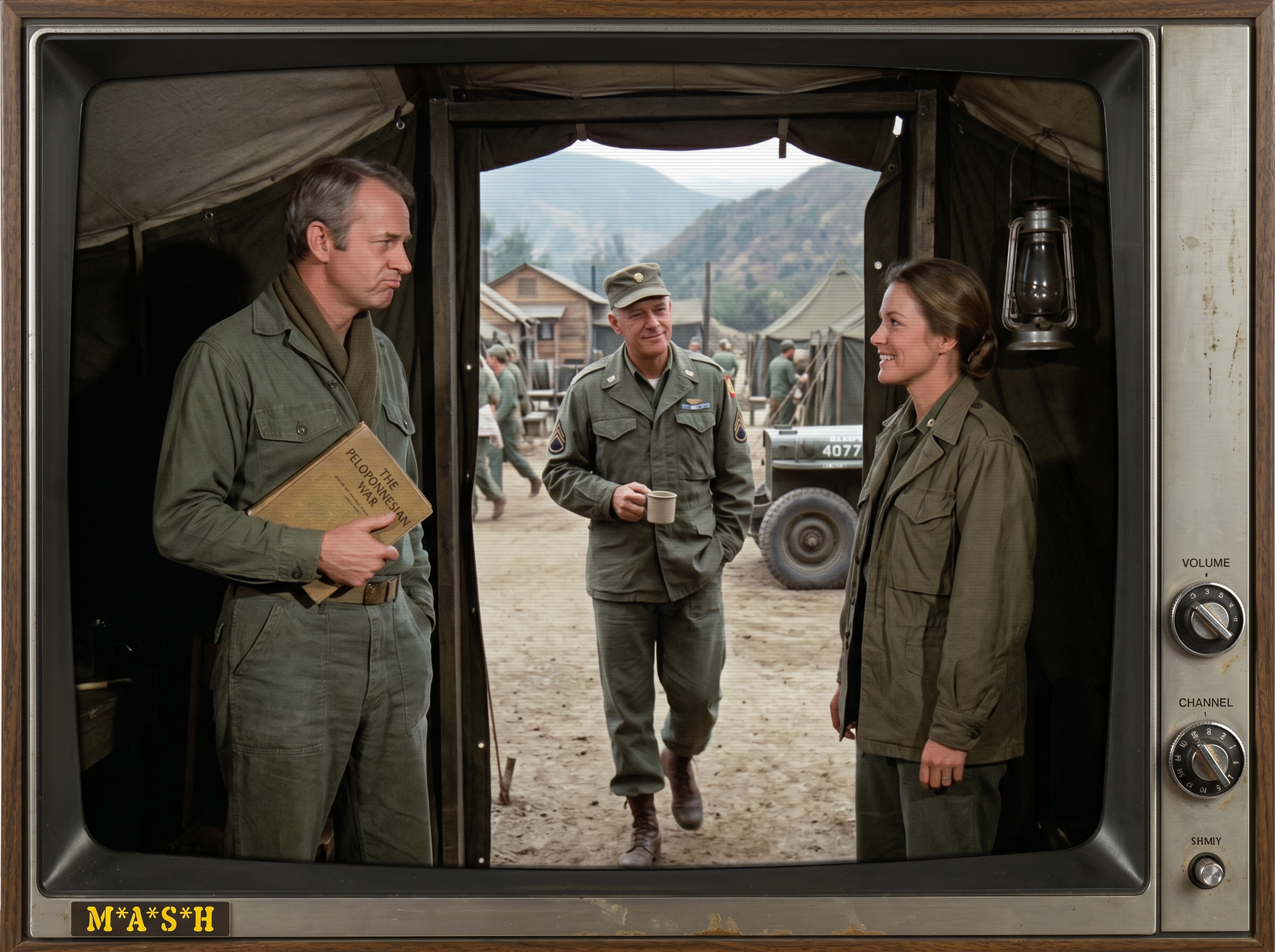
The dust of the 4077th had a stubborn way of settling onto absolutely everything.
It clung to the olive drab canvas of the tents, it coated the heavy boots of exhausted surgeons, and it even managed to find its way into the pristine pages of ancient Greek history.
It was late afternoon, that strange, suspended hour in a Mobile Army Surgical Hospital when the operating room was blessedly quiet. The camp was holding its collective breath, waiting for the inevitable rhythmic chopping of helicopter blades to shatter the peace.
Major Charles Emerson Winchester III was doing his utmost to pretend he was anywhere else.
Standing just inside the doorway of his canvas purgatory, Charles attempted to find solace in the heavy, yellow-bound volume of “The Peloponnesian War.” He stood upright, his posture a masterclass in controlled, Bostonian restraint.
He held the book not just as reading material, but as a physical shield against the profound indignities of the Korean War. The soft, balanced light of the afternoon filtered through the tent flap, casting a golden hue over his crisp, impeccably maintained olive drab shirt.
But true peace was a commodity rarer than fresh eggs in this camp.
Major Margaret Houlihan stood just outside the flap, framed by the dusty camp path and the rolling, indifferent hills of the Korean landscape.
She was taking a brief moment between rounds, her field jacket worn but neat, her hair pulled back with customary precision. Margaret had caught Charles retreating into his literature, and she simply couldn’t let the moment pass without comment.
“Retreating to Athens again, Major?” Margaret asked, her voice carrying a fiercely proud retort.
“I am simply maintaining a tether to civilization, Margaret,” Charles replied without missing a beat. “Something this camp seems determined to sever with every serving of powdered eggs.”
Margaret offered a subtle, almost invisible smile. It was a sharp, familiar banter. Beneath her composed exterior, there was a quiet warmth, a mutual understanding of the absurd reality they were both trapped in.
“Civilization is overrated, Charles. Especially when the latrines are backing up again,” she countered, her eyes sparkling with the thrill of the intellectual fencing match.
Charles sighed heavily, a sound of refined irritation. He lowered the book slightly, his right eyebrow rising to a staggering height of pure, unadulterated condescension.
He drew in a deep breath, preparing to unleash a carefully constructed, multi-syllabic bombardment that would undoubtedly put the Head Nurse in her place. He raised his chin, his thumb tightly gripping the cover of his book.
But before a single perfectly enunciated word could leave his lips, a shadow suddenly fell across the wooden slats of the tent doorway.
Neither of them had heard the approach over the distant, ambient hum of a passing jeep.
Suddenly, Colonel Sherman T. Potter was standing right in the threshold, an enameled mug of coffee resting easily in his hand, a completely unreadable look on his seasoned face.
The air in the doorway grew incredibly still, the tension hanging heavy in the dusty afternoon light.
Colonel Potter didn’t say a word at first.
He simply stood in the shadow of the doorway, his eyes darting from the heavy historical tome in Winchester’s hand to the fiery, defensive posture of his Head Nurse.
The silence stretched out, thick and expectant. Charles swallowed his prepared retort, his rigid posture stiffening even further under the commanding officer’s gaze. Margaret instinctively squared her shoulders, awaiting the inevitable reprimand for loitering outside the Swamp.
Instead, Potter took a slow, deliberate sip from his dented gray mug.
“You know, Winchester,” Potter said, his voice a gravelly, calm drawl that instantly lowered the blood pressure of everyone in earshot. “I read Thucydides back in the First World War. In a muddy trench somewhere outside the Meuse-Argonne.”
Charles blinked, completely caught off guard. “Did you, Colonel?”
“I did,” Potter nodded solemnly, stepping fully into the shared space between the interior of the tent and the dusty compound. “Fascinating stuff. All those hoplites and triremes. But I gotta tell you, Charles. The Spartans had one distinct, undeniable tactical advantage over the 4077th.”
Margaret looked at Potter, her curiosity piqued. “And what was that, Sir?”
Potter looked deadpan at the two of them. “They never had to eat Igor’s creamed chipped beef on toast. If they had, Athens would have won in a week.”
For a split second, the military discipline held. Then, the tension shattered completely.
Charles’s indignation deflated like a punctured tire. He tried desperately to maintain his refined scowl, but the corners of his mouth betrayed him, twitching upward into a begrudging, genuine smirk. He let out a short, aristocratic huff of amusement, entirely despite himself.
Margaret broke into a brilliant, subtle smile. The fierce pride melted away, replaced by the quiet, undeniable warmth of shared exhaustion. She looked down at the dusty ground for a moment, shaking her head, her laughter silent but deeply felt.
Potter just stood there, a small, fatherly twinkle in his eye. He took another sip of his coffee, entirely pleased with his timing.
In that brief, shining moment, the doorway transformed.
It was no longer just a flap of canvas separating the Swamp from the compound. It became a sanctuary. A transitional space where rank, background, and pedigree faded into the background.
Framed by the hanging metal lantern and the distant, olive-drab jeep parked in the lot, the three of them shared a spontaneous, intimate quiet. They were thousands of miles from home, covered in dust, bone-tired, and waiting for the next wave of broken bodies.
But right here, in this doorway, they were just three human beings keeping each other sane.
Potter understood the banter wasn’t born of malice. He knew his officers. He knew Charles used his books as armor, a way to protect his sensitive core from the relentless tragedy of the O.R. He knew Margaret used her sharp tongue to maintain her strength, to prove she was unbreakable in a world run by men.
And he knew that sometimes, the best medicine he could prescribe was a perfectly timed, dry punchline to remind them that they were all on the same side.
“Keep reading, Major,” Potter said softly, the humor fading into a steady, comforting wisdom. “Just don’t let the Greeks tell you how to do a bowel resection. I prefer the modern methods.”
“Noted, Colonel,” Charles replied, his voice uncharacteristically gentle. He looked at the book in his hands, suddenly feeling a little less isolated.
Potter gave Margaret a warm, acknowledging nod. “Major.”
“Colonel,” she replied, her voice soft and full of absolute respect.
Potter turned and continued his walk down the dusty camp path, his shoulders bearing the weight of command, yet remarkably steady.
Margaret lingered for just a second longer. She looked back at Charles, the competitive edge entirely gone from her eyes. In its place was a quiet, mutual recognition of their shared endurance.
“Try to get some rest, Charles,” she said quietly.
“And you, Margaret,” Charles replied, offering her a slight, dignified bow of his head.
Margaret turned and walked back toward the hospital wards, her step a little lighter than it had been five minutes ago.
Charles stood alone in the doorway for a moment longer. The camp was still quiet. The afternoon sun still bathed the olive tents in a soft, forgiving light. He looked down at the heavy book, ran a thumb over the cover, and gently closed it.
He didn’t need to retreat to ancient Greece today. The company right here in the mud was surprisingly sufficient.
In the end, the only history that truly mattered was the quiet grace they managed to show one another while waiting for the choppers.