A Few Miles From Home, A World Away From Anywhere
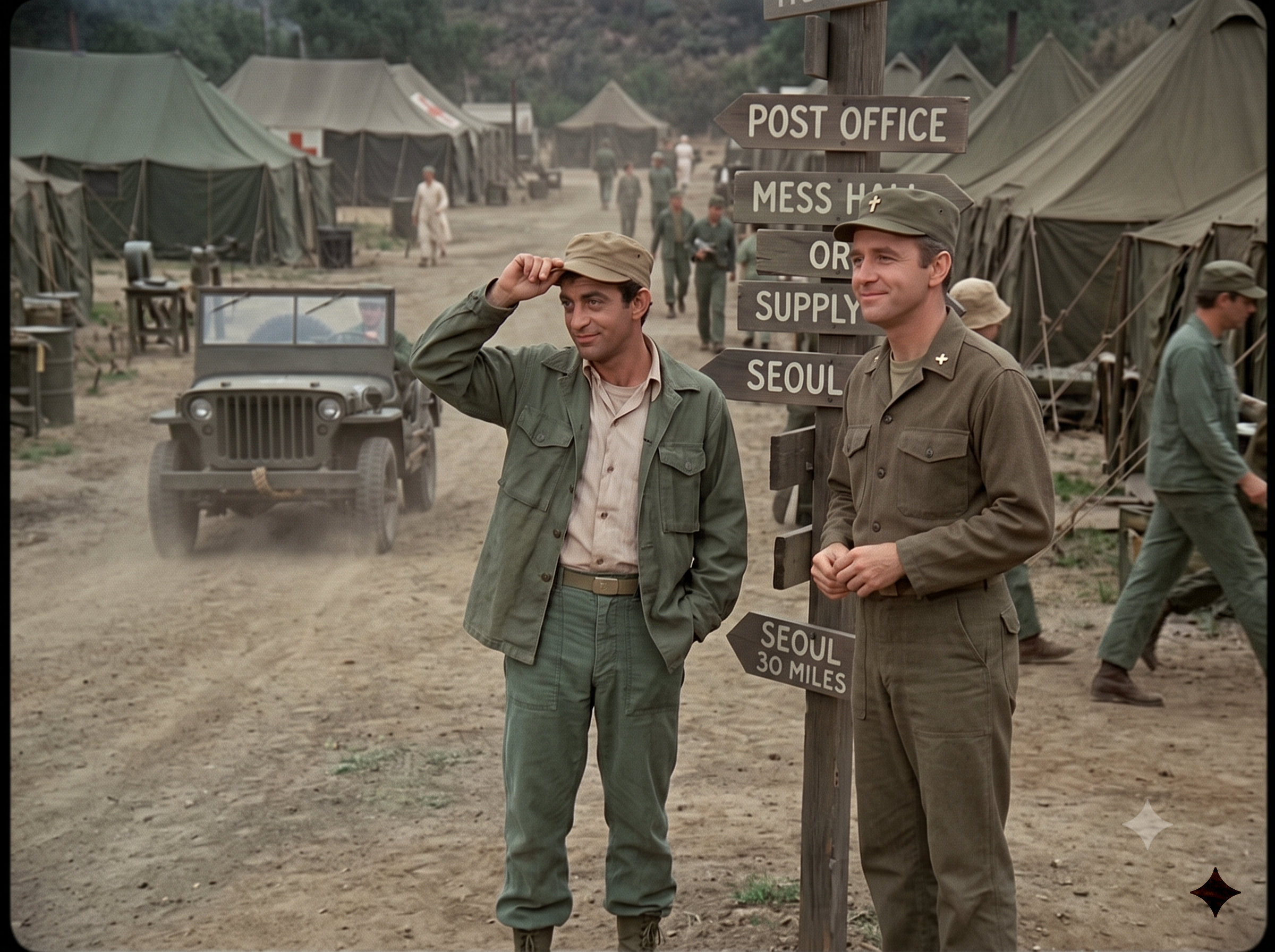
The dirt of the compound always seemed to find its way into everything—your boots, your lungs, and eventually, your soul. It was a Tuesday that felt exactly like a Monday, and probably like a thousand other Tuesdays before it.
Hawkeye stood by the signpost, his hand resting lightly on the brim of his cap as he squinted against the harsh, relentless Korean glare. Beside him, Father Mulcahy leaned into the quiet, his expression a mixture of gentle patience and the kind of weary resignation only a man of the cloth in a war zone could truly understand.
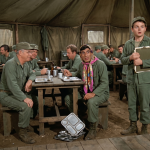
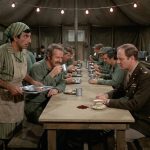
They weren’t discussing theology, and they certainly weren’t discussing the war. They were arguing, with the peculiar intensity that only happens after forty-eight hours on the surgical floor, about whether or not the mess hall had served real powdered eggs or some new, experimental form of industrial spackle.
“It had a texture, Father,” Hawkeye insisted, his voice dropping into that familiar, sardonic register. “It possessed a structural integrity that defied the laws of physics. If I had brought a spatula, I could have used it to patch the roof of the O.R.”
Mulcahy smiled, a small, tired twitch at the corner of his mouth. “It’s a balanced breakfast, Hawkeye. Or so the quartermaster claims.”
A Jeep rattled by in the background, kicking up a cloud of dust that hung in the stagnant air like a shroud. Hawkeye adjusted his cap, his eyes momentarily wandering toward the sign pointing to Seoul. It was just a wooden board, weathered and peeling, but it felt like the most important thing in the world at that moment.
“Thirty miles,” Hawkeye murmured, his humor suddenly evaporating. “It’s not far, is it? And yet, it might as well be on the moon.”
The silence that followed wasn’t uncomfortable; it was heavy. It was the silence of two men who had seen too much and were currently holding their breath just to keep the world from spinning off its axis.
Just then, Hawkeye reached up to pull his cap lower, shielding his eyes, and caught the Father looking at him. There was a look in Mulcahy’s eyes—a quiet, searching compassion—that made Hawkeye feel entirely, uncomfortably seen.
“You’re not thinking about running for it, are you?” the Father asked softly.
Hawkeye looked at the sign again, the wood grain rough and splintered. “No, Father. I think I’m just trying to remember what it feels like to be somewhere where the only thing on the horizon isn’t another tent.”
Hawkeye sighed, the exhaustion finally catching up to him, drooping his shoulders beneath the olive drab jacket. He wasn’t really looking for an escape—not today. He was just looking for a moment of stillness in a place that had forgotten how to be quiet.
Father Mulcahy stepped a little closer, placing a hand briefly on Hawkeye’s shoulder. It was a grounding touch, steady and devoid of judgment. “Sometimes, the horizon is just where you choose to look, my friend. You don’t have to be in Seoul to find a bit of peace.”
“That’s easy for you to say,” Hawkeye countered, though his voice lacked any real bite. “You have a direct line to the big guy upstairs. I’m just trying to keep the patients from needing to talk to Him ahead of schedule.”
Mulcahy let out a soft, genuine chuckle, a sound that seemed to cut through the oppressive heat of the afternoon. “I think He appreciates the effort, Hawkeye. Even when you’re being insufferable about the eggs.”
A gust of wind shifted the dust around them, swirling around the base of the signpost. For a fleeting second, the chaos of the camp seemed to dim. The shouts from the tents, the distant drone of a helicopter, the relentless grind of a war that felt both eternal and entirely temporary—it all faded into the background.
There were just two men, standing at a crossroads of nothing and nowhere, finding common ground in the simple, shared act of standing still.
Hawkeye looked at the Father, his expression softening into something sincere, stripped of the usual layers of sarcasm and wit. “I don’t know what I’d do without you, Father. I’d probably have turned into a pile of cynical shrapnel months ago.”
“We’re all just trying to keep each other in one piece,” Mulcahy replied, looking toward the distant hills. “That’s the business of the 4077th, isn’t it? Patching up the body, and hoping the rest of us stays mostly intact.”
Hawkeye took a deep breath, the dry air filling his lungs, and finally stepped back from the signpost. He didn’t look at the arrow pointing to Seoul again. Instead, he looked toward the mess tent, where the smell of coffee—or whatever they were calling coffee that day—was beginning to drift through the camp.
“Well,” Hawkeye said, nudging the Father toward the path. “If we’re going to survive the afternoon, I suppose we’d better go see what kind of culinary disaster is waiting for us.”
As they walked away, the camp hummed with the quiet, persistent rhythm of life continuing in spite of everything. The signpost remained behind them, pointing in directions they couldn’t go, but for the first time all day, neither of them felt like they were drifting. They were exactly where they needed to be, together, in the middle of a war they didn’t ask for, holding onto the only things that mattered: each other and the hope that tomorrow would be a little bit quieter.
The sun dipped slightly lower, casting long, lean shadows across the dirt, turning the harsh reality of the camp into a soft, golden memory in the making. It wasn’t home, and it was a long way from peace, but as they walked, there was a quiet, stubborn comfort in the simple companionship of a friend.
In a place where everything is temporary, the only thing that lasts is the kindness we leave behind.