The Quiet War in the Reading Lamp
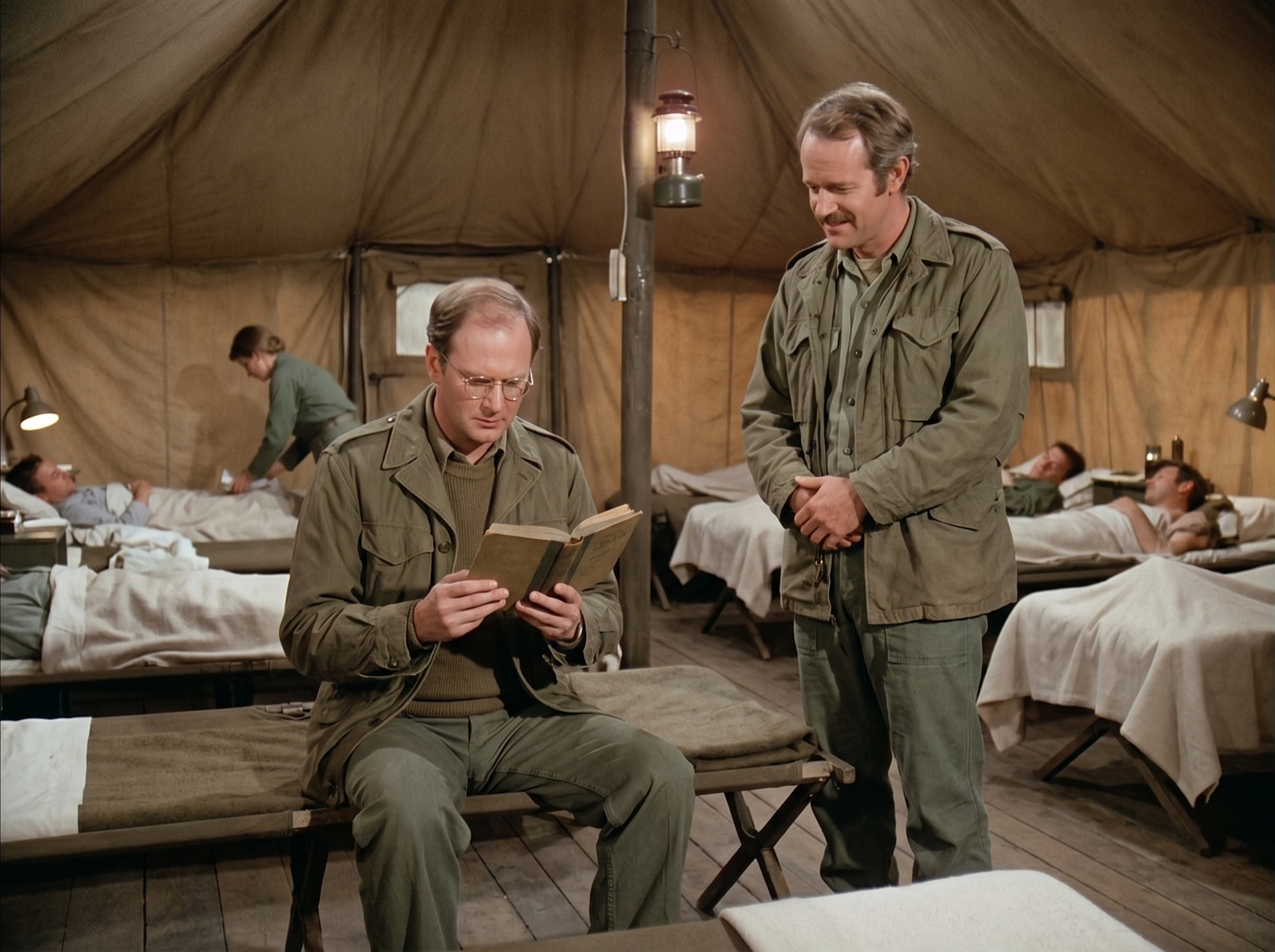
Sometimes, the loudest sounds in a war aren’t from the sky. They are the scraping of cots. The low, ragged cough of a sleeping soldier. The squeak of a floorboard under a nurse’s sneaker.
In the Post-Op ward, it was one of those nights. Not heavy with wounded, but heavy with silence. Heavy with the tired sighs of men who had seen too much.
Hawkeye sat on the edge of a vacant cot, and it wasn’t to nap. For once, he wasn’t making a wisecrack. He wasn’t mixing a martini.
He was wearing his glasses, the thin-rimmed ones he only pulled out when things got quiet. A worn, olive-green hardcover book was balanced in his hands. It looked older than the army.
Hawkeye was halfway down a page, but his eyes weren’t moving. He was looking *through* the words. It wasn’t a medical text. It was some cheap detective pulp.
The reading lamp near him hummed, its bulb too bright and too hot. It cast long, dancing shadows of him against the canvas wall. It made him look less like a doctor and more like a tired ghost.
Then B.J. appeared. He just materialized, a ghost himself, appearing on the edge of Hawkeye’s peripheral vision. He didn’t make a sound.
B.J. was in his jacket, arms casually crossed. He just stood there. He was watching Hawkeye, and Hawkeye could feel his gaze.
The silence was a palpable thing, a weight on their shoulders. Hawkeye just kept staring at the same paragraph. He didn’t turn the page.
B.J. hadn’t moved. He was patient. Waiting.
Hawkeye knew B.J. wasn’t leaving. The silent stand-off had begun.
Finally, without looking up, Hawkeye said, “If you’re waiting to inherit the book, B.J., don’t hold your breath. I’m only on chapter four.”
B.J. didn’t smile. “I’m not. I’m waiting for you.”
That was the problem. B.J. always was.
Hawkeye finally closed the book with a quiet thud. He didn’t use a bookmark. He just remembered the number. “It’s 3:30 in the morning, Beej. Don’t you have some sleep to lose in the Swamp?”
“I already lost it,” B.J. said. He moved in closer, the floorboards groaning, breaking the spell of silent watching. He stood over Hawkeye, blocking some of the heat from the reading lamp.
Hawkeye looked up at him. “What is it? Did the Still blow? Is Father Mulcahy performing an emergency exorcism on Winchester’s ego?”
“We just lost private Jensen from Ohio.” B.J.’s voice was flat. Human. Devoid of the performance they usually did for each other.
The humor in the tent evaporated. The distant coughs of the patients suddenly felt sharper. The reading light seemed less cozy, more harsh.
Hawkeye’s hand, which had been resting on the book, went still. He stared at B.J. for a long moment, then picked his glasses off his nose and massaged his eyes. The tired lines on his face deepened.
“Jensen,” Hawkeye repeated softly. He was the kid who’d arrived only a few days ago, barely old enough to shave. The one they couldn’t get stable. The one they’d used all the tricks on.
“You tried,” B.J. said. “I tried. Everyone tried.”
“Sometimes trying feels like a bad joke,” Hawkeye said, his usual armor trying to slide back into place. “You try, you try, and all you get is a tired friend at 3 a.m. telling you another kid isn’t going to Ohio.”
“We didn’t fail, Hawk. He had a hole in his chest. We did what we could.”
“What we could,” Hawkeye repeated, a trace of poison in his voice. “We can stop bleeding. We can set bones. We can’t stop death.”
“That’s not our job,” B.J. said gently, but firmly. He knew where this spiral was going. He’d lived it.
B.J. gestured at the book Hawkeye had been holding. “What’s that? A story where the hero always solves the crime and saves the dame?”
Hawkeye picked it up again, tracing the title. “Actually, in this one, the private investigator is an alcoholic, the dame is lying to him, and they’re all broke. A regular barrel of laughs.”
A small, quiet smile, barely there, twitched at B.J.’s lips. “Sounds familiar.”
The shared thought was a silent anchor. The Swamp. The martini glasses. The endless, desperate theater of wit that kept the ghosts at bay.
“You read the ending?” B.J. asked, nodding at the book.
“Don’t want to spoil it,” Hawkeye said. He tapped the worn cover. “Sometimes, it’s nice just *reading* a happy ending. Even if you know it’s just a story made up by some writer in a nice, clean office.”
Hawkeye put the book down, but he didn’t pick it back up. He had seen the ending of private Jensen’s story, and it wasn’t the one he’d written in his head.
“Potter wants a drink,” B.J. said casually, though they both knew Potter was likely asleep. “Said if you show up in the mess, he might share the good stuff.”
Hawkeye sighed. The armor was back, but it was thinner. “The good stuff, eh? That better be genuine moonshine, not that horse liniment Winchester has.”
He stood up, his bones creaking. He was too young to feel this old. He took off his glasses and folded them. B.J. was already turning, leaving the Post-Op ward to its tired ghosts.
Hawkeye picked up the worn detective story. He hesitated. He looked at the humble book, then at the bright, humming bulb of the reading lamp, the same lamp that had lit Jensen’s chart only hours ago.
With a definitive click, Hawkeye turned off the reading light.
The Post-Op ward plunged back into a dark, quiet peace, save for the rhythmic rise and fall of chests, and the distant scrape of an order of boots walking toward a mess tent for one more night of shared, quiet defiance.
Sometimes the best medicine is just a story and a friend, lit by the quiet war within.