The Symphony in the Mud
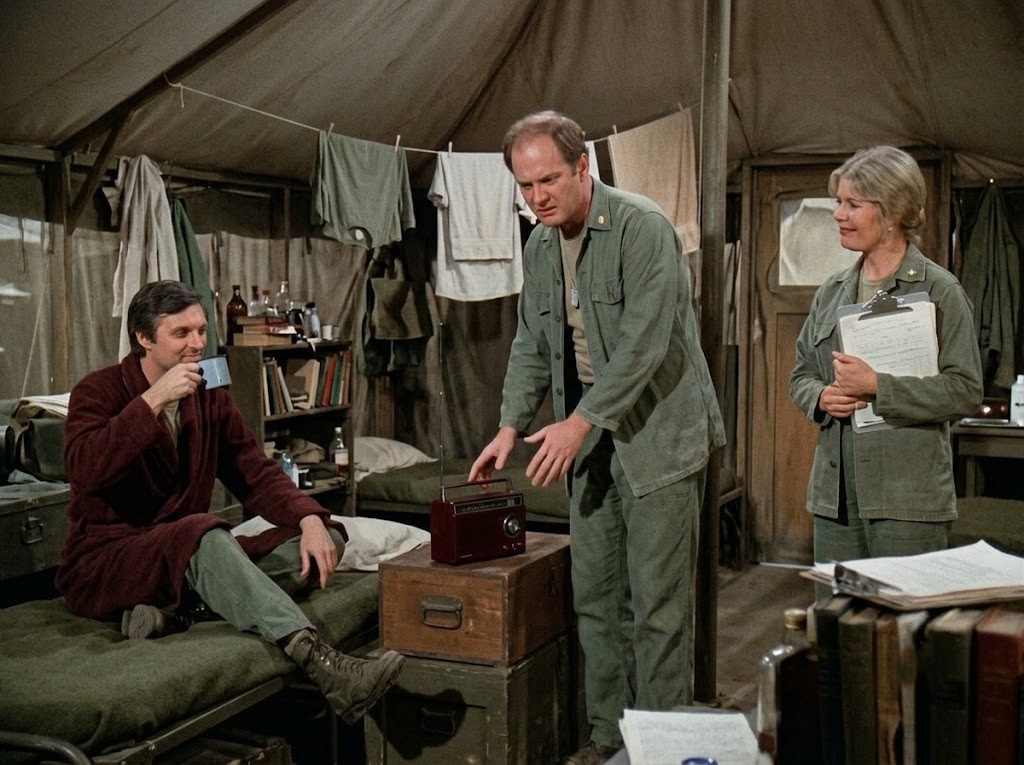
The mud in Korea has a way of seeping into everything—your boots, your cot, and eventually, your soul. But inside the Swamp, on a quiet Tuesday afternoon between incoming choppers, the biggest battle wasn’t against the elements or the war.
It was between Charles Emerson Winchester III and a stubborn, small plastic box.
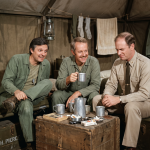
Hawkeye Pierce sat cross-legged on his cot, wrapped in his familiar maroon bathrobe, slowly sipping a lukewarm cup of blue-mug gin. His eyes danced with lazy amusement as he watched his tentmate.
Charles was practically vibrating with a mix of aristocratic fury and desperate concentration. He hovered over a small, reddish-brown transistor radio perched precariously on a wooden footlocker, his hands hovering over it like a frantic surgeon about to perform open-heart surgery on a mechanical patient.
“I assure you, Pierce, if this primitive piece of standard-issue garbage does not cooperate within the next three minutes, I shall crush it beneath the heel of my boot,” Charles hissed, his face twisted into a mask of pure concentration.
“Careful, Charles,” Hawkeye drawled, taking another slow sip. “That little radio is a sensitive soul. You have to sweet-talk it, not threaten it with a court-martial. Try mentioning the Boston Common. Maybe whisper a little Chopin into the battery compartment.”
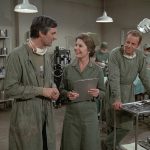
Major Margaret Houlihan stood just inside the tent doorway, holding a thick clipboard against her chest. She had originally marched over from the post hospital to demand Winchester’s overdue surgical logs, but the sheer absurdity of the scene had stopped her in her tracks.
Instead of her usual military sternness, a soft, knowing smile tugged at the corners of her lips as she watched the two doctors. There was something deeply humanizing about seeing the formidable Major Winchester reduced to a state of utter vulnerability by an antenna.
“What exactly are we trying to capture from the airwaves, Charles?” Margaret asked softly, stepping closer into the dim, laundry-lined sanctuary of the tent. “A news report? General MacArthur’s latest press release?”
Charles didn’t look up, his fingers delicately twitching the tuner dial by a fraction of a millimeter. “Do not mock me, Major. Today is the twenty-seventh. If my calculations regarding the time difference and the shortwave propagation are correct, the Boston Symphony Orchestra is performing Beethoven’s Ninth.”
He let out a sharp, agonized breath as a loud burst of static tore through the small speaker, sounding like a handful of gravel thrown against a tin roof.
“For months, I have lived in this cultural wasteland, surrounded by the droning of military communiqués and Pierce’s intolerable puns,” Charles muttered, his voice dropping into a rare, quiet register of genuine longing. “Just one movement. Just five minutes of pure, unadulterated civilization is all I ask.”
Hawkeye stopped smiling, his gaze softening as he looked at the older man. Beneath the layers of pompous arrogance and Bostonian pride, he could see the raw ache of homesickness that spared no one in the 4077th.
Charles leaned down further, his hands spread wide as if he could physically coax the symphony out of the ether. The static swelled, a deafening wave of white noise that seemed to fill the entire tent, drowning out the distant hum of jeep engines outside.
Then, through the crackle of a thousand miles of atmospheric interference, a single, clear note of a violin pierced the air, followed by the faint, unmistakable swell of an orchestra.
Charles froze, his eyes widening, holding his breath as if a single exhale would blow the fragile signal back across the ocean.
—
For a fleeting, magical second, the damp canvas of the Swamp seemed to vanish. The hanging laundry transformed into velvet draperies, and the scent of antiseptic was replaced by the phantom aroma of polished wood and old sheet music from Symphony Hall.
Margaret took a step forward, her breath catching in her throat as the melody struggled to break through the noise. Even Hawkeye set his blue mug down on his knee, the teasing light completely gone from his eyes.
But Korea was a cruel audience.
Before the orchestra could even finish the phrase, a vicious wave of static crashed over the melody, swallowing the violins whole and replacing them with the harsh, rhythmic scratching of a distant military morse code broadcast.
“No, no, no! Confound it!” Charles cried out, his hands dropping onto the footlocker with a dull thud. His shoulders slumped, the regal posture completely evaporating, leaving him looking smaller, older, and deeply exhausted.
He turned his head away, staring blankly at the canvas wall, trying desperately to mask the sudden brightness in his eyes. “A futile exercise. Idiotic of me to think a piece of cheap plastic could bridge the gap between Boston and this godforsaken ditch.”
The silence that followed was heavy, filled only with the rhythmic *dit-dit-dah* of the radio’s static.
Margaret walked over slowly, setting her clipboard down on a nearby stack of medical journals. She didn’t offer a lecture on military discipline or demand her paperwork. Instead, she gently placed a hand on Charles’s shoulder, a rare gesture of quiet solidarity.
“It wasn’t idiotic, Charles,” Margaret said, her voice incredibly gentle. “We all try to find a way back home. Some of us look at old photographs until the edges fray, and some of us look for it in the airwaves.”
Hawkeye swung his legs out from his cot, his boots hitting the floorboards with a soft thud. He stood up, adjusting his maroon robe, and walked over to the wooden chest.
“You know, Winchester,” Hawkeye said, his tone devoid of its usual sharp edge, replaced by a warm, grounded sincerity. “The Boston Symphony is great and all, but their acoustic quality leaves a lot to be desired in a combat zone.”
Charles gave a bitter, humorless sniff. “Thank you for that staggering observation, Pierce.”
“I’m serious,” Hawkeye countered, gently nudging Charles’s hand away from the radio. He reached down and confidently turned the dial completely away from the shortwave band, spinning it toward the local Armed Forces Korea Network station.
Instead of classical grandeur, the tiny speaker vibrated with the slow, melancholy brass of a familiar big band jazz tune—a soft, drifting melody that felt perfectly suited for a rainy afternoon. It wasn’t Beethoven, but it was steady, warm, and entirely clear.
“See?” Hawkeye smiled faintly, looking up at Charles. “It’s not home. But it’s music. And more importantly, it’s ours.”
Charles looked at the small radio, then at Hawkeye, and finally at Margaret, who gave him an encouraging nod. The rigid line of his jaw slowly relaxed. He let out a long, slow sigh, the tension draining out of him as he accepted the substitute.
“It is… severely lacking in counterpoint,” Charles murmured, though the aristocratic bite was gone, replaced by a tired, grateful acceptance. “But I suppose the tempo is acceptable.”
“High praise indeed from the Beacon Hill music critic,” Hawkeye joked softly, picking up his blue mug again and raising it in a silent toast.
Margaret smiled, pulling up a wooden stool to sit for just a moment longer before duty called her back to the triage tent. For the next ten minutes, nobody spoke about surgeries, casualties, or how much time they had left on their rotations. They just stood together in the small, crowded tent, listening to a cheap radio play a song that kept the rest of the world at bay.
In the end, we learned that home wasn’t a place on a map, but the quiet moments we stole together to keep the music playing.