The Weight of the Word
The mud at the 4077th had a specific kind of gravity.
It didn’t just pull at your boots; it seemed to pull at your spirit, dragging you down just a little bit more with every step you took across the compound.
It was a quiet, gray Tuesday morning, the kind of morning that usually followed a brutal forty-eight-hour session in the operating room.
The sky hung low and heavy over the mountains, threatening rain but never quite delivering anything more than a damp, bone-deep chill.
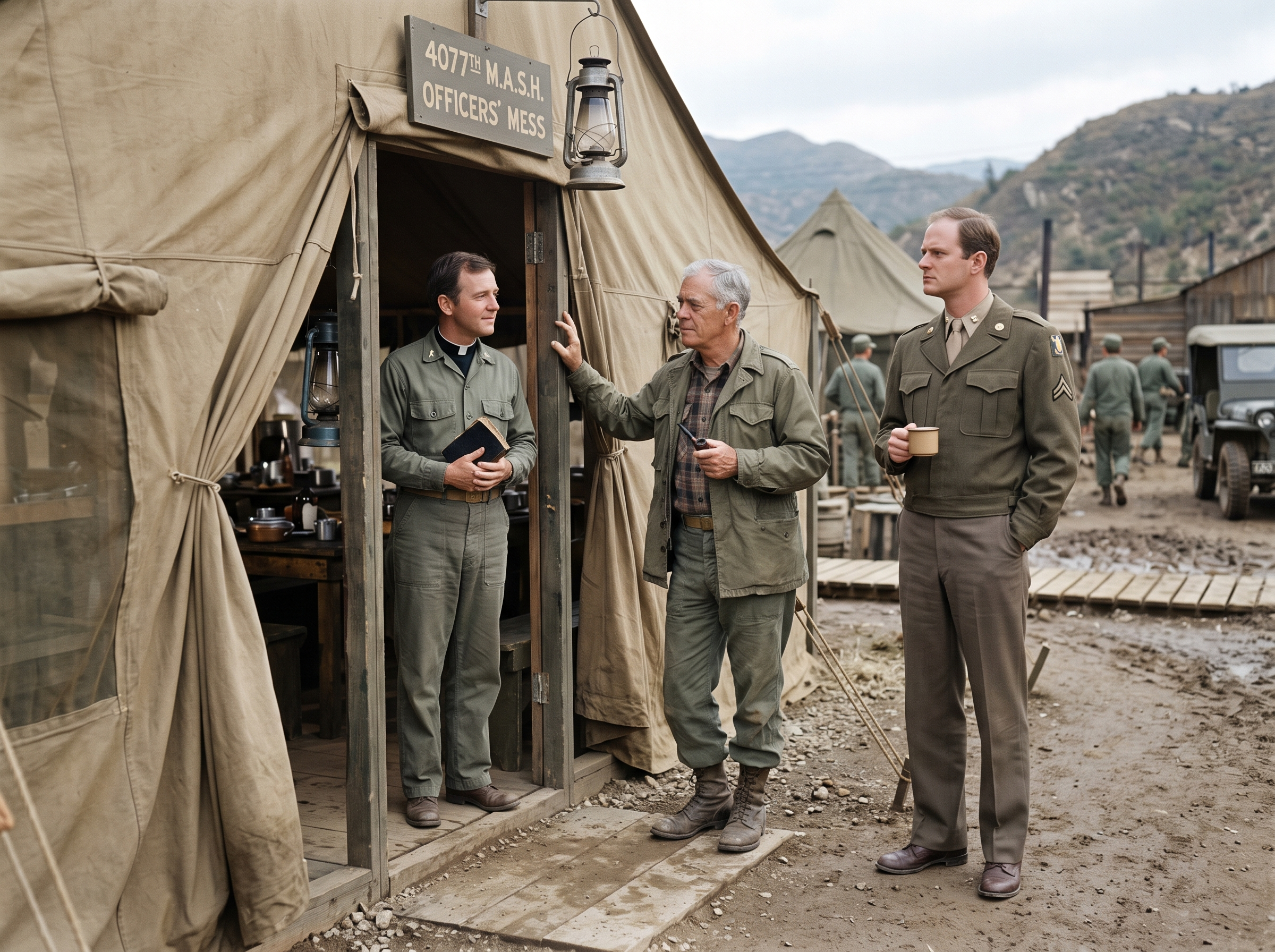
Father Francis Mulcahy stood in the doorway of the Officers’ Mess, leaning heavily against the wooden frame.
Above his head, the stenciled sign reading “4077TH M.A.S.H. OFFICERS’ MESS” looked just as tired and faded as the people who walked beneath it.
Mulcahy wore his green fatigues, his clerical collar standing out starkly against the drab military issue.
In his hands, he clutched his small, black, leather-bound Bible, holding it close to his chest like a small shield against the cold reality of the war around him.
He looked out over the compound, but his eyes weren’t really seeing the jeeps, the tents, or the muddy duckboards.
He was seeing the faces from the night before.
A few feet away, Colonel Sherman T. Potter strolled up, wearing a plaid flannel shirt under his unzipped field jacket.
Potter had a way of walking through the mud as if it were a freshly paved sidewalk in Hannibal, Missouri.
He paused, pulling his pipe from his pocket, his sharp, observant eyes taking in the slumped posture of his camp chaplain.
Just to Potter’s right stood Major Charles Emerson Winchester III.
Charles was dressed in his impeccably kept Class A jacket, standing tall and rigid despite the exhaustion that clearly pulled at the corners of his eyes.
In his hand, he held a battered tin mug of mess tent coffee, looking at it with a mixture of profound suspicion and deep aristocratic sorrow.
“Morning, Padre,” Potter said gently, tapping his pipe against his palm. “You look like a man who’s carrying the whole world on his shoulders. And from where I’m standing, it looks like it’s getting a mite heavy.”
Mulcahy offered a small, reflexive smile, but it didn’t reach his eyes. “Good morning, Colonel. Major. I’m just… gathering my thoughts, I suppose. It was a long night in post-op.”
“It was a veritable parade of misery, Father,” Winchester murmured, finally taking a tentative sip from his mug and wincing. “And this so-called coffee is the grand finale. I am convinced Igor brews this by dragging an old boot through a puddle of warm despair.”
Usually, Mulcahy would offer a lighthearted chuckle at the Major’s complaints.
Today, however, he simply stared down at the black book in his hands.
His fingers traced the worn edges of the leather, his knuckles white with tension.
Potter narrowed his eyes, stepping a little closer to the doorway.
He knew his people. He knew when Hawkeye was covering pain with a joke, he knew when B.J. was homesick, and he knew when his gentle priest was nearing the end of his rope.
“Francis?” Potter asked, his voice dropping its casual tone, replacing it with the quiet, sturdy authority of a father. “What’s eating at you, son?”
Mulcahy took a shaky breath.
He looked up, his eyes suddenly bright with unshed tears, the polished veneer of his usual cheerful optimism cracking wide open.
“It’s not just the Bible, Colonel,” Mulcahy whispered, his voice trembling as he slipped a piece of folded paper from between the pages of the holy book.
“It’s a letter. To a mother in Ohio. Her son was the young corporal who… who we lost just before dawn.”
Mulcahy swallowed hard, gripping the doorframe to steady himself.
“I’ve sat at my desk for two hours, Colonel. I’ve written hundreds of these. But today… today the words just aren’t there. I look at the blank page, and I feel absolutely, terrifyingly empty. I have nothing left to give them.”
The priest closed his eyes, leaning his head back against the canvas tent, looking entirely defeated by a war that asked too much of good men.
The silence that followed was heavier than the damp Korean air.
Even the distant, constant hum of the motor pool seemed to fade away, leaving only the sound of the wind flapping against the canvas of the mess tent.
Winchester stopped glaring at his coffee mug.
He slowly lowered the tin cup, his usual haughty expression melting into something remarkably soft, his eyes fixed on the crumbling priest in the doorway.
Potter didn’t say a word at first.
He just stepped up to the wooden duckboard, slowly put his unlit pipe into his pocket, and placed a weathered, heavy hand on Mulcahy’s shoulder.
It was a grounding touch, the touch of a man who had seen three wars and knew exactly what the bottom of the emotional barrel felt like.
“Francis,” Potter said quietly, his voice a low, steady rumble. “You’ve poured your heart out into every cot in that post-op ward. You’ve given pieces of your soul to kids who were terrified, to kids who were in pain, and to kids who just needed someone to hold their hand in the dark.”
Potter squeezed the chaplain’s shoulder gently.
“A well runs dry sometimes, Padre. It doesn’t mean the water is gone forever. It just means you need a minute to let it fill back up. You can’t expect yourself to have a miracle ready every single morning before breakfast.”
Mulcahy looked down at the mud, a tear finally escaping and tracking through the dust on his cheek.
“But they need to know, Colonel. They need to know their boy meant something. That he didn’t just fade away in a tent halfway across the world. And I… I can’t find the poetry to tell them that.”
“They do not require poetry, Father.”
The voice came from Charles.
It was quiet, entirely lacking its usual theatrical resonance.
Winchester took a slow step forward, his tall frame blocking the wind.
He looked at Mulcahy with a deep, profound respect that he rarely let show.
“I operated on that young man, Father,” Charles said softly, his eyes completely sincere. “And while I was fighting to repair the physical damage, I saw you standing beside him. I saw you stroke his forehead. I heard you speaking to him when the anesthesia took hold.”
Charles glanced down at his mug, then back up to the priest.
“You gave that boy the last human comfort he will ever know. You were the presence of grace in a room entirely devoid of it. You do not need to search for eloquent words to write to his mother, Francis.”
Winchester reached into the breast pocket of his pristine jacket and pulled out a beautiful, silver-plated fountain pen.
He held it out toward Mulcahy, a silent, deeply personal offering from a man who guarded his emotions behind high walls of Boston propriety.
“Just tell her,” Charles said gently, “that he was not alone. Tell her that he was cared for. And tell her that he was prayed for by a man of profound goodness. That is the only truth a mother needs.”
Mulcahy stared at the silver pen, then up at Charles’s face.
For the first time all morning, the crushing weight in the priest’s chest seemed to ease, just a fraction.
He looked at Potter, who gave him a slow, encouraging nod.
“The Major is right, Francis,” Potter said warmly. “You don’t have to be a saint today. You just have to be you. That’s always been more than enough for this camp.”
Mulcahy let out a long, shuddering breath.
He reached out and took the pen from Charles, his fingers brushing the cool silver.
“Thank you, Major,” Mulcahy said, his voice thick with emotion. “Thank you, Colonel.”
“Tell you what, Padre,” Potter smiled, patting Mulcahy on the back. “Why don’t you come inside? Sit at my table. I’ll have Igor find a fresh jar of instant coffee that hasn’t been near a boot, and we’ll sit with you while you write it.”
“I would consider it an honor to join you,” Charles added, stepping up onto the wooden planks beside them. “Though I insist on pouring the water myself. I trust Igor’s culinary skills about as far as I can throw the latrine.”
A small, genuine smile finally broke through the exhaustion on Mulcahy’s face.
The mud was still deep, the war was still raging just over the mountains, and the letters would always be heartbreaking to write.
But as the three men stepped together into the warmth of the mess tent, the chaplain knew he didn’t have to carry the burden all by himself.
Here, in this strange, muddy corner of the world, they carried each other.
In a place designed to fix broken bodies, it was the quiet mending of each other’s spirits that truly kept them all alive.