The Melody from Home
The Korean mud had a way of seeping into everything, including a man’s disposition. Inside the commander’s office, the air was heavy with the smell of damp canvas, stale coffee, and the collective exhaustion of three years of a two-week war.
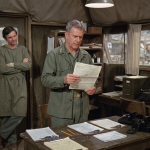
Colonel Potter sat behind his desk, staring down at a mountain of supply requisitions that never seemed to end. His reading glasses rested low on his nose, and his fountain pen was poised like a weapon against the army bureaucracy.
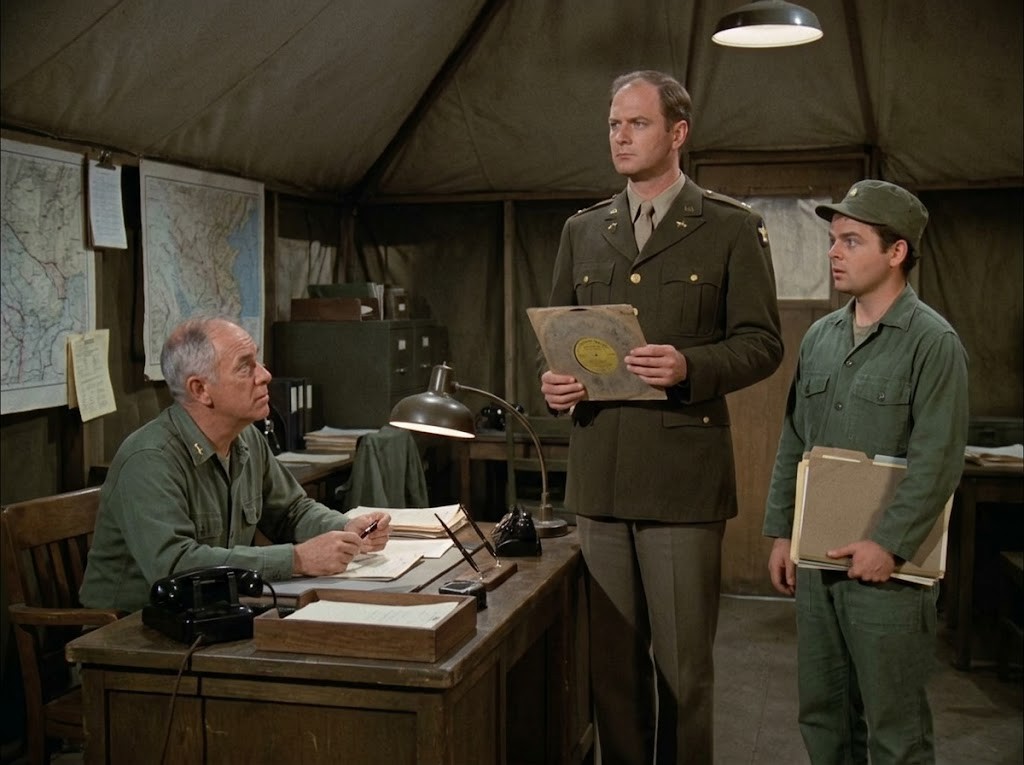
Suddenly, the door squeaked open, and Radar O’Reilly slipped into the room, a thick stack of folders clutched tightly against his green fatigues. He looked even more nervous than usual, his eyes darting between the Colonel and the tall, imposing figure who had just marched in behind him.
Major Charles Emerson Winchester III stood in the center of the tent, looking entirely out of place in his crisply pressed dress uniform, despite the primitive surroundings. He wasn’t holding his usual medical charts or a glass of smuggled brandy; instead, his hands carefully cradled a single, scratched vinyl record, stripped of its paper sleeve.
“Colonel,” Winchester announced, his voice carrying its usual Bostonian grandiosity, though there was a strange, tight tremor beneath his words. “I must request—nay, demand—the immediate use of the camp’s public address system.”
Potter didn’t look up immediately. He slowly finished signing a form for three dozen standard-issue bone saws before lifting his gaze, his face a mask of weathered, midwestern skepticism.
“Charles, unless that piece of plastic can be melted down into sterile surgical gloves, it waits,” Potter sighed, tapping his pen on the desk. “The generator is coughing blood, and Radar here tells me we’re down to our last box of penicillin.”
“Sir, this is not a matter of mere entertainment,” Winchester insisted, drawing himself up to his full height, his eyes wide and unblinking. “This arrived in the morning mail delivery from Boston. It is a rare, archival recording of Mozart’s Clarinet Concerto in A Major.”
Radar shifted his weight from one foot to the other, his brow furrowing as he looked up at the tall Major. “Gee, Major, I thought it was just a big yellow label. It looks kind of scratched up.”
Winchester shot Radar a look of pure, aristocratic disdain. “It is a masterpiece, Corporal. And at this precise moment, it is the only thing standing between myself and total psychological collapse.”
Potter leaned back in his wooden chair, the springs groaning in protest. He looked at Winchester’s rigid posture, then at the record, and finally at Radar, who was subtly nodding his head as if sending a silent distress signal on behalf of the Major.
“We’ve just spent fourteen straight hours in the meat market, Charles,” Potter said, his voice dropping its sharp edge, replaced by a deep, paternal fatigue. “The kids are asleep. The nurses are exhausted. If you blast opera through those tin cans outside, Hawkeye will throw a scalpel at your head.”
“It is not opera, it is Mozart!” Winchester snapped, his composure suddenly fracturing. His fingers tightened on the edges of the fragile vinyl, his knuckles turning white. “And if I do not hear something beautiful, something civilized, in the next five minutes, I cannot guarantee I will be able to hold a scalpel myself when the next chopper lands.”
The tent fell completely silent, save for the distant, low rumble of artillery in the hills. Radar held his breath, staring at the record in Winchester’s hands, realizing just how close the proud Bostonian was to breaking.
Colonel Potter looked at Winchester for a long, quiet moment. He didn’t see an arrogant, blue-blooded surgeon demanding special treatment; he saw a profoundly lonely man who had reached the absolute end of his rope.
“Radar,” Potter said softly, never breaking eye contact with Winchester.
“Yes, sir?” Radar piped up, pulling the folders closer to his chest.
“Go over to the clerk’s desk. Crank up the phonograph and patch it through to the PA system,” Potter ordered. “But keep the volume low. Just enough to drift through the compound, not wake the dead.”
Radar blinked, surprised by the sudden capitulation. “Yes, sir. Right away, sir.” He turned and scurried out of the office, his boots clicking against the floorboards.
Winchester stood frozen for a second, his chest rising and falling beneath his olive-drab jacket. The rigid, defensive posture slowly began to melt away, replaced by a look of profound relief that he tried desperately to hide behind his usual mask of dignity.
“Thank you, Colonel,” Charles muttered, his voice barely above a whisper. He turned on his heel and walked out toward the clerk’s station to hand over his prized possession to Radar’s clumsy, capable hands.
A minute later, the camp speakers gave a loud, familiar pop. Then, through the static and the hum of the dying generator, the beautiful, clean notes of a clarinet began to float through the 4077th.
The music drifted into the Swamp, where Hawkeye and B.J. were lying face down on their cots, too tired to even take off their muddy boots. Hawkeye opened one eye, listening to the elegant melody bouncing off the canvas ceiling. He didn’t crack a joke. He just closed his eye again, a small, tired smile touching the corner of his mouth.
Down in the post-op tent, Margaret Houlihan stopped mid-sentence while checking a patient’s pulse. She listened to the music, her shoulders dropping an inch as the tension of the day left her body. She reached out and gently tucked a loose blanket around a sleeping soldier.
Back in the office, Potter sat quietly at his desk. He didn’t return to his paperwork right away. He just listened, staring out the small screen window into the compound, where Charles Winchester was standing perfectly still in the dirt, his head held high, letting the music wash over him like a breeze from home.
The music didn’t stop the war, and it didn’t bring more penicillin, but for a few minutes, it reminded everyone in the camp that there was still a world outside the mud and the blood.
Sometimes, the best medicine didn’t come from a bottle, but from a scratched piece of vinyl and a moment of shared humanity.